

Q&A with Anna Robinson, Employment Partner at Watson Farley & Williams LLP
Recent reports have suggested that some businesses are accelerating performance management processes, restructuring programmes and hiring decisions ahead of major employment law reforms due to take effect from January 2027. The focus has largely been on financial services and technology companies, where concerns about the removal of the unfair dismissal compensation cap and the reduction of the qualifying period for unfair dismissal claims have prompted employers to review their workforce strategies now rather than later.
But while much of the commentary has focused on those sectors, the implications for automotive businesses could be equally significant. From manufacturers and suppliers to dealer groups and fleet operators, organisations across the automotive sector are already grappling with skills shortages, electrification, operational transformation and cost pressures.
The real question for automotive leaders is not whether employment law is changing, but whether their existing approach to recruitment, talent development and management remains fit for purpose for the next phase of the sector’s transformation.
We spoke to Anna Robinson, Employment Partner at Watson Farley & Williams LLP, a leading law firm with significant expertise in the transport sector, about what automotive leaders should be thinking about as they prepare for 2027.
Key Takeaways for Automotive Leaders
- The unfair dismissal qualifying period will be reduced from two years to six months from January 2027.
- The compensation cap for unfair dismissal will be removed, increasing potential exposure for employers.
- Recruitment, probation and performance management processes should be reviewed now rather than in late 2026.
- Automotive employers should assess the impact of reforms on labour flexibility, agency workers and workforce planning.
- Employment reform should form part of broader 2027 strategic and budget planning discussions across the business.
Q: What are the key employment law changes businesses should be aware of, and why are they significant?
Anna Robinson: The Employment Rights Act 2025 represents one of the most significant changes to the UK’s employment law framework in recent years. While implementation is being phased over 2026 and 2027, several of the most impactful changes for employers are still to come.
Two changes in particular are attracting significant attention.
First, the current two-year qualifying period for ordinary unfair dismissal claims will be reduced to six months from January 2027. In practice, this means employees will acquire the right to bring an unfair dismissal claim much earlier in their employment than under the current regime. At the same time, the cap on compensation for unfair dismissal is expected to be removed, potentially increasing employers’ financial exposure where claims succeed.
In addition, employers will need to navigate reforms relating to zero and low-hours workers, shift scheduling, collective consultation, industrial relations and enhanced enforcement powers through the new Fair Work Agency. Taken together, these changes increase both compliance obligations and legal risk for employers.
However, focusing solely on legal risk arguably misses the bigger picture. The reforms may accelerate a shift that was already underway, away from workforce models that rely on flexibility after recruitment and towards greater emphasis on workforce planning, management capability and employee retention.
For many employers, the challenge will not be adapting policies. It will be adapting behaviours.
Q: We’ve seen reports that some organisations are accelerating restructures, performance management and probation decisions. Is that something you’re seeing, and why?
Anna Robinson: Many employers are undoubtedly looking at their workforce through a different lens as they prepare for the forthcoming reforms.
Headlines suggesting businesses are “rushing to fire staff” probably oversimplify what is actually happening. In reality, many organisations are using the period before implementation to review their performance management processes, workforce structures and recruitment practices.
Once unfair dismissal protection begins after six months’ service and compensation becomes uncapped, getting recruitment, onboarding and probation decisions right will become even more important. Employers are therefore looking carefully at how they assess performance, document concerns and manage probation periods.
More broadly, we are seeing organisations use the time available to complete planned restructuring exercises, review workforce models and strengthen management capability. That should not be viewed as a reaction to the reforms so much as sensible preparation for a very different employment landscape.
The more interesting trend, however, is not whether employers are accelerating decisions today, but how they are thinking about workforce strategy for tomorrow. For many businesses, the reforms are prompting a broader discussion about recruitment quality, management capability and the extent to which existing workforce models remain fit for purpose. In that sense, the Employment Rights Act may prove to be a catalyst for organisational change rather than simply a legal compliance exercise.
Q: For automotive businesses planning for 2027, what should HR and leadership teams be thinking about now rather than waiting until the legislation takes effect?
The automotive sector faces some unique challenges.
Many businesses are already balancing the transition to electric vehicles, changing skills requirements, supply chain pressures and ongoing cost management. Workforce planning is therefore a strategic issue rather than simply an HR consideration.
Employers should start by understanding where their key risks sit. For manufacturers, that may be agency labour, shift patterns and collective employee relations. For dealership groups, it could be recruitment, retention and management capability. For suppliers, it may be workforce flexibility and restructuring plans.
However, the more fundamental question is whether existing workforce models are fit for purpose for the next phase of the industry’s evolution. As the sector continues to evolve, many businesses will need different skills, different management capabilities and, in some cases, different organisational structures. The Employment Rights Act arrives at a time when those conversations are already taking place and is likely to accelerate them.
The biggest mistake would be assuming these reforms are purely a legal issue. They will influence budgeting, workforce costs, recruitment strategy and organisational design. For forward-thinking organisations, the focus should not simply be on managing legal risk, but on building a workforce that is capable of supporting long-term business objectives in a rapidly changing market. Those discussions should already be happening as part of 2027 planning exercises.
Q: How might these changes affect recruitment strategies, probation periods and onboarding?
Recruitment is likely to become more important than ever.
When employers have less time before employees gain unfair dismissal protection, making the right hiring decision at the outset becomes critical. Businesses may place greater emphasis on recruitment processes, candidate assessment, reference checks and onboarding programmes.
Probation management is also likely to become more structured. Managers will need to be clear about expectations, hold regular review meetings and address concerns promptly rather than allowing issues to drift.
For automotive employers facing technical skills shortages, there is a balance to strike. Businesses still need to attract talent in a competitive market, but they will also need stronger processes to ensure new hires are capable of meeting required standards within a relatively short timeframe.
Perhaps the biggest shift will be cultural rather than procedural. Employers may find themselves placing greater emphasis on helping new hires succeed through effective onboarding, training and performance support, rather than relying on probation periods to identify and manage poor recruitment decisions.
Q: Are there common misconceptions or assumptions employers are making about the reforms?
One common misconception is that employers will suddenly be unable to dismiss underperforming employees.
That is not the case. Employers will still be able to dismiss employees for conduct, capability, redundancy and other fair reasons. What is likely to change is the level of scrutiny applied to those decisions and the potential financial consequences where the correct process is not followed.
Another misconception is that these reforms are primarily about dismissal. In reality, some of the most significant implications are likely to be felt much earlier in the employment lifecycle, through recruitment, onboarding, probation management and manager capability.
There is also a tendency to assume that businesses have plenty of time to prepare. While some provisions are not due until 2027, organisational change often takes considerably longer than employers anticipate. Reviewing contracts, updating policies, training managers and embedding new ways of working cannot be achieved overnight.
Perhaps the biggest misconception is that employment law reform is simply a compliance exercise. For many organisations, the more important question is whether their existing people practices are supporting the business they want to be in five years’ time. The employers that approach these reforms strategically are likely to gain far more value than those that focus solely on legal compliance.
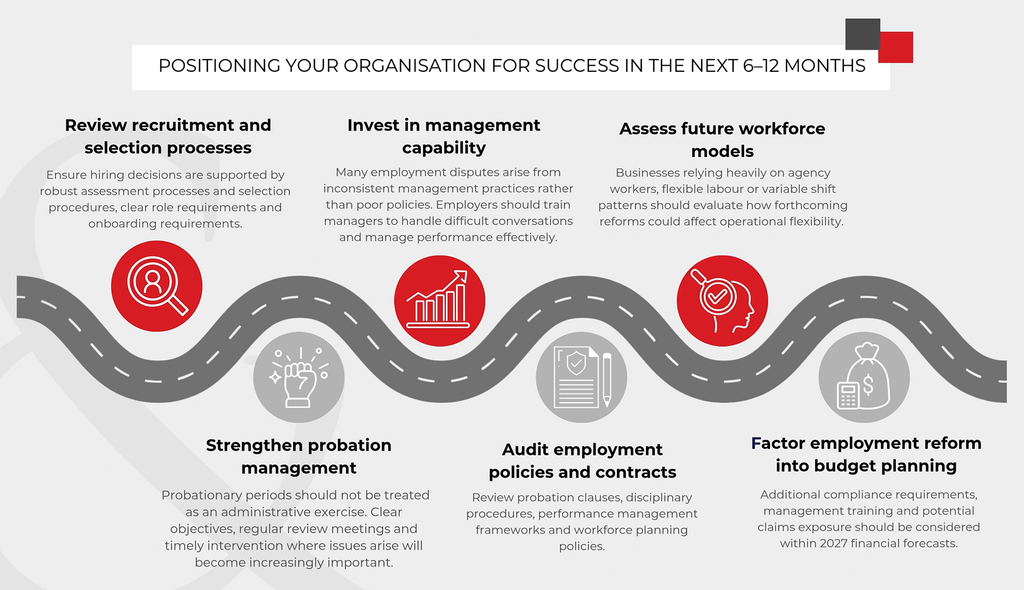
Q: What practical steps can organisations take over the next 6–12 months to put themselves in the strongest position?
There are several practical actions businesses should consider:
1. Review recruitment and selection processes
Ensure hiring decisions are supported by robust assessment processes and selection procedures, clear role requirements and onboarding requirements.
2. Strengthen probation management
Probationary periods should not be treated as an administrative exercise. Clear objectives, regular review meetings and timely intervention where issues arise will become increasingly important.
3. Invest in management capability
Many employment disputes stem not from poor policies but from inconsistent management practices. Employers should ensure managers are equipped to have difficult conversations, manage performance effectively and document decisions appropriately.
4. Audit employment policies and contracts
Review probation clauses, disciplinary procedures, performance management frameworks and workforce planning policies.
5. Assess future workforce models
Businesses relying heavily on agency workers, flexible labour or variable shift patterns should evaluate how forthcoming reforms could affect operational flexibility.
6. Factor employment reform into budget planning
Additional compliance requirements, management training and potential claims exposure should be considered within 2027 financial forecasts.
The common thread across all of these actions is the need to make workforce decisions earlier, more consistently and with greater confidence. Organisations that start those conversations now will be in a much stronger position than those that wait until implementation is imminent.