Last year, our Torque & Truth research reached a conclusion that appeared to settle the matter. Third-party relationships, we found, are now essential to strategy (no organisation can deliver its future alone) and yet automotive is structurally ill-suited to them. Built around control, process and internal capability, the industry finds collaboration hardest, precisely where it has become indispensable.
This was a diagnosis rather than an answer. It named the condition without saying what a leader is actually supposed to do about it on a Monday morning: how you make a partnership work when the other party doesn’t report to you, doesn’t share your incentives and doesn’t move at your pace.
In our search for answers, we found them in an unexpected place; among the leaders who never had the luxury of “control” to begin with.
Organisations that succeed without formal authority
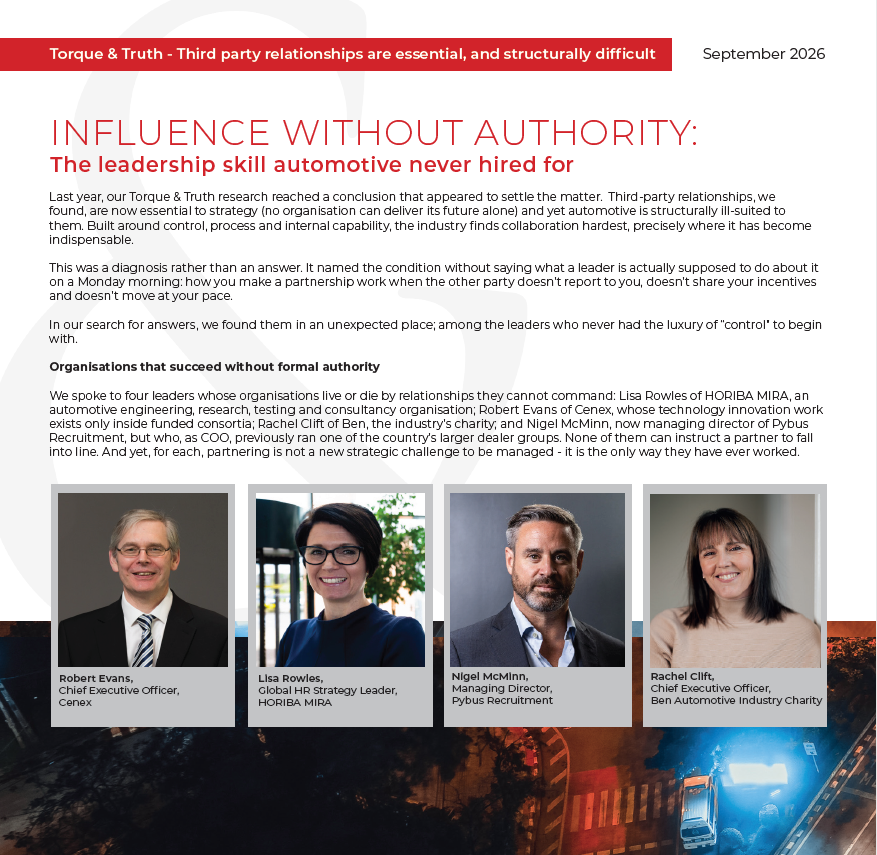
We spoke to four leaders whose organisations live or die by relationships they cannot command: Lisa Rowles of HORIBA MIRA, an automotive engineering, research, testing and consultancy organisation; Robert Evans of Cenex, whose technology innovation work exists only inside funded consortia; Rachel Clift of Ben, the industry’s charity; and Nigel McMinn, now managing director of Pybus Recruitment, but who, as COO, previously ran one of the country’s larger dealer groups. None of them can instruct a partner to fall into line. And yet, for each, partnering is not a new strategic challenge to be managed – it is the only way they have ever worked.
In selecting these individuals, we fully recognised the risk: interview four leaders whose organisations survive on collaboration and, of course, they will tell you collaboration matters.
But that objection assumes we only heard from the naturally collaborative. We did not. McMinn ran one of the country’s larger dealer groups (a mainstream player at the heart of the industry) yet he described the same challenges around influence as the others did. Even at that scale, he often found himself the smaller party in relationships that decided the success of the business: with Autotrader, with the systems provider that ran his dealerships, and increasingly with the Chinese manufacturers now reshaping UK retail.
A big automotive player, in other words, is already living the same reality as a small consultancy or a charity; it has simply been slower to admit it.
The uncomfortable lesson for an industry that prizes command and control is that
“Even the biggest names don’t necessarily hold the whip in the relationships that most determine their success.”
What then did these four have to say about how they approach influence in their third-party relationship? Across very different organisations, the same handful of habits separated the partnerships that worked from the ones that ground to a halt, and each one runs against an instinct the industry has spent decades reinforcing.
Principle one: match structure to the partnership
Generally speaking, when a partnership matters, the industry’s instinct is to reach for structure: define the boundaries, write the agreement, govern from the top. McMinn makes the case for it. The clearest partnerships, he argues, draw firm lines of demarcation and rules of engagement at the outset – each party good at its own part, the differences hammered out before anyone starts. In support of his argument is the cautionary tale of Ford’s Premier Automotive Group. This was the attempt to gather Aston Martin, Jaguar, Land Rover, Lincoln and Volvo under one roof, which blurred every line until it produced Aston Martins with Mondeo switchgear and a Jaguar that was visibly a Mondeo underneath. Structure, from this perspective, may have prevented the partnership collapsing into mush.
Evans has watched the same instinct do harm. The moment you force a relationship into lots of legal agreements, he warns, the lawyers make it all about what could go wrong – and that caution, imported at the outset, can corrode the very thing it was meant to protect.
Both are right, which is why the real question is one of degree: how much structure clarifies a partnership before it begins to poison it?
Evans’s answer is to move the relationship off the contract and onto the people. Partnerships fail on mismatched power, so you shrink the working unit until the mismatch disappears. Two or three people from each side, working as one team, can find a balance of equality that the parent organisations (wildly different in size) never could. At that point the team, as he puts it, becomes almost more important than the companies its members work for. The contract sets the outer edges; the people do the work.
Principle two: drop the buyer’s reflex
The old automotive supply relationship had a settled shape: a dominant buyer at the top, suppliers arranged beneath, and instructions flowing one way. Rowles, who has spent more than three decades in the industry, recalls the generality that previously when the buyer spoke, everyone else fell into line. That model has now softened.
Insisting that everyone assemble behind a single dominant player, she argues, is short-sighted: a more agile rival buyer, unburdened by that rigid hierarchy, will simply get there first: to a working solution, to market, to the customer. The leadership change she describes is deceptively hard: to approach even your own supply chain from a partnership footing rather than from the reflex of being the controlling buyer.
Part of the difficulty is the diversification and variation between organisations within the market, even within category. Rowles draws a sharp contrast between the traditional OEM and the newer technology entrants. The established players bring process, rigour and a clear sense of where their funding sits: real strengths, but ones that can sometimes make decision-making slower and relationships more complex. The newcomers move quickly and carry a far greater appetite for risk, but may have less established industry knowledge, meaning they need to place greater trust in their supply chain and external expertise. Neither is simply better. The leader’s task is to hold both kinds of partner at once (to work within the discipline the established firms need without smothering the pace the newcomers depend on), and that balancing act is precisely what the old command reflex was never designed to do.
Principle three: never start with suspicion
If the first principle is about structure and the second about stance, the third is about the thing everyone names and few can manufacture: trust.
McMinn has lived two extremes and can articulate what separated them. One long-standing supplier relationship worked because both sides put the effort in – regular contact, honest feedback, disputes aired openly inside what he calls a wrapper of genuinely liking each other. It was never all sweetness; it escalated and de-escalated, but then carried on all the better for it.
Another, with a supplier that held the whip, stayed purely functional in a relationship in which, as he puts it, they had him in a vice and both sides knew it.
But dominance has its own short-term logic: the supplier who held the whip did well enough, while McMinn had nowhere else to go. But that is the trap, not the lesson. Command buys a captive customer straining to leave; collaboration builds one who leans in and produces things neither side could manage alone.
The collaborative relationship gave McMinn an early, low-cost tool and gave the supplier a co-developer who promoted them to others. The functional relationship gave its holder a hostage. As the lock-in that once made dominance safe erodes across the industry, the whip buys less every year and leaves more on the table.
It is why the posture each side brings matters more than the size of the partner or the terms of the deal. McMinn’s warning is the sharpest line in any of the interviews: go into a partnership with suspicion and you make its failure self fulfilling. Treat a new partner as a threat and you guarantee the relationship you feared.
Clift approaches the same truth from the other end; how a partner with no leverage at all builds trust from nothing. Her method is to prove value before asking for anything in return, leading with the difference her organisation can make rather than the funding it needs. The counter-intuitive result is that the question comes back to her: partners, unprompted, ask what more they can do. She has even put a figure on it, telling a room of senior leaders that the real question is not what collaboration costs but whether they can afford to do without it since every pound invested returns several times over in reduced absence and stronger engagement.
Trust, on both accounts, is not declared at the outset but earned into being. McMinn earns it by refusing to treat a partner as an adversary; Clift earns it by giving before she asks. Neither has a whip to fall back on and both end up with partners who choose to lean in rather than pull away.
Principle four: build it to outlive the champion
The original Torque & Truth research noted that partnerships too often rest on individual relationships rather than systemic support, which means they are only ever one departure away from collapse. The leaders who partner well, guard against this deliberately, by embedding the relationship at several levels of both organisations so that no single person is load bearing.
Clift describes what this looks like in practice. Her strongest partnerships run on multiple tiers at once; a periodic check-in between her and the managing director, a working relationship with the people team a level down, and a scattering of advocates further inside the organisation who fly the flag day to day. The seniority gives her altitude on how things are going; the depth means the partnership is woven into the organisation rather than balanced on one relationship.
McMinn describes a similar architecture. In his most durable supplier relationship, the two organisations were, as he puts it, “glued together”. Senior people knew their counterparts, the franchise directors knew theirs, and a dedicated account manager worked on the ground in the dealerships, reinforced by a deliberate social layer of dinners, conferences and shared industry events that kept the connection alive between the formal reviews.
Evans supplies the reason this matters over the long run. Collaboration, in his world, is banked over years: help others reach their goals and you build goodwill and a reputation that brings them back to you, project after project. But goodwill and reputation attach to organisations only if they are carried by more than one person. Build a partnership that lives in a single champion and you have built a liability; build one embedded at every level and you have built an asset that compounds.
The competency the industry never hired for
Step back from the four principles and a single feature comes into focus. The leader who partners well is comfortable with shared control, exercises influence without authority, leads laterally rather than from the top, and brings a genuine curiosity about what the other side actually needs.
Evans highlights that it is a move away from the leader as the face of the company (the Iacocca, the Musk, the figure with every answer) towards something closer to servant leadership, where your job is to help the other party reach their goal because that is how you reach yours. The best leaders he has seen are not the ones who dominate the room; they are the ones willing to say, plainly, that they don’t yet understand something.
And yet, this is not what automotive has historically selected for. An industry built on control, process and internal capability has spent decades promoting the people who mastered exactly those things, which is the original paradox restated as a talent problem. What partnering demands is something that is possibly diametrically opposed: comfort around sharing control, influence without authority and a reliance on people you cannot technically direct. The leaders who see this are already acting on it.
Rowles of HORIBA MIRA now looks explicitly for open-mindedness and curiosity as part of the leadership development, and highlights the risk that less experienced people can be so eager for the title that they overlook the relationship skills the job now turns on. As the industry continues to de-verticalise (where no organisation can deliver its strategy alone), the ability to partner stops being a soft skill and becomes a criterion – something to identify deliberately, develop on purpose, and, increasingly, hire for.
Conclusion: structure and leadership
Last year’s research asked whether automotive was structurally built to partner, and concluded, rightly, that it largely was not. That was the necessary first step: you cannot solve a problem you have not properly named. What these four leaders add is insight into the next layer down.
Every one of them works inside the same industry, subject to the same governance, the same regulation, the same commercial pressures. Yet each has found a way to make collaboration work where others find it grinds to a halt. The variable that separates them is not a different structure. It is a different kind of leadership – one comfortable with shared control, fluent in influence without authority, and willing to treat a partner as a partner rather than a subordinate or a threat.

This article is the sixth in a series of deeper dives into the themes that emerged from Ennis & Co’s Torque and Truth research, conducted by interviewing fifty senior automotive leaders earlier this year.
This series of conversations developed from a research partnership between Ennis & Co and Pybus Recruitment and delivers a unique platform of insight from leaders speaking candidly about success in their organisations.