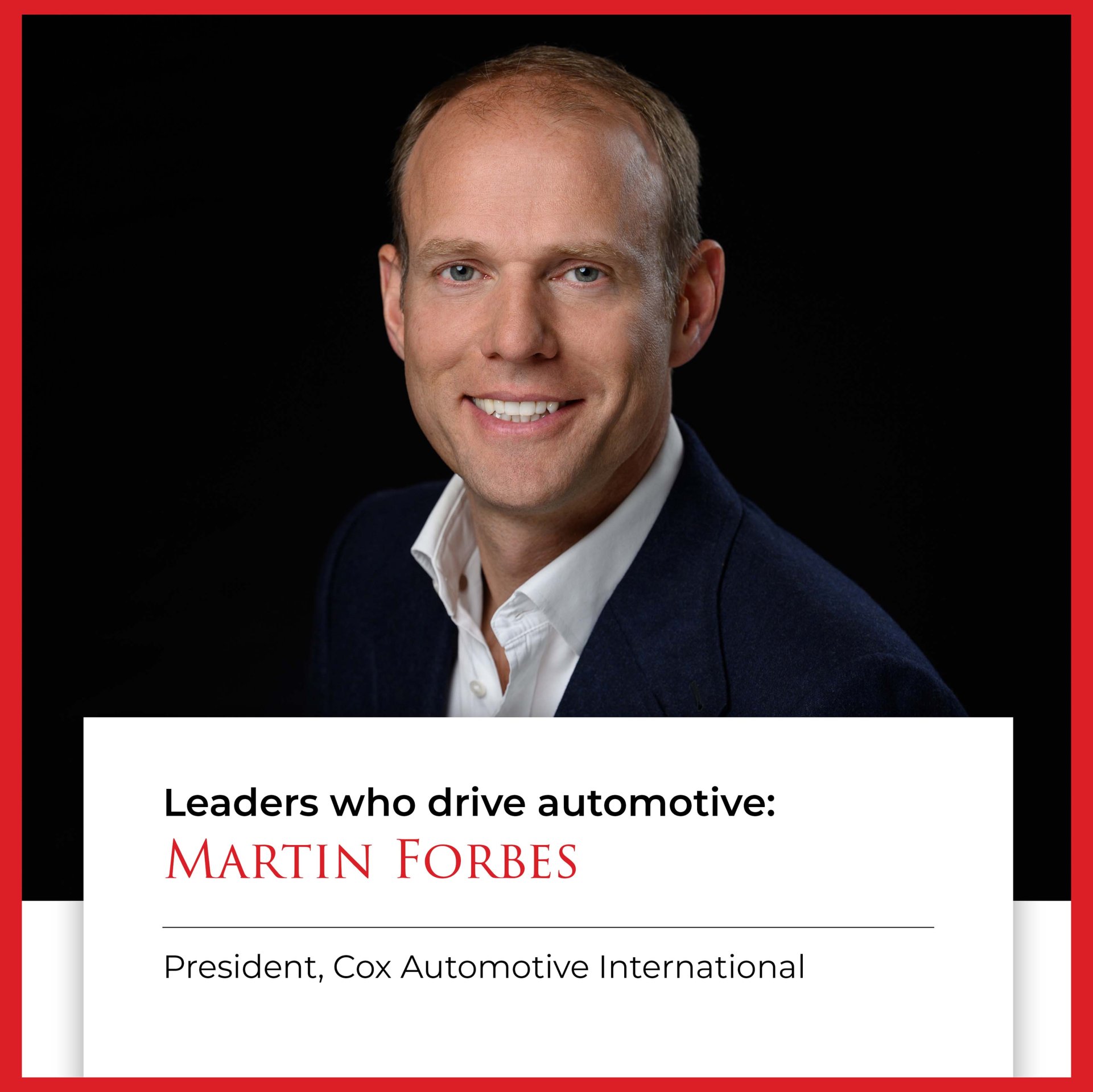
He has been a tax specialist at PwC, a ‘suit’ in the creative media world and now runs Cox Automotive’s international business outside North America. Martin Forbes tells Lynda Ennis, Co-founder and CEO of Ennis & Co Group, about his varied journey to automotive and his simple approach to leadership.
LYNDA ENNIS: After joining Cox Automotive in 2014 as Managing Director of Manheim, you rose to become CEO of Cox Automotive UK before stepping up to your current global role of President of Cox Automotive International. Your route into automotive was unconventional, though. Tell me about your journey into the industry.
MARTIN FORBES: Actually, the early part of my career was pretty conventional – GCSEs, A levels, a degree and then getting a place on a graduate trainee scheme to enter the workplace. After leaving university, the graduate job market was pretty competitive, and I considered trying to differentiate myself by studying for a master. As I researched what to do, I found that by joining one of the Big Six accountancy firms, as they were then, I could get one of the best qualifications in the professional world while being paid to study. That sounded perfect to me.
I did interviews with all of the Big Six and ended up choosing Price Waterhouse on the grounds that even during the interview process, they seemed most interested in their employees as individuals. Six months later, Price Waterhouse merged with Coopers, who were actually my second choice. I started in the world of auditing before moving into tax a year later. To me, auditing was all about looking back at the past going through historical numbers. I was more interested in impacting the future, which tax planning and structuring companies offered.
To be frank, I absolutely loved it at PwC and never thought I was going to leave. The investment they put into their staff is phenomenal – not just the professional training in accountancy and tax but the development of leadership skills. I haven’t come across any other organisation in my career that invests in its people so heavily, so my time there was an incredible foundation for my career. The reason I left the company after nearly nine years began with an opportunity to work two ex-AOL executives who had founded a digital advertising company, Vibrant Media, that leaned on contextual technology to understand the context and semantics of online content. I was initially engaged to provide tax advice regarding the sale of the business to a west coast online search company called Ask Jeeves. However, the deal fell through at the 11th hour. As a result, the founders decided to raise Private Equity investment funds to further continue and accelerate their growth strategy. Again, I was engaged to provide tax structuring advice regarding the $30 million investment that they raised with an east coast Private equity fund. Following the completion of the deal the founders kept approaching me to join the business and help then establish a true global SME business with the aim of an exit in the next 2-3 years.
Eventually, I agreed to take up the opportunity to join the company as part of the C-suite, on the basis that it would further develop my career allowing me the chance to gain experience in the commercial world. The plan was to return to PwC after couple years as a more rounded and commercial adviser with a broader experience base. I considered myself quite a good commercial adviser at the time but, on joining the company, I realised I wasn’t quite as commercial as I had first thought. The move from the PwC environment to a relatively small start-up was a massive culture shock and I found the change extremely challenging at first. In the first year I came very close to waving a white flag to return to PwC. However, I told myself I would stick with it for at least one year. But, from the second year onwards, I really started to enjoy it. It made me realise there was much more to the world than sitting in a building and advising on one deal after another, so the decision was made that I would not return to PwC. I ended up working in digital media for the best part of the next eight years.
This new phase of my career taught me a lot about managing stakeholders – the founders, in particular, as well as angel investors – and it also gave me my first insight into managing and leading a business globally as we expanded to San Francisco, New York, Australia and Europe. I was going back and forwards between the US and the UK and had apartments both in New York and London, so it was an exciting and enjoyable period. I was also learning a great deal about another industry and meeting lots of interesting, different people, developing my people skills along with my commercial skills.
Eventually, there came a point where I had a divergence of opinion with the founders about future strategy. I and a few colleagues felt that the market was moving in a different direction and that we needed to pivot, but the founders wanted to stay true to their core. I therefore decided to leave the business and made a very interesting leap into the world of films and media production as Global Group CEO of a very high-end and award-winning production/digital creative agency, which at that time was called Stink & Stink digital. It was the largest independent and private owned production company in the world, and the company was effectively run by creatives. But, as they started to bring in more investment and seek further growth opportunities, the founders/investors recognised the need for a different form of leadership. One that could help provide structure and controls to help navigate an expanding global organisation dealing with tightening regulations and governance – yet maintain the creative core of the organisation. That was where I came in my PwC experience balanced with the skills and knowledge, I had gained from my years in a growing digital media business. They called me ‘the Suit’, even though I hadn’t worn a suit in years.
The business was operating in UK, US, Brazil, Hong Kong, China, Russia and all-over Continental Europe, involving large complex production projects involving significant capital investments and global teams. At times running a production business is like managing a football club, with a team of highly talented individuals but with varying needs, demands and, as you can imagine, some with big egos. As a production company, the reputation of the business can often depend on the quality of its roster of directors – a blend of world-class film / content directors and new and up-and-coming directors – so it was very much the football mentality of signing and retaining world-class talent. What did it teach me? It taught me a lot about how to flex and change my approach, and it underlined the importance of understanding the industry you’re working in and showing that you are credible and know what you’re talking about.
The move into automotive came about when I got a call from a head-hunter about a role at Manheim. I’d never heard of the company and when I researched it and discovered it was a car auction business, I wondered whether the head-hunter had got the wrong person. It was only when I started digging a bit further that I realised it was owned by Cox Enterprises, who I knew about through my previous dealings with their Cox Media division in my digital media days in New York. If it wasn’t for that link, I probably would have said no to the opportunity, but the more research I did into Cox, the more interested I became.
So, suddenly I found myself working in the automotive services business, which was again a huge leap into a new sector. I went from tax to digital media to traditional media, and now I was in the automotive industry. It’s been a long and very interesting journey.
LE: You talk about your career in terms of a series of big leaps into new sectors. What is it about your leadership style that attracted to you to that kind of career path?
MF: Moving into a brand-new industry requires a lot of learning. I would say I have high curiosity levels and a strong hunger to learn new things. When talking to colleagues or team members that work directly with me, I want to be able to talk with knowledge, conviction and understanding. So, when I move into a new industry, I try to absorb as much information as I can.
One of the key things about my leadership style is that I love people. No matter what industry I’m in, I’m at my happiest sitting in front of a customer, and that’s something I’ve carried through to my current role. I deliberately spend a lot of time doing lunches and dinners meeting CEOs, MDs and senior leaders across the automotive industry. It’s something I also did when I was working in media. You can read research, articles and talk to your own people, which is obviously extremely important as well, but it’s when you talk to customers that you really get to know what’s going on across the industry. It’s when you get to know about their particular needs and challenges, and you’ll also find things out about competitors or about the latest developments in technology. If you think about what we do at Cox, we’re there to serve our customers and maintaining those relationships is so important.
LE: Do you think we are doing enough to prepare the leaders of the future in terms of the pace of transformation that is taking place in the industry and the personal sacrifices they’re going to have to make to be successful leaders?
MF: We all know that there is a change in people’s expectations and how much value they place on work-life balance. People are becoming more precious around their personal time and there is a feeling that ‘we don’t live to work, we work to live’. Personally, I’ve made a lot of sacrifices for work, right from my PwC days when expectations and demand are so high it can easily result in working extremely long hours – often in a competitive environment to maximise chargeable hours every month. In my current role, where I’m effectively responsible for all business outside North America, I’m doing a lot of travelling, with long-haul trips at least a week every month. You need a very understanding wife and understanding children. Without that, it would be a lot harder.
I sometimes think to myself, ‘Who’s got it right? Am I right and they’re wrong, or vice-versa?’ I’d probably say I’m a little old school in my working style and my views on the amount of effort you need to put in to achieve personal growth, and this level of work ethic is becoming less common as the next generation of future leaders enter the workforce. The talent coming through is expectational, but I’m not convinced that they are so willing to make the level of sacrifice that’s required to make it to the top of organisation – but that is ok, not everyone wants to. I think this is a real risk for many organisations. When team members get a glimpse into my working week or month, they will often remark – I wouldn’t want to do your role!!
LE: Leading a global business means working across diverse cultures, markets, and teams. How important do you think it is for tomorrow’s leaders to gain international experience to be effective in such varied contexts?
MF: It’s extremely important. If you have aspirations to be a CEO or an MD in a big or even a medium-sized company, it’s very rare these days just to have UK responsibilities. You’re likely to be a leading a European or international business of some sort, and you’re going to need the necessary skill set. I witness so many companies, dare I say it, often US companies trying to expand into the international marketplace and it takes them time to realise what works in the UK doesn’t work in France, or what works in Germany doesn’t work in Spain. You have to look through multiple lenses. Cultural awareness is especially important when it comes to people. Our three most important stakeholders at Cox Enterprises are our team members, our customers and of course the Cox Family owners, and I’ve learned some significant lessons during my tenure interacting with them all. I have gained valuable learnings over the years to help my personal growth with adapting to cultural differences in terms of how you dress, how you greet people and the language you use, the different attitudes to verbal agreement versus a contract. It’s something you can’t really teach. I know there are training courses that help, but you have to go and learn it through experience.
LE: The automotive sector is transforming so rapidly in terms of technology, digital retailing and new ownership models. What leadership skills do you anticipate will be most important for up-and-coming leaders?
MF: I think leaders need to be extremely curious and to have the ability to solve problems. I have the advantage of working internationally so I’m very inquisitive about what’s going on in every market. You need to be continually talking to your customers, and you need to be having conversations with other people in the industry, including your competitors. You need to be spending quality time with all of your leaders on the ground in every market. That can be time-consuming but it’s crucial to ask them about what’s going on in their market and how they are responding. It also requires good listening skills and you need to encourage people to be bold and to try new things. I take the view that if we don’t experience failings, we’re not progressing and pushing ourselves. If someone comes back from their first or second experience of a skiing holiday and says didn’t fall over once, and proud of it, then I would question if they really tried to progress. If you’re skiing hard and learning new techniques, you’re falling over all the time. It’s the same principle applies in the business world. Failure is part of business, fail fast, learn adapt and keep learning. Remember the word FAIL can also mean “First Attempt in Learning”.
The other part of being curious is that I spend a lot of time reading to try to keep up with the pace of change. At the moment I’m reading AI For Dummies, and I’m listening to a lot of podcasts about AI. I’m also a big advocate of upward mentoring. For example – I am sponsoring a very talented team member in the US and who is an off-the-scale brain box (ex-NASA Scientist) who’s working in a specialist group looking at the growth of AI and how we maximise the power of AI across Cox Automotive. I am using the opportunity to gain knowledge and understanding of AI from a completely different perspective. Let’s face it we all need to be continuously increasing our skill and knowledge with AI and as leaders we need to lead from the front.
LE: Cox Automotive is a division of the family-owned Cox Enterprises. How do you balance the commercial pressures of running a large international business while aligning with the company values throughout your brands?
MF: The family ownership structure is fundamental to our culture. We have an incredible CEO and chairman in Alex Taylor, a fourth-generation member of the family, and the culture starts at the top, with the family, and flows down through the organisation. It’s a culture and style that really resonates with me and is why I love the organisation so much. It’s an environment that allows me to flourish and be the best leader that I can be. We’re not backed by private equity, and we’re not listed, so we’re able to take a long-term view with our investments without worrying about announcements to the market or exit strategies. We’re building the business for generations to come and we’re highly values-driven, with those values being embedded throughout the organisation.
LE: Who would you say has had the greatest impact on your leadership style?
MF: I could talk about a lot of people who have helped me in my career, but I would have to pick out my dad. He always said he wanted me to have two qualities, to be curious and to be kind, and I’ve instilled the same message on to my girls. I used to think he wanted me to be curious in the sense of a continuous learning style, but in addition it was the importance to show real interest in people, asking them questions, find out who they are etc. As a leader, that’s so important if you want to get the best out of people.
Another quality I learned from him is adaptability when it comes to talking to people. He was a head teacher, and he was incredibly adept at engaging with different types of people, whether he was talking to children, their parents, a head of department or the caretaker. That has really helped me throughout my career because being a leader is essentially about people. My approach to leadership is pretty simple and involves three elements: people, customer and performance. People come first and then it’s the customer. If you can get those two right, performance will follow.