Last year, through our work with 50 automotive leaders, Ennis & Co found that AI had become everyone’s priority but no one’s strength. Leaders were unanimous that digital capability would define future competitiveness – and almost as unanimous in admitting their organisations were not yet confident in delivering it.
A year on, in conversation with four leaders working at very different points in the industry, the narrative has moved on. Almost everyone is now learning to use the tools. Far few are seeing meaningful benefits from them.
What separated the leaders who have properly harnessed the deeper, transformational benefits of AI from those merely using it came down to three questions.
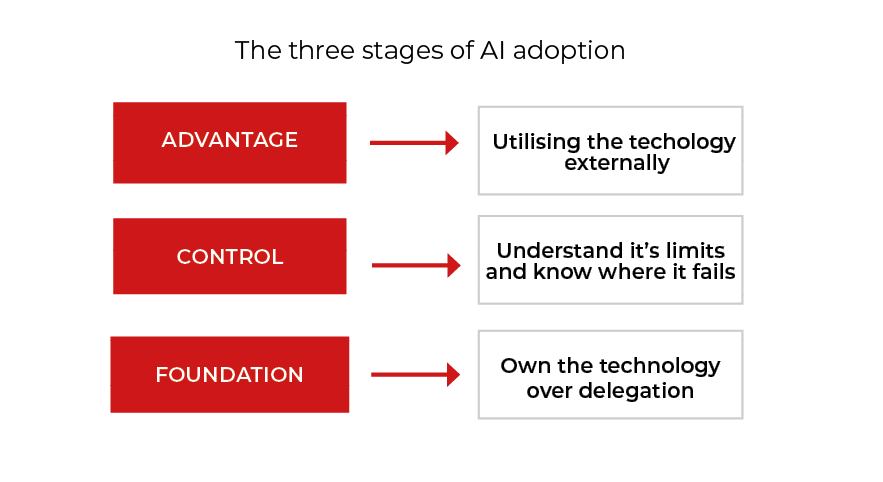
The first is a question of grip: do you know how to own the technology? – not who it is assigned to, but whether the leadership team holds it closely enough to direct it at all. The second follows only for those who do: do you know where it fails? – because confidence without that knowledge is exposure rather than strength. And the third is the one almost no one is yet asking: are you pointing it at your own conveniences, or at your customers’? – the question that decides whether AI ever becomes a source of advantage rather than merely a saving. Most of the industry is still working on the first. The leaders these conversations reveal are already living the third.
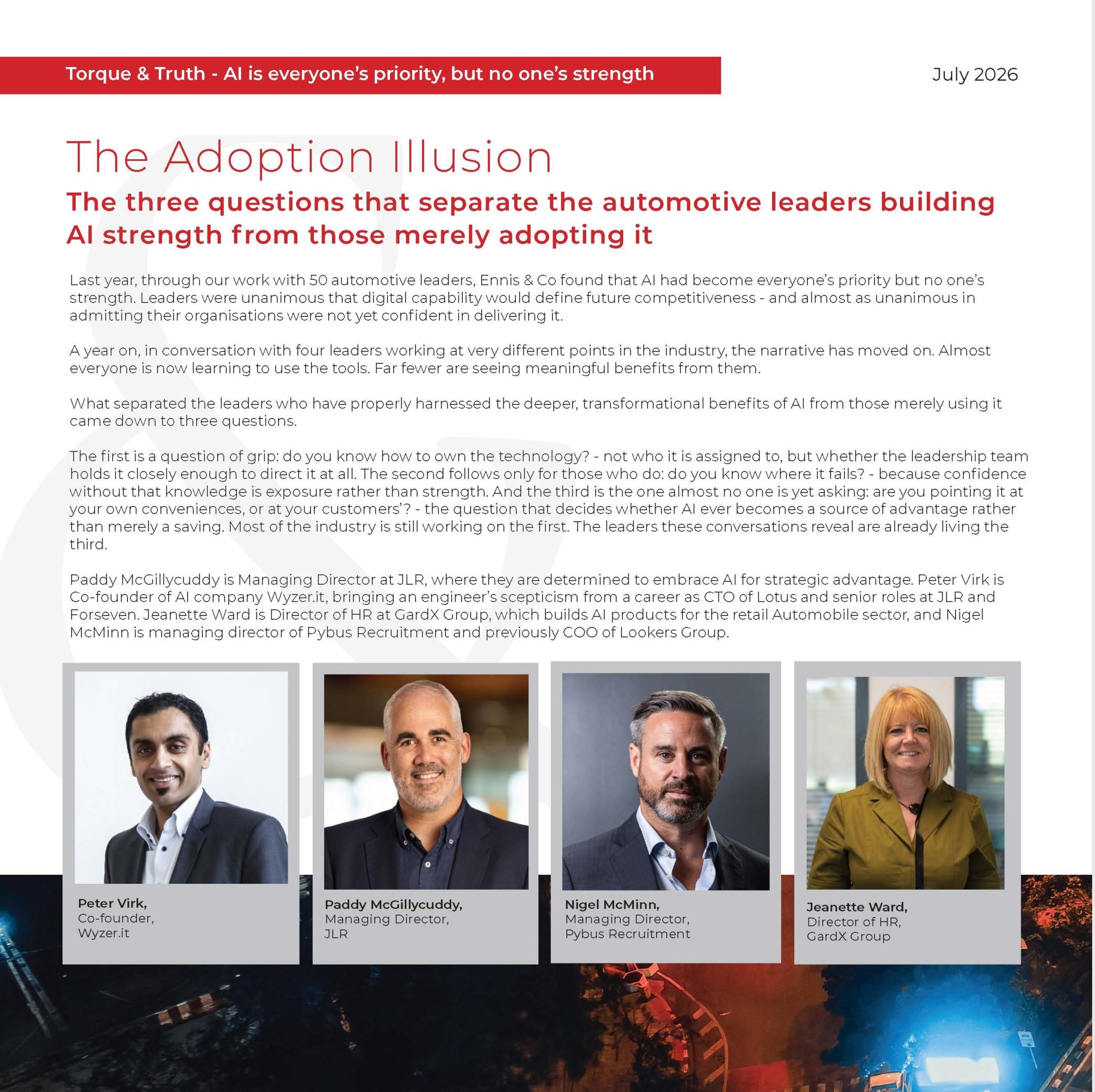
Paddy McGillycuddy is Managing Director at JLR, where they are determined to embrace AI for strategic advantage. Peter Virk is Co-founder of AI company Wyzer.it, bringing an engineer’s scepticism from a career as CTO of Lotus and senior roles at JLR and Forseven. Jeanette Ward is Director of HR at GardX Group, which builds AI products for the retail Automobile sector, and Nigel McMinn is managing director of Pybus Recruitment and previously COO of Lookers Group.
Owned or just assigned?
The first question sounds like it is about org charts. It isn’t. Almost every business can name who AI is assigned to – a function, a working group, a head of data. Far fewer can say the leadership team actually holds it: understands it well enough to direct it, rather than delegating it to a corner of the business and hoping something useful comes back. The gap between assigning AI and owning it is where the original research found so much digital capability quietly stalling.
Ownership begins with something unglamorous: knowing how to work the tools at all. You cannot direct what you cannot use. Jeanette Ward, who both builds AI products and runs a business on them, sees most failures start here – with people who “chuck the one-liner in and then expect this huge answer.” Her advice to her teams has become something of a mantra: “You’ve got to treat AI as if it’s an individual working for you. You’ve got to give them clear instructions and depth to get what you need.”
“The gap between assigning AI and owning it is where digital capability quietly stalls”
Which is why ownership cannot be exercised at arm’s length. Peter Virk, whose company is built on the technology, is blunt about operationalising ownership: “You can’t lead AI from a PowerPoint presentation. You have to use it. Research is starting to show that ownership of AI needs to sit at C-Level. But whilst “ownership can start with the founders”, he argues, but it “mustn’t stop with the founders or sit in a central AI team” – everyone touching the product or the customer needs a working feel for what it does well and where it should be questioned.
JLR has taken the same principle and industrialised it. AI sits on the CEO’s and the main board’s agenda, with the chief growth officer folding it into his monthly narrative. Every teammate on the commercial side is being skilled up, with quarterly competitions and awards for the best uses.
Jeanette Ward’s approach is similarly transparent, with the good, the bad and the ugly of the company’s AI use travelling up and down the organisation, so ownership is shared rather than hoarded.
Where these leaders genuinely part company is on how hard to push. Some businesses have written AI use into annual objectives; Jeanette Ward deliberately won’t, arguing that some people don’t yet have the behaviours for it and that forcing the issue does more harm than good. It is an open question: whether AI capability is built faster by mandate or by invitation. But it is a question only available to organisations that have already stopped treating AI as someone else’s job.
Do you know where it fails?
Ownership gets you a workforce using AI with confidence. The second question is what tempers that confidence into something safe – because the more an organisation trusts the technology, the more it is exposed to the particular way AI goes wrong. It rarely fails obviously. It fails plausibly.
Peter Virk, whose career has run through safety-critical engineering, states it precisely: “AI can be convincingly wrong.” It will hand you something beautifully written, technically structured and entirely credible – and still wrong. His team has seen engineering requirements, apparently AI-assisted, in which outdated or unrelated technologies have quietly worked their way into the text. Nothing looks amiss. It takes an experienced engineer to read it and think: hang on, that isn’t right. The danger scales with the tool’s power. Replace a hand drill with something far stronger, Virk observes, and a person can do more good work – and, used carelessly, far more damage. Left unchecked, AI becomes “a very powerful way of scaling mistakes.” Which leads him to a distinction most organisations have not yet made: knowing who owns AI matters, but knowing who owns the quality of what it produces matters more. In an industry racing to generate requirements, specifications and code faster, the unglamorous question is whether all that speed simply produces poor engineering content faster.
The discipline is the same at every scale, even where the stakes are lower. Jeaentte Ward teaches her people never to take the confident answer on trust – the tool that cites employment law fluently may be citing the wrong country’s law entirely unless told otherwise. The failure mode is identical to Virk’s: not silence, but plausible confidence.
And some failures are not a matter of checking at all, but of a line the technology cannot yet cross. McMinn is blunt about it. The AI candidate-matching now built into recruitment systems is, in his experience, “spectacularly useless” – not because it is slow or clumsy, but because it cannot read what an experienced recruiter reads instantly: the too-many-jobs-in-too-few-years pattern, the interpretation of the written words that decides whether a CV is worth a conversation. He expects the technology will get there. It has not yet. Until it does, that judgement is not a limitation to be automated away but the very thing the human is for.
There is, of course, a trap on the other side of caution too. A few years ago, JLR was highly risk-averse about AI: approval gateways, use cases to be proven, deep concern about data and control. The unintended consequence was striking. Employees’ home tools were better than their work tools – people were using ChatGPT and Claude in their own time, and finding them easier, faster and more intuitive than anything the enterprise permitted. “Our restrictions in the past held people back,” McGillycuddy admits. The controls designed to manage the risk had become the risk: a workforce ready to adopt, held behind the gate while the technology moved on. The posture has since reversed – clear controls remain, with the information and data team as gatekeepers, but the default has flipped from proving why AI should be used to encouraging its use everywhere.
Are you pointing it at your conveniences, or your customers’?
Here is where the industry divides, and where advantage is quietly being won and lost. Most organisations, understandably, aim AI first at their own inconveniences: the slow processes, the crowded inboxes, the administrative drag. It is the safest place to start and the easiest to justify. But it is also the place where the returns are smallest and most easily matched. The leaders building genuine strength are pushing the technology outward – at the product, at the work that changes the product, and at the experience the customer actually has.
The most striking example of redesign rather than tidying-up sits in JLR’s marketing. The company has folded its historically separate global advertising and media agencies into a single arrangement with WPP, built on the agency’s AI-led platform – not a tool bolted onto the old process, but a rebuild of how the work flows. The case for it is best told through a failure of the old way. Campaigns for religious festivals in the Middle East were, under the previous process, sometimes finished only after the festival had passed – collateral for Ramadan arriving once Ramadan was over. Now content that is culturally sensitive, legally compliant and specific to each market can be produced in minutes; campaigns that once ran to forty weeks take twenty, and week-long tasks take hours. The cost saving, McGillycuddy is careful to stress, “was not the driving force.” Speed and relevance were. Efficiency came out as a by-product of building the work properly, not as the aim.
Virk pushes the same logic further, and turns it into a challenge. “If the whole objective is to do the same work with fewer people,” he says, “I’m not sure that’s particularly ambitious.” The prize he cares about is capability that did not previously exist. Automotive has spent a century learning to industrialise physical quality – simulation, testing, validation at enormous scale. But as the vehicle has become software-defined, with tens of thousands of requirements running across systems, suppliers and domains, “I’m not convinced we’ve industrialised understanding at the same rate.” AI, in his view, is how the industry finally builds that missing capability: catching a contradiction before development begins, giving a good engineer sight of a scale of information no individual could ever hold in their head. Every problem caught early is rework avoided, an integration failure prevented, a fault stopped before it reaches the customer. “That’s more than efficiency,” he says. “It’s a new engineering capability” – and a better product at the end of it.
For Jeanette Ward, the outward move is the whole point of the business. GardX is building AI directly into how a customer finds and buys a car – search that works the way people actually think using high algorithms with AI assistant good enough that some customers take it for human, with imaging that presents every vehicle completely and consistently, every time. McMinn sharpens the same point by inverting it. A remarkable proportion of used cars are still listed online with no images at all – even though everyone in the trade knows good imagery drives enquiries, and even though AI now makes complete, high-quality imagery achievable on every car, every time. “That’s the bit I don’t understand,” he says. The technology has already solved a problem the industry has simply not yet chosen to fix – the clearest sign of how much advantage is still sitting on the table, pointed in the wrong direction.
Strength, not strategy
Ennis & Co’s original article closed by observing that AI’s importance was universally recognised, and that the real differentiator would be turning language into embedded organisational strength. These four conversations show what that turn actually requires – and how little of it is about the technology.
The three questions describe a climb. Owning AI rather than delegating it is the ground floor. Knowing where it fails is what makes that ownership safe. And pointing it outward (at the product, at the customer, at the work that competitors cannot easily copy) is where it finally becomes an advantage rather than a saving. Most of the industry is still on the lower steps, quietly improving its own conveniences and mistaking motion for progress. The leaders in these conversations are further up, and clear that fluency alone was never the point.
None of these leaders describes AI adoption as a continuous-improvement curve to be climbed at a comfortable pace. It reads much more like a window.
Everyone, by now, has an AI strategy. Strength is the rigour that comes after the strategy – and, as Paddy McGillycuddy, Peter Virk, Jeanette Ward and Nigel McMinn each show in their own way, it is built by leaders willing to own the technology, who are honest about where it fails, and who are ambitious enough to aim it at the things that matter most.
These are predominantly leadership questions before they are technology ones. If you’re working through what they mean for your own business, Ennis & Co can support the talent oriented aspects of your thinking: assessing and strengthening your leadership team, helping you move AI from something you’ve started to adopt into a source of transformational strength.
This article is the fourth in a series of deeper dives into the themes that emerged from Ennis & Co’s Torque and Truth research, conducted by interviewing fifty senior automotive leaders earlier this year.
This series of conversations developed from a research partnership between Ennis & Co and Pybus Recruitment and delivers a unique platform of insight from leaders speaking candidly about success in their organisations.