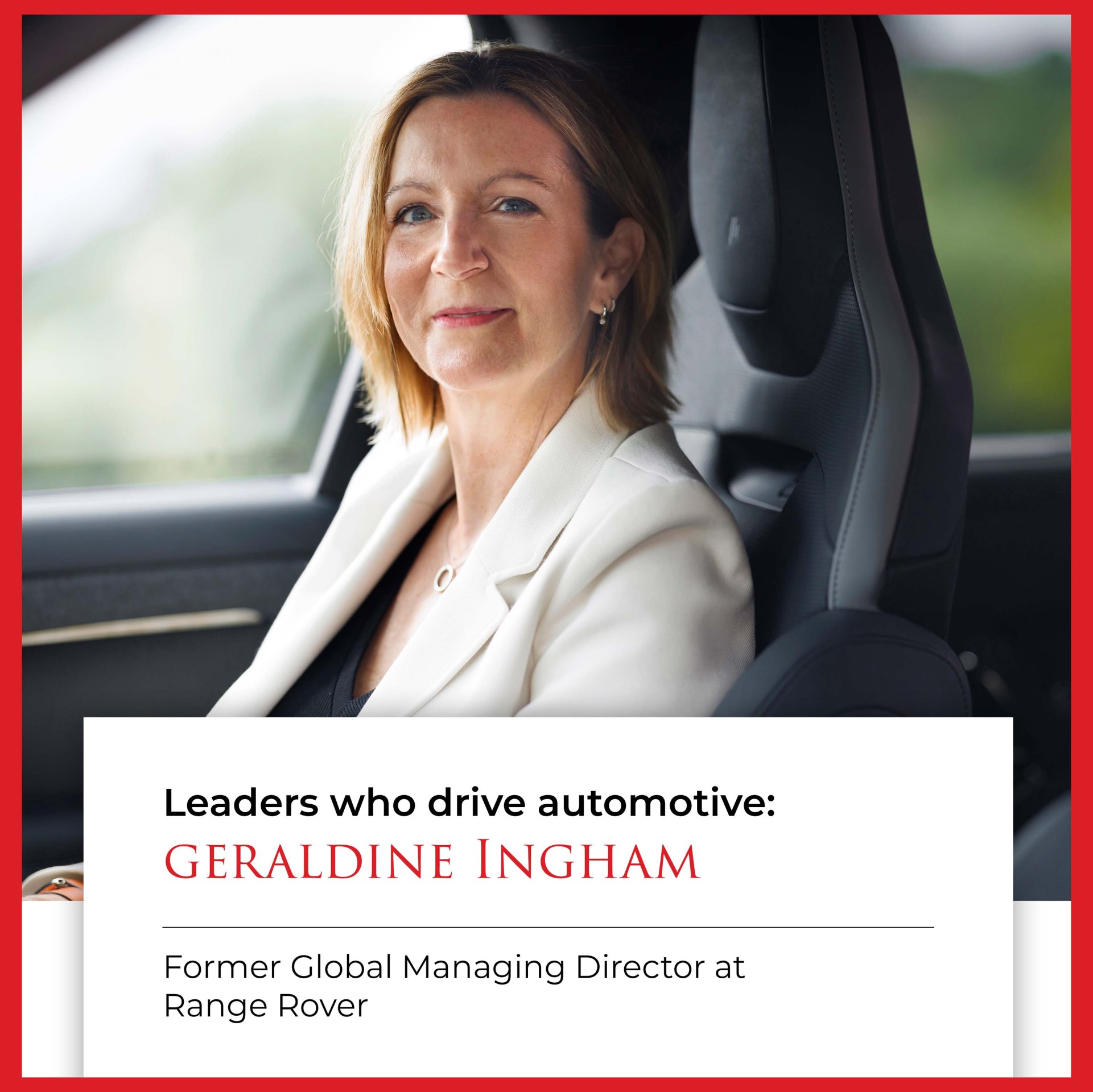
Geraldine Ingham has experienced multiple organisations and sectors, from command-and-control cultures to environments built on empathy and openness. Now a consultant, she stresses the importance of resilience and inspiring lasting performance across people and businesses.
Your career has been interesting in terms of your unconventional route from finance and procurement into marketing. Did you always intend to explore different disciplines, and what pivotal roles or experiences helped you reach your recent global positions?
I don’t think when I started out as a graduate that I ever imagined I’d end up where I am today. One of the most amazing things about this industry is that you have the opportunity to work across almost every function. You don’t have to leave the business or the sector to experience different areas. For me, a lot has come down to a combination of luck and hard work.
One of the most pivotal moments in my career was my decision to work abroad and take a major step outside my comfort zone. I chose to join Renault in France when I could have accepted an alternative offer with a UK-based OEM. That HQ exposure in France proved invaluable. Later in my career, taking a regional role with Nissan was another defining experience. Staying in a single-market role can be very one-dimensional, whereas these international positions opened my perspective on politics, tensions and strategy within a global business. Experiencing both local and international dynamics has been hugely formative.
I started out through the ‘milk round’ with a role in procurement, which I really enjoyed. Procurement gave me early exposure to measurable impact on the bottom line and the chance to work closely with suppliers. It allowed me to see the business from multiple perspectives rather than being insular, which really sparked my interest in exploring different functions. From there, it was a natural progression. My approach has always been to go across the business rather than just climb a single ladder.
Being multilingual helped, particularly when working in France. Speaking someone’s language builds bonds and connections, earning respect and allowing deeper relationships to develop. While it’s not strictly necessary, it definitely helped me navigate complex international roles and foster strong working relationships.
Across organisations you’ve worked for, what differences did you notice in leadership styles, and how did those experiences influence your own approach to leading teams and fostering engagement?
Nissan was a challenger brand, but its leadership style was very process-driven. It was typically Japanese – structured governance but with a real sense of family and unity. In Europe, there was a strong sense of being one team, and that way of leading became part of our DNA. Of all the companies I’ve worked for, Nissan stands out for that feeling of belonging.
Another OEM I worked for was very different. It was more centralised command-and-control leadership which impacted the ability to think creatively or challenge the status quo. The rationale for it was clear, but the environment stifled innovation. I learned a lot from that experience, particularly about the impact of rigid structures on people’s engagement.
I think this kind of centralised control is quite inherent in the automotive industry. Many organisations talk about empowering people but, in times of crisis, they tend to default to command-and-control. By contrast, my experience at Meta was very different. Leadership there was centred on creating an environment of authenticity, empathy and openness. That blend of authenticity with the governance and structure I’d experienced in automotive showed me what I believe is the ‘magic combination’ – empathy paired with discipline and clarity.
When you stepped into your first global managing director role, how did you approach the position and define your leadership priorities?
When I joined JLR, the business was in the middle of a big cultural shift moving towards the ‘Creator’s Code’ – more conversational and collaborative, and far less hierarchical. The board were clearly embracing that new approach. Good advice I received prior to joining JLR was the importance of network and relationships. Unlike Nissan, where there was a lot of process and governance, or Volkswagen, which was centralised command-and-control, JLR was about building the right relationships with the right people. In such a large organisation, Influence was very dispersed in the organisation, so understanding where power sat and investing in those relationships was essential.
What has been your most challenging leadership experience, and how did it impact your growth as a leader?
I would say JLR was the most challenging period of my career. It was the biggest and broadest position I had held, responsible for a significant part of the company’s profit. With that came a lot of opinions and scrutiny from a lot of stakeholders, with a new house of brands structure where everyone was learning how to work together, adding to the complexity.
Becoming a consultant has given me a whole new perspective. It is important to invest enough time researching when looking at making the jump to a new company, to really understand the company culture and chemistry. Today, when I work with different organisations, I can see how important that fit is, and I value the fact that, as a consultant, I have the freedom to step away when it isn’t right.
You’ve worked across volume and luxury automotive brands, in the tech industry and now as a consultant. How have you adapted your approach to lead effectively in different industries, cultures and organisational contexts?
Leadership styles can vary enormously depending on culture, ownership structure and the priorities of the organisation. For example, there can be the approach of asking teams to achieve the seemingly impossible, with the expectation that by aiming high, you land closer to the right solution. Understanding the mindset of those around you is critical to leading effectively in any context.
By contrast, in other companies, leadership can be very structured and KPI-driven, with a remarkable clarity about what is expected at every level. That kind of discipline and transparency is something I’ve always valued and tried to incorporate into my own leadership style. On the other hand, in other companies the focus can be very short term, responding to immediate crises rather than setting a clear, long-term strategic direction. This can require a more reactive approach, with an ability to navigate ambiguity and manage through constant change.
Across all these experiences, I’ve learned that adapting your style is essential. You have to be able to adjust to the culture, the ownership mindset, and the pace of the organisation, while staying true to your core principles as a leader. Being flexible, empathetic and responsive has allowed me to work effectively across very different industries and organisational contexts.
How have you helped the brands you’ve worked with adapt to the evolving market, from rebranding to addressing technology, sustainability and customer expectations?
For me, resilience is absolutely key – both for brands and for people. Part of it is innate but a big part comes from work ethic and team spirit. The leaders I’ve admired most combined a strong work ethic with real attention to detail. Time spent together, working through challenges, helps build resilience and a sense of camaraderie that I think is harder to achieve in a world where people are increasingly working in silos or behind screens. Collaboration and idea generation happen best when teams are together, which is why I believe in being in the office at least three days a week.
In terms of brand work, I’ve always focused on ensuring teams not only understand the strategy but also feel ownership of it. At Norton, for example, we worked on brand strategy in a way that gave the business a clear purpose employees could connect with – something they could articulate even outside of work. Too often, companies spend huge sums on strategies that never filter through to the people who deliver them. Leaders can be so focused on hitting financial KPIs that they neglect embedding that sense of purpose. Nissan was excellent at this. Strategy started at the top and cascaded right through the organisation. That clarity helped everyone see how their role fitted into the bigger picture. I think that’s something the industry risks losing if it rushes to the end results without investing in the cultural foundations that build true resilience.
Do you feel that organisations today are doing enough to invest in developing future leaders, or is there more that could be done to prepare the next generation for leadership roles?
To genuinely develop future leaders, it’s about far more than simply running a programme or following a process. It starts with having a clear strategic vision and ensuring that this vision is embedded consistently throughout the organisation. Leadership development only works when everyone understands the broader direction and purpose, and when those leading the process truly value people. At its core, leadership is about standing up, motivating others and inspiring them to want to follow you, not just issuing instructions.
Too often, career progression is seen as a product of sheer hard work, tenure or being being in the right place at the right time rather than being a reflection of true leadership capability. Many organisations run leadership programmes early in people’s careers, which is useful, but the fundamentals still need to be there from the start: agility, ambition, emotional intelligence and the ability to stand out in ways that inspire confidence in others.
The real challenge is that we haven’t yet connected the dots between recognising these qualities and nurturing them in a structured, sustained way. Without a clear system for identifying and developing potential leaders based on these core capabilities, we risk falling short of producing the calibre of leaders that the industry will need in the future. Building leadership isn’t just about training – it’s about creating the conditions for people to grow, take responsibility and be empowered to make a difference.
What’s one piece of advice that has stayed with you throughout your career, and how has it shaped the way you lead today? Additionally, what guidance would you offer to future leaders on developing their skills, building resilience, and creating a positive and inspiring impact on their teams?
One of the most important lessons I’ve learned over the years is not to make assumptions about how opportunities will come your way. You have to make yourself visible and actively put yourself forward. Building a strong and lasting career requires both breadth and depth. It’s not just about specialising in one area but gaining experience across different roles and functions. I often advise people to take on three or four lateral roles before moving up the ladder, so that they have a solid foundation of skills and perspectives to draw on when they step into leadership positions.
Above all, you have to be willing to challenge yourself, take on responsibilities that feel uncomfortable and do the heavy lifting that others might shy away from. That’s often where the real learning occurs. Growth doesn’t happen when everything comes easily. It happens when you push beyond your comfort zone, take the initiative and embrace the challenges that come with high-responsibility roles.
The combination of visibility, diverse experience and a willingness to work hard and learn from every opportunity is what builds resilience and capability in future leaders.
My advice to future leaders is quite simple but fundamental: be kind, be authentic and be true to yourself. There’s no need to try to adopt someone else’s style or emulate what you think leadership looks like. This is particularly important for women in industries like automotive, where there can be pressure to conform to a traditional style of leadership. The best leaders I’ve encountered are those who genuinely care about their teams. Pressure always cascades down through an organisation, so if you’re in a senior role, part of your responsibility is to protect, motivate and empower the people around you, rather than adding to
their stress.
When I look for successors, I seek a combination of vision, strategic capability, and the ability to inspire others. A great leader makes people want to follow them – not out of obligation but because they believe in the direction being set. That drive comes from passion for the industry, commitment to the team and a willingness to make sacrifices when necessary.
But more than anything, it’s the soft skills that matter most: empathy, effective communication and the ability to bring people along with you. Those are the qualities that build trust, loyalty and high performance, and that’s what ultimately distinguishes someone who is a strong, enduring leader from someone who simply holds a title.
Looking ahead, what impact do you hope to have on the people you lead and the brands you work with, and what does success look like for you in your consultancy and the wider industry?
For me, the greatest legacy isn’t measured solely by financial results or product launches, although I am proud to have delivered record profits and overseen successful vehicle introductions throughout my career. The real satisfaction comes from the impact I’ve had on people. I continue to meet up with former teams and hearing that I contributed positively to their careers and personal development is what I value most.
Being remembered as a good leader, someone who inspired, supported and empowered others, is the kind of legacy I hope to leave behind.
When it comes to consultancy, success takes on a slightly different dimension. It’s not always easy to quantify, but for me it comes from guiding organisations through change and seeing tangible outcomes take shape. Whether that means embedding a new brand identity, repositioning a business or helping teams adapt to new ways of working, success is about creating real, measurable improvements while also leaving a positive, lasting impression on the people involved.
It’s that dual achievement – delivering technical or strategic results while fostering growth and confidence in people – that I have always aimed for. That balance, between organisational performance and human impact, is what I hope will continue to define my work going forward.