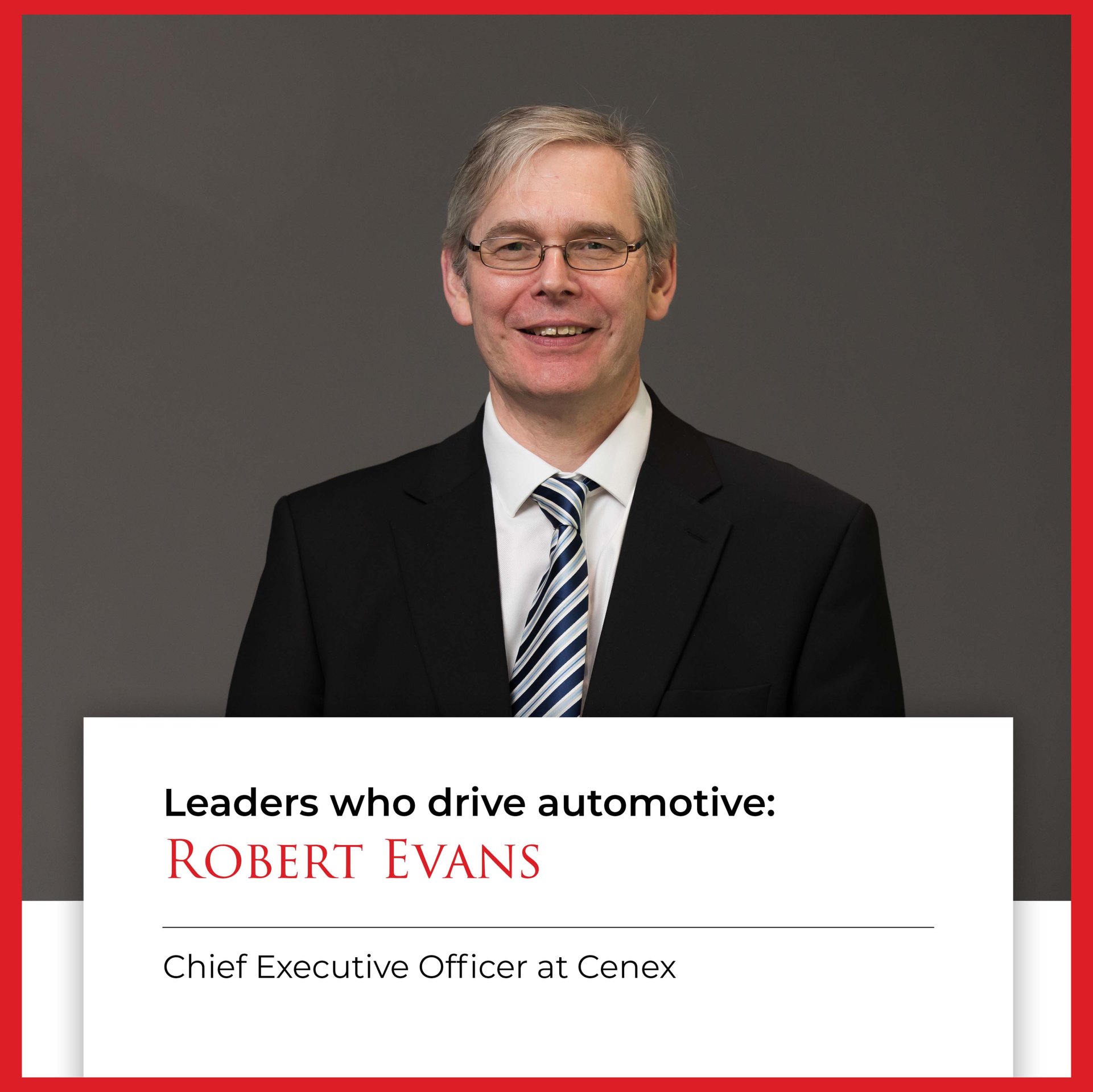
Having led Cenex since its inception 20 years ago, Robert discusses his notion of ‘servant leadership’ and how pathways to the top are opening up beyond the traditional automotive routes through engineering, sales or finance.
Tell me about the key moments of your career and how you came to move into the automotive industry.
I was a car enthusiast growing up and felt positively disposed towards the motor industry as a career option based on feedback from my father. He was an industrial chemist at ICI, and for about three years he worked on developing an antifreeze product and used to travel to the US to meet the ‘big three’ automotive manufacturers.
I studied chemistry at university and joined Johnson Matthey but with the aim of a career in business rather than to follow in my father’s footsteps as an industrial chemist. My early roles in market research gave me an opportunity to observe a whole range of industrial sectors, including an assignment to look at automotive fuel cell technology, which was then in its early infancy.
Johnson Matthey also had a business in vehicle emission control that was operating and growing at the beginning of the deployment of catalytic converters across the European motor industry. So, I was observing the automotive sector indirectly before I became more involved in research projects, including a fuel cell bus project that enabled me to engage more directly with automotive industry contacts. What I consider to be my full transition to the motor industry happened when I moved into the auto catalyst division of Johnson Matthey. This was at a time when the momentum for the business was being driven by diesel emission control. As a Tier 2 supplier, Johnson Matthey’s customers included Ford, Rover, Fiat, Renault, the PSA Group, Toyota and so on.
Having experience with fuel cells in a pre-commercial development phase, I was motivated to get involved in the early-stage market development of catalysts and diesel particulate filters for buses
and trucks, initially as retrofit but latterly to help meet Euro 4 regulations. This led to my getting involved in public affairs for the ‘green fleet’ agenda, trying to influence national and local policies on clean air zones in the UK and internationally.
It was through my participation in government-supported initiatives, including the Cleaner Vehicles Task Force and the Low Carbon Vehicle Partnership, that my interest broadened from clean air to low carbon and from market development to the supply chain development opportunity for the UK. From this, the opportunity arose to become the founding CEO of Cenex.
At the time, the UK motor industry was making 2 million cars and 3 million engines per year. There was a recognition by the government that, to help tackle climate change, there needed to be low-carbon solutions for vehicles and ideally the UK should be developing and manufacturing these solutions to an equivalent value to sustain a competitive motor industry in the UK.
Cenex was an instrument by which the government wanted to see the industry coalesce around low carbon as an innovation and supply chain development theme. They wanted a mechanism to put funding into low-carbon projects to build momentum, and I guess I was in the right place at the right time.
I saw it as an interesting opportunity where I could apply my skills and experience in public affairs, market development and working in the innovation space. After starting the role in 2005, I became immediately engaged with senior representatives of the UK motor industry – initially around the innovation theme and subsequently working closely with them as vehicle electrification became a credible proposition thanks to lithium-ion batteries.
You’ve modestly neglected to mention that you are now one of the longest-serving chief executives in the automotive industry, with 20 years under your belt. Did you always have an ambition or vision to take on an influential leadership role?
I would say I was deeply ambitious in my younger years – possibly uncomfortably so, which probably made me a very difficult person to manage in that sense. I was very driven to be successful in whatever role I did at Johnson Matthey, and I was really pushing myself towards fresh challenges.
I wanted to get to a more senior level because I wanted my working day to make a difference. I suppose I was a bit like someone who is highly entrepreneurial because I was uncomfortable about being ‘corporate’. Although I was a loyal employee of Johnson Matthey for 18 years, what I enjoyed most was engaging with external organisations to understand how they operated and then to see how to collaborate for shared benefits.
Once I reached the position of CEO, that restless ambition to take the next step went away. Instead, my focus changed to being thebest CEO that I could be for Cenex and developing my own authentic style of leadership. Cenex is about partnership working to drive forward market transformation as a catalyst or ‘change agent’ working with the motor industry and fleet operators to help push forward transport sector decarbonisation. The job suited me because it was a place where I felt I and my team could have influence, do good work, add value and contribute to cutting both carbon and air pollutant emissions. I still want to be the best that I can be as a leader and to help others in more of a servant leadership role.
I’ve heard you talk about the concept of ‘servant leadership’ before. Do you think that approach, rather than being a tub-thumping CEO, has led to your longevity in the role, because 20 years is a long time? You’re not in a role where you’re hanging on for grim death. You’re adding value, and you’re enjoying it. Do you think your style of servant leadership has contributed to that?
That’s definitely the case. I think that style of leadership suits the nature of the organisation. I’m comfortable with it, and I think it works for the people around me. I’m not 100% pure servant all the time. There are times when it is necessary to adapt to circumstances, whether to assert my authority and fight my corner or to take a more democratic approach. But it’s a style of leadership where what you’re trying to do is to put people in your team in a position to succeed and to help your partners succeed on projects that benefit the wider community. It suits my personal style because I like to build empathy with people. I want to understand those I work with and help them to be successful. I’m really a people person at heart. I like to know what makes people tick and what it’s like to walk in their shoes to achieve win-win outcomes. Working together means everyone achieves more.
The nature of what we do at Cenex means we have to work in partnership with other organisations. All our collaborative R&D is partnership working. The big things like our Cenex Expo event is a partnership-working activity and our consultancy is also partnership working. I find that highly motivational because you get so many different perspectives and viewpoints by being in a mixed ecosystem. I guess it’s a different way of working to how many people operate in the motor industry. You can be successful in the motor industry while remaining within the insular environment of the car company you work in. That’s fine for some people but it’s not my style, and it doesn’t work for Cenex.
If you’re the type of transformational or autocratic leader who wants to wave a pistol in the air and lead from the front, driving your troops over the top of the trenches and hoping they will follow, that’s a very hard style to successfully maintain for a long time. The servant leadership style is easier to sustain over a long period and is better suited to an organisation like Cenex.
As a not-for-profit, we’re unable to compete on salaries with commercial organisations, but what we do offer is a culture where our people are motivated by values and have a worthy mission in terms of decarbonisation. You need to build goodwill with your employees and with your stakeholders, and that comes from helping people to achieve their objectives. We’re not an organisation that has a quick ‘get in and then get out’ relationship with our stakeholders. We make a long-term commitment to help those who work for and with us to achieve their objectives, and therefore I need a leadership style that provides for consistency and longevity.
I understand how your leadership style is perfectly suited to Cenex as opposed to the more ‘command and control’ approach, but how do you overcome difficult challenges or conflicts in situations where many CEOs would simply say, ‘Just do it’?
There’s a perception of servant leadership that everything is employee-centric. Actually, it’s about maintaining a triangle between the team, the customers and the money. If you lean too far towards the people and focus all your attention on creating a lovely, people-centric working environment, you can lose sight of the fact that organisations like Cenex exist to serve the customer and, to be sustainable, you have to get the money bit right.
As a leader, I’m not trying to lead every single person – I’m trying to lead an organisation. In a very people-orientated organisation like Cenex, that means you need a lot of delegation and trust to manage down through the levels. This can bring challenges, though. While it is important to delegate trust and responsibility through the organisation, there are occasions when the senior leadership team has to toughen up to make sure team members are not being distracted from the company mission and are losing sight of the customer and money part of the triangle.
There have been occasions, for example, when there has been a perception among staff that the most important aspect of Cenex’s activity is the training and development. Of course that’s important, but you have to balance that against the needs of the customers. The customer is king and we’ve got to support our customers and align the organisation to help them achieve their objectives. The triangulation needs to be in balance. We need to ensure we’re in a sweet spot and that we don’t lean too far over the edges of the triangle.
To get back to your original question about the longevity, I think the secret is not to keep on having fresh strategies and new three-year plans but just to keep on doing the right thing. You see it so often in football where a manager runs a team a certain way and then is replaced by a new manager who brings in a whole new strategy. The staff aren’t aligned with the new strategy and the players can’t play how the new manager wants. I want to build leaders within the organisation while maintaining a common alignment. If someone is out of alignment, it’s about nudging them back towards the mission, vision and values.
I think you articulate very clearly how you can be people-focused but still absolutely commercial. You operate as a not-for-profit organisation, which is not uncommon but is a different style of entity. For anyone considering leadership in this type of organisation, what would you say is the difference compared to a ‘for-profit’ business? How do you manage the fact that people in your team could be lured away by bigger salaries in a commercial business?
As someone who was very ambitious in my younger days, I understand there will be team members within Cenex who feel the same way as I felt, and I have to accept that we can’t afford to pay super-high salaries. What we can offer as a smaller organisation is the opportunity for employees to gain responsibility quicker than would be possible in a larger corporate organisation. If a major project needs to be done and you’re available to work on it, you’re going to be given the responsibility. That means you’re going to get the opportunity to develop more quickly than you otherwise would do.
When I was in my first job at Johnson Matthey, I remember reading an interview with the CEO in the company’s Christmas magazine where he said his progression stemmed from the fact that he was given responsibility at a very early stage in his career. The fact that he was trusted to do things effectively kick-started his career. That’s very much what Cenex offers.
I firmly believe that responsibility given in the early stages of a career can be the platform needed for developing leaders of the future. To aid this process, our managers provide a lot of mentoring and support to help team members’ professional and hopefully also their personal development. It is in our shared interests to do so because the faster we can develop our people and give them projects to manage, the more impact we can have as an organisation.
My aim is also to give team members at Cenex a degree of job security. I’m not going to run the organisation in a cyclical way, with growth then followed by having to lay people off. I try to run the organisation on a consistent, steady profile that provides a level of security of employment.
Alongside this, we are rigorous in our recruitment process to seek to ensure what we offer is a good match with what motivates applicants and that they will fit with our culture.
When people do decide to move on from Cenex, you have to take the view that it’s great for them and wish them every success. Seeing Cenex alumni in the community doing great work and making an impact reflects well on Cenex as an organisation. When people move on, it creates a fresh opportunity to recruit and develop new talent with lots of potential, and so the cycle continues.
You’re in an organisation that constantly has to go out and sell new technology and new projects. How do you stay fresh and on top of developments after 20 years at Cenex?
The things I was doing 10 years ago are not necessarily the same things that I’m doing now. The sector is going through a big change, and it motivates me to work around the edges of where it’s changing. A key example of this is the emerging opportunity for driverless vehicles. The sector is in so much flux and there are so many new projects and different things we’re doing. My job is constantly refreshing itself and every day is an opportunity to make Cenex better and do good work. In terms of getting to grips with new topics and subject matter, that’s where my reading comes in. I’m always learning about new stuff in my spare time.
Reflecting on your experience and looking at today’s industry, are the traditional career pathways in the automotive industry still there, or have they evolved?
The traditional career pathway I saw when at Johnson Matthey was that to reach the top, you needed to come from what was called the ‘middle line’. This was basically comprised of four functions: engineering, manufacturing, sales and marketing, and finance. One of those functions had to be your starting point, and you ideally had to work in at least one of these other functions, and potentially two or three, as you made your way up through the organisation. Only someone who had come from one of those four functions could hope to become a CEO in the industry.
If you came from outside those four key areas and worked in what was considered a support function, such as public affairs or legal, you could get to a senior advisory position but you couldn’t rise beyond a particular level. I am an example of that because I didn’t go through the middle line at Johnson Matthey, and so I knew I wouldn’t have the breadth of experience to be a strong candidate to run a large department or division. That realisation led me to take a different route in the not-for-profit space.
I think this requirement to progress through the middle line may now have changed. Certainly, the smaller companies that I see within the innovation space aren’t necessarily following this same approach. Because of all the new trends that are coming through in areas such as software-defined vehicles, power electronics and AI, there is a greater need for the entrepreneurial tech approach typically associated with Silicon Valley. There’s also a need for diversity in thinking and a focus on talent. There are far more opportunities now for people in different kinds of roles and backgrounds to rise to senior positions because different skill sets are going to be needed at the leadership level.
Organisations will still need people to be good at sales and marketing and to run production plants but, as the industry changes and diversifies, there will be opportunities for different roles and different thinking. People can now move into the sector from outside and make progress rather than having had to do their time in the industry. There’s more uncertainty in the market, and that uncertainty brings opportunity.