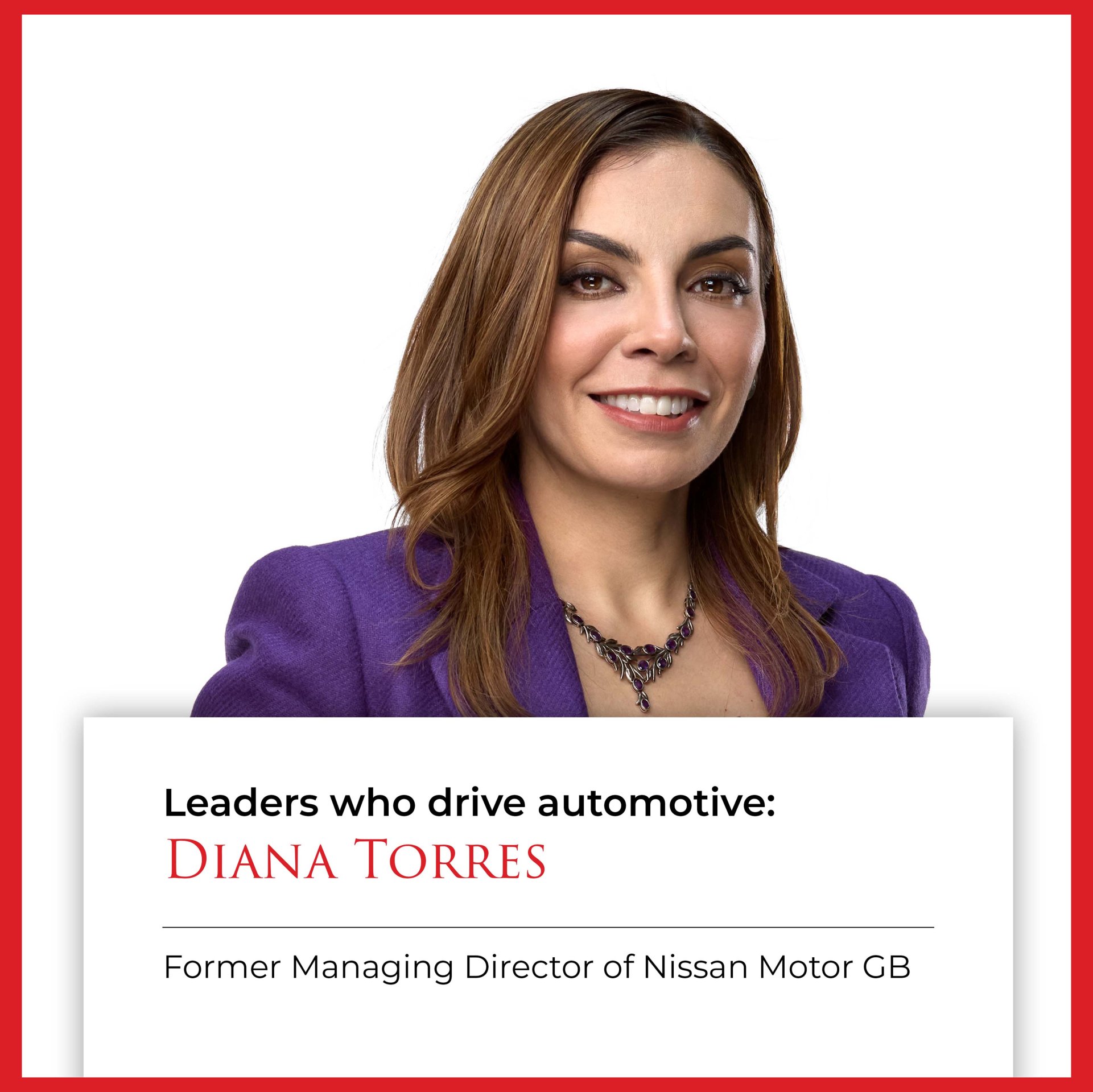
Diana Torres, former Managing Director of Nissan Motor GB and now Senior Managing Director at the global CEO advisory firm Teneo, tells Lynda Ennis, Co-founder and CEO of Ennis & Co Group, that aspiring leaders need to get out of their comfort zone and embrace change.
LYNDA ENNIS: Tell me about your journey into the automotive industry from your early days working in the aviation sector. What key roles did you hold and how did you choose each opportunity along the way?
Diana Torres: My career path has been an unusual one. My first job following university was with Avianca Airlines in Colombia just when the company entered Chapter 11. Working for a company in bankruptcy gave me experiences that truly shaped my career and character. I was working closely with the CFO, witnessing hard decisions being made, learning how to find investors and putting together turnaround plans while trying to keep stakeholders engaged. I discovered my natural skills in these areas and I realised that I loved it, even though it isn’t an environment for everyone. It was tough, stressful and full of uncertainty, but it gave me the ability early on to navigate change and understand to never compromise mid-long term value creation for short-term KPIs in a way that most people probably would not understand that early in their careers.
Later, when one of our advisory companies offered me an opportunity to join their graduate rotational programme in the UK, Germany and Holland, I just grabbed the opportunity. It was an unexpected move, full of challenges. Leaving everything behind and starting a new life was another key turning point in my career. Living abroad was a transformative experience that opened my mind to perspectives and possibilities far beyond what I once imagined. It was uncomfortable, but it fed the curiosity I have had from an early age and it turned out to be a great step in my career.
My move into the automotive industry was, in all honesty, not an intentional one. I was looking to learn beyond the aviation/finance space, as I was feeling too specialised too early in my career, so I decided to do my Executive MBA at London Business School. At that point, Nissan came along as part of an executive rotational programme for MBAs, and that was appealing to me as it fit perfectly with my willingness to embrace change. I started out in a Nissan plant in Sunderland – another new environment – and I loved it. I completed all my rotations and ultimately spent the next 13 years with Nissan, holding eight jobs across six different countries. My problem solving and people management skills were key assets as all my early positions were about leading transformations or setting growth strategies in short periods of time.
Within the industry, two key experiences stand out. The first, and most prominent for me, was the opportunity to work in Japan for four years. That was an incredibly different and challenging period, but one I’ll never forget. It taught me patience and gave me confidence. I realised I could operate in a completely different culture and lead projects with the local team, when at the time I saw many other foreign leaders just bringing in their own teams. I feel proud of what I achieved in Japan as, despite being an outsider, I was able to deliver very strategic projects for the company in an agile and sustainable way. I also learned that real transformation happens when you stand behind your team instead of breaking them down or burdening them with all the pressure.
The second key experience in the industry was my move into the LATAM Managing Director role for Nissan Importers. Up until that point in my career, my focus had been more on executive roles in finance and strategy. Although I have always been close to the operations, I admit that I initially felt the role might be too commercial, but it turned out to be another key milestone in my career. It was my strategic, sustainability-focused and long-term mindset, not just the numbers, that shaped how I approached commercial operations. Managing a full P&L taught me that true growth and transformation go far beyond financial metrics. It requires balancing profitability with innovation, understanding operational levers, and knowing how to lead and empower people. A strong financial foundation provides the clarity needed to make sound decisions, while strategic thinking ensures those decisions drive long-term value rather than short term gains.
After more than a decade in automotive, building my extensive experience leading large-scale transformations and managing complex P&Ls, I am now expanding my focus to corporate advisory. In this capacity, I partner with boards and executive teams – whether in a traditional advisory role or through interim positions such as Chief Transformation or Restructuring Officer – to help organisations navigate complexity, unlock sustainable growth and implement meaningful change.
LE: Reflecting on your experience and looking at today’s industry, how have traditional career pathways in the automotive industry evolved, and what advice would you give to emerging leaders looking to progress today?
DT: My advice is simple; get out of your comfort zone and embrace change. The traditional, linear career ladder doesn’t really exist anymore – or at least, it doesn’t guarantee success. You can’t just focus on climbing upwards, because the best leaders are those who have moved sideways, taken risks and gathered a wide range of experiences along the way. Make lateral moves, explore different functions and don’t be afraid to go somewhere that feels unfamiliar. If an opportunity comes up, even one that doesn’t look perfect on paper, take it.
That’s always been my mindset – what’s the worst that can happen? You’ll never truly know until you try. Even if something doesn’t work out, it’s still an investment in your learning. I often say it takes six months to understand a role and another six months to really add value. If, after a year, you find it’s not for you, you’ve still learned something invaluable and you can always pivot – whether that’s back to what you did before or on to something entirely new.
For young leaders, I think the most empowering thing you can have is the knowledge that you always have options. Don’t let your title or job define you. If you start too high too soon, it can be difficult to separate your identity from your position and that can make it harder to take risks or make bold choices later on.
Your professional life is only one part of who you are. You’re really the sum of your experiences – what you’ve done, what you’ve learned and what you can share with others. The best leaders never stop learning; they stay curious and adaptable, but they also recognise the importance of balance. Being “on” all the time is unsustainable. Good leaders operate at a consistently high level and that’s tough to do if you don’t learn how to step back, protect your personal life and recharge. Detaching your sense of self from your work isn’t weakness – it’s what allows you to stay grounded and keep perspective over the long term.
LE: And what about sacrifice? Do you think being a good leader also means being honest with yourself about the sacrifices you have to make and being prepared to accept them?
DT: True leadership requires personal and professional sacrifices. It’s not always talked about, but it’s a real part of the journey. In general, careers are rarely linear and when I speak to younger people coming into the industry it is interesting to see that they are not looking for linearity but excitement. What you want at one stage of life may not be what you want ten years later, and that’s perfectly fine. Priorities shift, circumstances change and so does your definition of success.
What’s important is being honest with yourself about those trade-offs and sacrifices. Life will inevitably throw challenges your way, and in those moments, you must think long term; what will truly make me happy? What will I look back on and not regret? Sometimes that means making difficult decisions like taking a step sideways, missing a family event or moving to a different country. But the key is to do it consciously, knowing why you’re doing it and what it means for you.
Some of this thinking comes from my own upbringing. I grew up in a modest family where education was seen as the pathway to a better life. I went to one of the best private universities in Colombia, but to do that I had to take out a significant loan. I remember the mix of excitement and fear, the determination to pursue something bigger and the anxiety and uncertainty about how I would find a job afterwards. Those experiences taught me resilience, perspective and to work hard to pursue what you want.
In the end, you have to live with and stand by the decisions you make. Sacrifice is part of leadership, but so is balance and self-awareness. If you understand your values and stay true to them, those sacrifices feel less like losses and more like deliberate steps on a path you have chosen.
LE: You have led Nissan businesses across four continents, including manufacturing and distribution. Can you talk about some of the challenges that you had to deal with in these organisations and the demands of working in different cultures?
DT: Moving outside your own culture and environment can be frightening, but it’s also one of the most rewarding experiences you can have. I am grateful for the experiences and opportunities that have shaped my career and allowed me to make an impact, but I have also been deliberate about taking opportunities when they came along, even when they felt uncomfortable or risky at the time. For me, so much of it comes down to mindset. You must know what drives you and what you’re trying to achieve. Personally, I struggle to just coast along. I have always been motivated by the challenge of fixing and improving things and believe that true impact comes from pursuing the highest standards. That mindset has helped me face change in a more constructive way and to build resilience over time.
I have learnt that resilience doesn’t come from staying where you’re comfortable, it’s something you build by stepping into the unknown. Every time you take on a new role, move to a new culture, or even do something as simple as switching your routines, you grow a little stronger and more adaptable. Working across Europe, Asia, North America and Latin America, I’ve seen how different cultures approach business, leadership and relationships. You must listen, observe and adjust your own style as what works in one country won’t necessarily work in another. The key is to stay humble, be curious and never assume you have all the answers.
The way that the world is evolving – new technologies, new expectations, constant disruption – resilience has become one of the most important skills anyone can develop. It’s something I talk about often with my own children. Yes, Maths and English are important, but the ability to adapt, recover and keep moving forward is what will really determine how they thrive in life.
That said, the car industry remains quite conservative when it comes to bringing in people from outside. There’s still a tendency to look for the familiar rather than the different. But the truth is, most industries face the same challenges at their core, they just use different language. Success ultimately comes down to mindset: being open, receptive to change and willing to learn continuously, wherever you are in the world. Learn to feel comfortable with the uncomfortable.
LE: As your career unfolded, did you have a specific goal in mind – a role you wanted to achieve? If so, how did you build a pathway towards it and what advice would you give to others developing their own careers?
DT: Although I never had a specific goal in mind, I have always aimed for excellence and meaningful impact in everything I do. Reaching executive positions was always appealing to me, because of the significant impact you have on driving change, motivating and leading teams, and delivering results with integrity. If you do those things you are contributing to society in a meaningful way and that is rewarding.
On the pathways and advice, I say that any professional career is like your personal life. Sometimes it’s a marathon, sometimes it’s a sprint. We’re living longer now, so you can spend a decade in a career, starting from scratch and getting to the top, and still easily have four different careers in a lifetime and be excellent at each. This is a conversation I regularly have with myself. If I stay in one place for too long, in a couple of years I will become bored and start questioning why I didn’t make a move. Going back to my previous point, what is the worst that can happen when you change roles or pathways? You do not know what you really like until you try different things, but what is guaranteed is that you will still have learned something valuable. Until you try different things, you can never be sure what really drives you and motivates you. That experience is wonderful and incredibly helpful in navigating the future and this is why it is so important to embrace change.
One of the challenges I see as people progress into leadership roles is that it becomes easier to detach. Power can be addictive for some, they cling to it because they fear that if they step away, they will lose the title and the respect that comes with it. That mindset not only stops that leader’s personal advancement, it also leads to bad leadership that destroys value in organisations.
LE: Developing and managing people is a core responsibility of leadership. How have you balanced this with the pressures to deliver results and how has your approach evolved over your career?
DT: Developing people is the core responsibility of leadership. You need to develop certain traits over time, have a lot of self-awareness and never stop learning. Many people fail to realise that managing and inspiring people is the most challenging part of leadership, but it’s also the key to getting results in a sustainable way. The higher you go, the less it is about you and the more it is about enabling and empowering teams to deliver, generate ideas and execute. You only learn how to do this by experiencing different leadership styles and environments and adapting accordingly.
Looking back on my career, I’ve learned just as much from bad bosses as I have from the good ones. You need to be willing to take on tough roles, even terrible jobs, because those experiences teach you just as much, and sometimes more, about the type of leader you want to be and the environment and culture you want to create. There are some aspects of great leadership that do not change over time, such as the importance of trust and integrity, leading by example and empowering others. However, there are other parts of the approach that do need to be adjusted depending on the role and environment, such as the level of support and tools the team need, the best way to give and receive feedback, and how to motivate people to do their best work. Getting this right is especially important now as we have several very different generations all working together.
LE: Have you had any significant mentors or inspirations that shaped you? What lessons did they impart that you carry with you today?
DT: Somebody once said that women are over mentored and under sponsored and that is the reality in the corporate world. During all my career I have seen a lot of mentoring, which is very important to develop your skills, self-awareness and leadership style, but what makes a real difference to career progression are sponsors. I have been fortunate that throughout my career, I had outstanding sponsors that not only advised me, but also actively advocated for me, pushed me forward and stood up for me when it mattered most. Sponsors are the ones who help you take that next step when you might not yet have the confidence to do it yourself. I’ve had several such people and I’m deeply grateful to each of them. Behind every pivotal career move I have made, there has always been a key sponsor.
Those key sponsors always had three things in common: integrity, strategic thinking and a high level of accountability. They have inspired me to lead in a similar way by being an active sponsor and trying to spot the talented people that might be overlooked just because they are different and do not fit the “normal” stereotype, but have the right mindset and attitude to get things done.
One key executive mentor and sponsor in those pivotal career transitions that stands out for me was a former Nissan executive and his pragmatism and absolute clarity of thought. He had this ability to cut through complexity and focus on what really mattered. He was always direct, straightforward and unpretentious – there was no corporate fluff. I found that incredibly refreshing and grounding, especially in a large global organisation where it’s easy to lose sight of what’s important. That directness, and his ability to simplify without losing depth, is something I’ve always tried to emulate in my own leadership.
Even now at Teneo, I continue to learn from the people around me. One of the Senior Managing Directors said something that really stuck with me: “The best Chief Restructuring Officers are the ones prepared to get fired.” At first, that idea completely threw me – it sounded counterintuitive. But when you think about it, it’s about courage and conviction. To be truly effective, you can’t spend your time trying to please everyone. You have to make tough calls, challenge assumptions and be willing to stand by your decisions. That mindset of being brave enough to take risks and accept the consequences is a great piece of advice at any stage in your career.