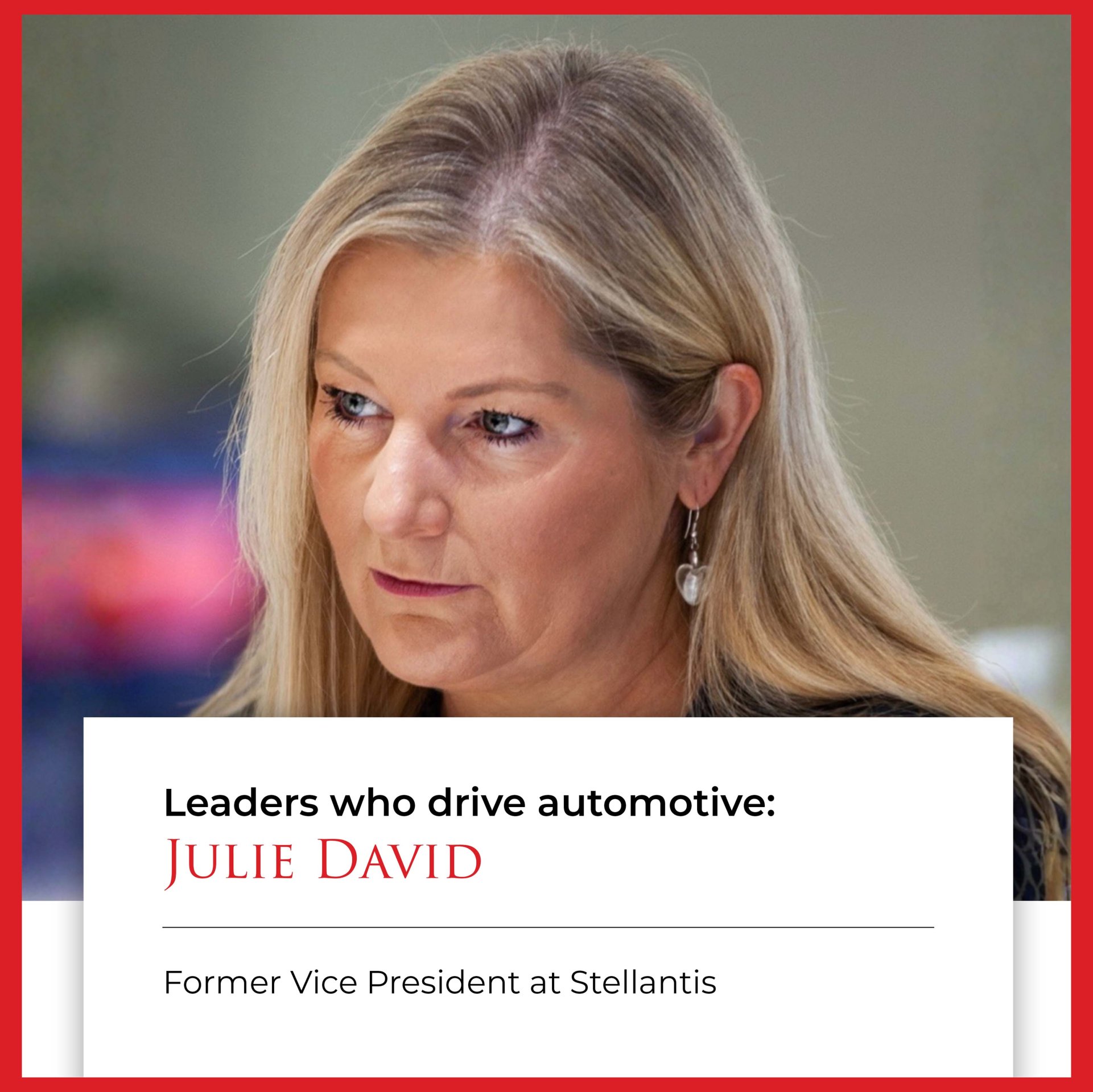
As a former VP at Stellantis and now an executive coach and mentor, Julie David has a dual perspective on what makes great leadership. She advises leaders to make time to reflect, listen and observe what is happening around them, and to always show humanity and humility. Interview: Lynda Ennis
You began your career as a graduate trainee and went on to hold senior global leadership roles in automotive. Could you talk about your career journey, including how you started and the key experiences that shaped you as a leader?
I began my career in the aerospace and defence industry as a sponsored undergraduate business studies student. This opportunity allowed me to work on fascinating international defence contracts. However, I eventually realised I was more drawn to businesses that were more aligned with the culture I wanted to be part of after graduating.
Reflecting on my journey, I was fortunate to graduate at a time when there were greater opportunities to explore different career paths. I came across an intriguing advert in The Times recruitment pages – yes, I’m that old – which piqued my interest. The advert was for a graduate traineeship and although it didn’t disclose the brand or sector, it turned out to be the start of my automotive career at Ford Motor Company, where I joined their fast-track programme for graduates with prior work experience.
The Ford programme was instrumental in giving me a comprehensive understanding of all aspects of the retail and franchise business model. I believe all graduates entering the automotive sector today would benefit greatly from a similar grounding. I followed a traditional path of climbing the corporate ladder within national sales company roles, but I also took sideways moves that broadened my experience.
These later proved invaluable in enabling me to step into senior leadership roles. I deliberately sought opportunities to move between brands, taking on less glamorous or more complex functions and teams that needed turning around. My time at Volkswagen Group provided multiple opportunities in this regard, and I’ve had similar opportunities in many different brands and group functions. Finding a business that allows you to grow in both breadth and depth of experience can be super helpful in supporting one’s personal growth.
Some of the key experiences that shaped me as a leader came from encountering significant cultural changes when moving into new positions. Navigating challenging business behaviours and dealing with senior leaders who did not always welcome constructive challenge strengthened my resolve and confidence. I learned never to be afraid to challenge in the right way, to persist in influencing the right outcomes, to protect my teams so they could focus on their priorities, and to be accountable and dependable as a leader who values human decency alongside business performance.
Transitioning to a global position allowed me to work with, and within, many different regions and countries. This was particularly significant at a time when China was rapidly launching challenger brands. I highly recommend this route to others as it broadens one’s perspective on optimising business models and processes in a complex geopolitical world where customer expectations and leadership styles vary greatly.
Understanding and responding to international trade laws and tariffs has become increasingly important in recent years, as has the ability to grow a truly global brand while recognising the importance of local differences.
My early forties were also a transformative period. I spent time consulting and collaborating with a range of public and private-sector service organisations outside of automotive. Working alongside some of the lowest-paid yet most compassionate individuals in medical and funeral settings – and seeking to understand their patient and client experiences to share with their senior leadership teams in order to facilitate improvements across their business – was deeply humbling and profoundly impactful. This exposure stretched my capabilities and provided essential new perspectives that I continue to carry forward in my career.
One of the most insightful activities that I have always done and also promoted to my teams and colleagues is to continually appraise your own business and that of your competitors as a customer. Mystery-shopping other businesses, or looking at your own business on a regular basis with your eyes and ears really open to what you might have stopped noticing, can really heighten your awareness of what really matters. Often, just one or a few simple changes can make an exponential difference to a customer’s experience.
As much as processes, systems and the physical environment are important in driving efficiencies and creating a brand experience, in almost all instances it is people that make the difference to how someone feels about their experience – the choices that individuals in that business make to show they care about others and are innately proud of their business and their own personal standards. Empowering teams to show up in this way is also critical to their ability to do what they feel is right.
You joined Stellantis from JLR when it was formed from the merger of PSA & FCA. What key lessons have stayed with you from that experience which may be valuable for other leaders navigating M&A activity?
The key lesson from the merger experience was recognising that the global senior leadership team faced as much change and challenge personally as the rest of the organisation. While the power struggles at the top could sometimes seem unhelpful, it was essential for us, as leaders in the UK business, to remain focused on what truly mattered for maintaining performance.
We needed to identify effective, pragmatic solutions amid the competing demands and cultures of the French, Italian and American leadership teams. My prior global experience proved invaluable in navigating the different communication styles, expectations and decision-making approaches that surfaced in each interaction. I felt it was important to be respectful to the varied opinions about what was the best way of operating rather than assuming they were wrong. It was also important to find compelling ways to offer up our ideas of constructive alternatives that were more relevant to our market to achieve our common goals.
I joined Stellantis during the full lockdown in the UK and Europe. At that time, it was quite unusual for a senior leader to be recruited externally and not already be a known quantity within the business. This situation provided an important learning experience, teaching me how to build trust and credibility remotely, both with my internal team and with the franchise network, during those first crucial months. It reinforced the importance of clear communication, consistent engagement and demonstrating reliability and support, even when face-to-face interactions were limited.
While remote working has since become far more common, albeit not so extreme as during our lockdown experiences, I would encourage leaders and their teams to ensure they don’t allow it to somehow diminish business behaviours or the ability to lead effective meetings. People also need to be respectful of our most precious commodity of time.
As an executive coach, you now help other leaders to grow. What are the most common challenges you see leaders facing today, and how do you help them navigate those challenges? What makes a successful leader stand out today?
The most common challenges I see leaders facing today include decision-making paralysis, lack of confidence in their choices, dysfunctional remote teams, ineffective communication and difficulty leading with clarity and purpose toward a shared, attainable goal where everyone understands their role in achieving it. Many organisations are overwhelmed with data yet fail to extract meaningful insight from it. This often leaves leaders waiting for more information before deciding or acting, resulting in hesitation and stagnation; missing opportunities to grow or make critical changes that are timebound for their business.
New board members, in particular, often struggle to make a meaningful impact or influence their peers. They need to see their role as extending beyond their functional responsibilities, contributing to strategic direction and overall organisational outcomes. The ability to understand operational complexity while operating at a strategic level remains rare but is one of the most valuable skills a leader can possess today, particularly when stepping up into a C-suite role.
In my coaching practice, I help leaders reflect on how they ‘show up’ each day – how they manage the shadow they cast as leaders, how they navigate their packed schedules and how they explore alternative ways to influence outcomes outside standard meeting structures. I work with them on managing conflict, turning around dysfunctional teams, delegating more effectively and being more thoughtful and intentional in their interactions with both their teams and their boards.
One surprising and consistent observation is how many leaders, men as well as women, experience imposter syndrome. I coach senior men and women in roughly equal numbers, and while women tend to open up about their worries and vulnerabilities earlier in the coaching relationship, my male clients at chair or board level often express similar doubts about their decisions and the weight of their responsibilities.
If leaders could view imposter syndrome as a natural trait among highly motivated individuals striving for excellence, they might see it as a useful self-check to find a helpful positive coping technique rather than a weakness to fear. I often compare it to the nerves we feel before public speaking. No matter how confident we appear, it’s a sign that we care and want to perform at our best.
Ultimately, the most crucial behaviours often missing from busy leadership routines are pausing to reflect, listening and noticing what’s happening around them, asking powerful, thought-provoking questions, staying curious and showing humanity and humility. These are the same principles I bring to my work as an executive coach. However, unlike in leadership, my role as a coach is intentionally less directive and more about creating the space for others to find their own answers.
You mention on LinkedIn about how embracing diversity across gender, ethnicity, disability and age can bring value to businesses. In particular, you talk about connecting younger and older generations in the workplace. What responsibility do you think today’s leaders have in making some of these changes?
Today’s leaders have a responsibility to lead by example and to build teams that reflect a truly diverse mix of thinkers and perspectives, always prioritising meritocracy alongside the many facets of diversity that continue to challenge organisations. The most effective environments are those where inclusive and sustainable ways of working become second nature across the organisation, rather than one-off initiatives introduced in response to a poor engagement score or disappointing business results.
Leaders can actively encourage diversity by ensuring that everyone has an equal voice and feels genuinely heard. Mixing teams to collaborate on cross-functional initiatives, listening from the bottom up through skip-level meetings, implementing reverse mentoring, investing in talent programmes and giving equal weight to the employee and customer experience are all practical ways to foster connection, understanding and inclusion.
When these practices are embedded into everyday behaviours, decision-making and leadership priorities, they help bridge generational gaps and create workplaces where all employees feel valued and empowered. These are the hallmarks of organisations that genuinely integrate diversity into their culture, rather than treating it as a compliance exercise or a box-ticking activity.
I have noticed a recent increase amongst my clients of leaders who, when joining a new team or board, are told to repress their individual style or personality and conform to the collective culture. This probably says more about the individual offering this observation, and it ignores the fact that diversity of thinking and background can enhance rather than detract from the overall success of the team. Recruiting people who conform to one’s own style can be more comfortable but, in my experience, teams are far more successful when a range of styles work together in a complementary way.
You’ve mentioned taking a new approach to your professional life by being more purposeful. What does success as a leader look like for you today, and how has that definition evolved over time? What do you hope to achieve through your career, both personally and professionally, and how do you encourage other leaders to define success for themselves?
For me, success as a leader has always been about making a meaningful difference and having a positive, progressive impact on the people I work with, both internally and externally. Over time, as I’ve grown older, wiser and more experienced, I’ve become more discerning and confident in the choices I make about what I take on and who I work with. I now focus my energy and efforts where they can add the greatest value, which is why I describe my approach as being more purposeful.
In my current role as an executive coach, mentor and adviser, I support leaders as they navigate both the challenges and opportunities in their roles and careers. I aim to be a discreet, trusted and supportive partner, helping them reflect, make informed decisions and develop their own definitions of success. I share helpful insights, knowledge and reflections with those who seek more guidance from me as a mentor or adviser if that is what serves my client the best.
Ultimately, success for me now is about enabling others to thrive and achieve their potential, while fostering leadership that is thoughtful, intentional and impactful – leadership that leaves a lasting, positive imprint on the people, teams and organisations they serve.
Today, I am far more confident in being true to myself and to the things that create joy and satisfaction in my life; while ensuring I stay true to my values.
Looking back on your career, what advice would you give to leaders who are stepping into senior roles today? What do you see as the most important skills and qualities for leaders to possess in order to succeed? How do you feel leadership is evolving, and what mindsets or habits have served you best throughout your own career?
In my view, modern leadership should focus on the ‘how’ rather than just the ‘what’ and ‘by when’. Achieving performance at the expense of exhausted, demotivated teams who are afraid to challenge ideas or raise concerns is not sustainable. Leaders need to create environments where people feel safe to speak up, share different perspectives and innovate, while still driving strong results. Balancing accountability with empathy and support is key to building resilient, high-performing teams.
The best leaders of the future will be those who demonstrate and reward excellent business behaviours alongside performance outcomes. They will lead with quiet confidence, listen more than they speak, communicate clearly and consistently, nurture their teams and talent and remain engaged with their customers’ evolving needs. Being self-aware, adaptable and approachable will be just as critical as technical or commercial expertise as these qualities create a culture of trust, collaboration and sustainable success.
Recruiting based on attitude as much as aptitude, and treating everyone with equal respect – from the apprentice technician to the chairman or investor – has been a mindset that has consistently served me well throughout my career. This approach not only strengthens teams and relationships but also fosters a culture of fairness, accountability and mutual respect that endures through change, challenge and growth. I believe there is no place for dominant egos or poor emotional intelligence in modern leadership for today and the future.
LE: Who have been your most influential mentors or leaders throughout your career, and what made them so impactful? Are there particular leadership habits, philosophies, or approaches that you have carried forward from them into your own style? How have these influences shaped the way you lead, make decisions, and support others in your professional journey?
My dad has been by far the most influential mentor in my life. He is the most generous person I know, both in time and wisdom. Coming from humble beginnings and helping others achieve so much, he has always been the person I turn to for advice or to discuss options in both my professional and personal life.
Interestingly, from a multi-generational perspective, I have often consulted my sons as they have grown into young adults about certain decisions and major life changes. Considering different generational perspectives and consulting with your family when your professional life can have such an impact on home life is incredibly helpful, given that we are all managing a blend of our personal and professional lives.
This, in turn, has encouraged my sons to be more open to my support when it comes to their own decision-making – something that can often be a barrier as a parent, regardless of the experience we might have been able to offer. If I can be even half the person my dad has been to me in this regard throughout their adult lives, that would be a very humbling achievement.
In terms of professional mentoring, I do think I would have benefited from having a senior business mentor earlier in my career, and I now encourage others to find someone they trust for the long term. That said, I have benefited greatly from close, long-standing colleagues and friends who have followed similar career paths, particularly from my time at Ford and Volkswagen Group. Along with some senior women I have been fortunate to network with outside the automotive sector, they remain my go-to sources for encouragement, perspective and validation of my career choices.
Over time, I have learned what kind of leader I want to be by appreciating the best qualities in others and consciously avoiding the aggressive or ineffective traits I have observed. My philosophy has remained constant: be kind and generous in spirit and with your time, treat everyone with respect, listen and notice, be relentlessly persistent, never give up and believe that anything is possible. These principles continue to guide how I lead, coach and interact with others today.