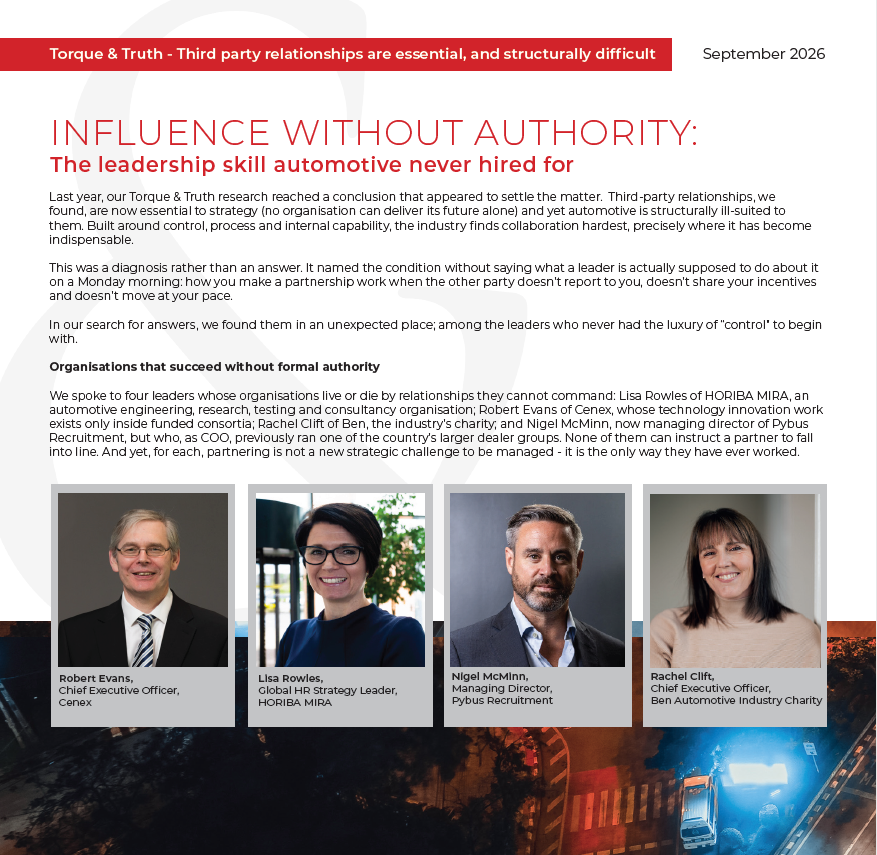
Last year, through our work with 50 automotive leaders, Ennis & Co argued the case that cost pressure in automotive has stopped being cyclical. Leaders are no longer managing through a downturn and waiting for conditions to improve. The constraint, we found, is permanent and something that strategy must work within.
In conversation with three industry leaders the picture that emerges of how businesses behave is more than a little ironic: Cost discipline, applied badly, can quietly destroy the precise thing it was designed to protect.
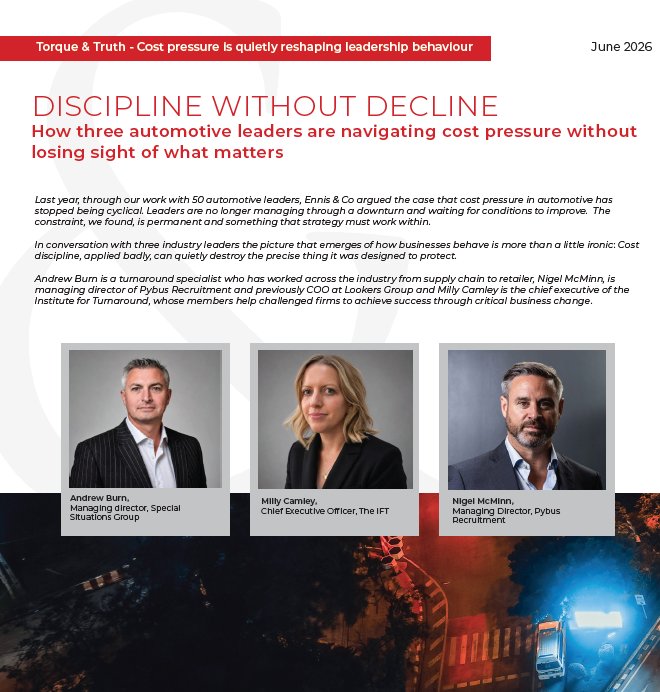
Andrew Burn is a turnaround specialist who has worked across the industry from supply chain to retailer, Nigel McMinn, is managing director of Pybus Recruitment and previously COO at Lookers Group and Milly Camley is the chief executive of the Institute for Turnaround, whose members help challenged firms to achieve success through critical business change.
From reduction to optimisation
The starting point, perhaps, is the language leaders use.
Andrew Burn has spent three decades transforming businesses in financial difficulty. One of the first things he notices in organisations under pressure is how they frame the challenge. Too often, he says, the conversation defaults to cost reduction, when a more useful starting point is cost optimisation. “It’s actually what you do with your money and how you get the better return for it,” he says.
“Cost reduction is defensive; it asks what can be cut. Cost optimisation asks where money is best deployed, which is a different question entirely. It opens up conversations about investment in automation, about portfolio decisions, about sequencing. It keeps the future in view.”
Burn is clear that not everyone has made this shift.
Some businesses still reach for the blunt instrument, say a 5% savings target handed down from the top, with the expectation that teams will simply find a way to deliver it. The problem, he argues, is that senior leaders rarely stop to ask whether their people have the tools or the thinking to do it properly. Left without guidance, teams take the path of least resistance cutting whatever is easiest rather than whatever makes sense. The risk, as he puts it, is that they simply “salami slice” their way to a number that satisfies the directive but changes nothing of substance. The result is short-term compliance and no real change.
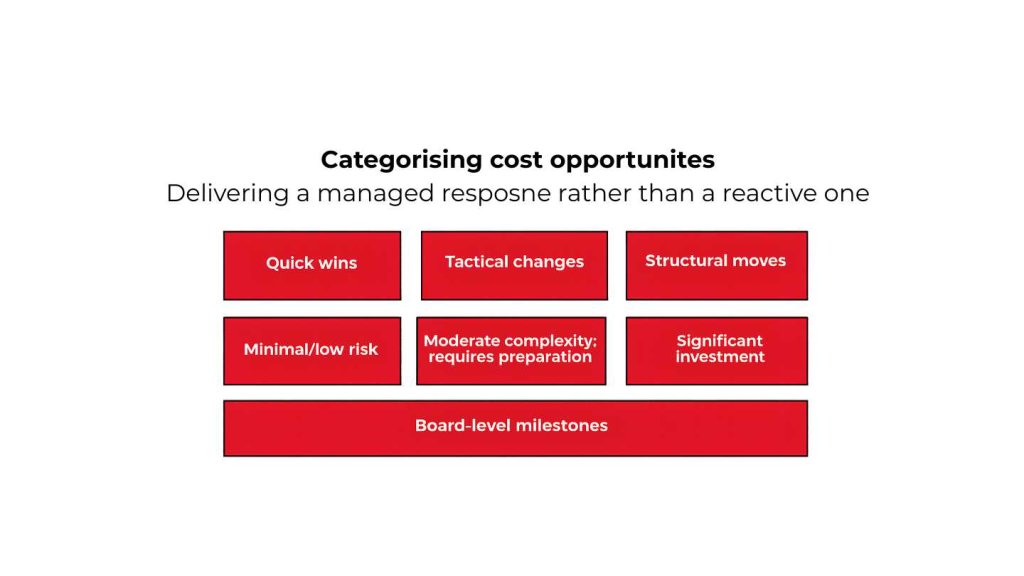
The businesses that do it well, in his experience, categorise their cost opportunities. Quick wins that carry no risk. Tactical changes that need more thought. Harder structural moves that take time and investment to deliver. Working through those in sequence, with board-level milestones, is what separates a managed response from a reactive one.
The cost-first trap
If Andrew Burn’s concern is about how cost pressure is framed at the top, Nigel McMinn’s is about what happens when it filters down into the culture of a business.
McMinn brings thirty years of motor retail experience to the conversation. His concern is not with cost management itself, which he sees as necessary and healthy. It is what happens when it becomes the whole story.
He uses an analogy that has stayed with him since his early days in the automotive industry. A burger van owner, running a profitable roadside business, takes his Economics student son’s advice and starts cutting costs ahead of a predicted recession.
Cheaper burgers. Thinner buns. Lettuce going out of date. Within a year the business has failed, but not because of the recession, but because the product got so bad that customers stopped coming. “Of course,” McMinn says, “he just made it self-fulfilling.”
The parallel with automotive retail is direct. McMinn describes a dealership that reduced its service advisor team from six to three. On paper, a saving. In practice, each advisor is now handling 25 customers a day instead of eight to ten. The remaining staff are going off sick. Some are thinking of leaving. “If you’re not careful,” he says, “you create such a negative atmosphere that it doesn’t matter how much costs are under control, you’ve damaged your business.”
The take-away is not that cost reduction (or optimisation) is wrong. Cutting headcount without fixing the underlying structure just moves the problem – and often makes it worse.
Running on empty
Milly Camley sees the same pressures from a different angle. As chief executive of the Institute for Turnaround, her accredited members work with businesses that are at the sharp end of financial difficulty with the leaders trying to hold them together.
One theme comes up consistently. “During lockdown,” she says, “management teams managed to rise to the challenge pretty quickly with this confluence of issues.” The problem is what has happened since. Responding to one crisis after another, for year after year, takes a toll. The energy and headspace needed to think structurally (to lift the eyes from the immediate problem and ask harder questions about the long term) gets consumed by the demands of the day.
Camley calls it management fatigue, and she sees it across sectors. It shows up not just in exhaustion but in avoidance – the tendency to hope that conditions will improve rather than confront what needs to change. “Hope is not a strategy,” she says. In automotive, she notes, that can manifest as an assumption that volumes will return to levels that, in reality, it may never come back.
The evidence bears this out. Camley describes a market that is quietly polarising. At one end, businesses are slamming into liquidation with problems that have gone unaddressed for too long, and with no runway left to fix them. At the other, a growing number are undertaking genuine transformation; restructuring their models, finding new propositions, making hard decisions early enough to matter. What is shrinking, she observes, is the middle ground. The businesses that are managing through, waiting for conditions to improve, hoping the pressure eases, but that group is getting smaller.
The data the IFT tracks reinforces the point. Among the top reasons for business distress in early 2026 were inflationary pressures, energy costs and the depletion of working capital – pressures that have been building for several years. For businesses that have been managing reactively rather than structurally, the runway is getting shorter.
What good looks like
The businesses that navigate this well, in McMinn’s experience, share a common trait. They manage the cost base without letting it become the lens through which every decision is made. The customer stays at the centre. The culture stays positive. Arnold Clarke is a benchmark; an organisation with an exceptionally tight grip on its finances, but one whose whole orientation is towards generating revenue and serving customers rather than managing decline.
Sytner under Penske is another example he points to. The model was never about building cheap; it was about building something people wanted to come to. Manicured grounds. Immaculate facilities. The right cars, properly prepared. “If you do things in a high-quality way,” McMinn says, “you’ll build really big, solid, profitable businesses.” The logic is simple. Customers don’t always default to the cheapest option. Marks & Spencer and Waitrose have never gone bust.
Burn adds a further dimension. Good looks different, he argues, depending on where a business sits on the spectrum.
A business with time and stability can afford to be methodical as it works through categories of opportunity in sequence, investing where necessary to unlock bigger savings down the line. A business managing a cash crisis has to move faster and accept less elegance in its choices. The skill is in reading that position accurately and calibrating the response accordingly. “It depends what you’re trying to achieve,” he says, “and what your starting point is.” What he rarely sees in the businesses that handle it well is the assumption that one approach fits all situations.
Camley’s version of the same idea is self-awareness. The number one trait she sees in businesses that successfully turn themselves around is an honest read of their own position; not where they wish they were, but where they are. That clarity, she argues, is what makes everything else possible. It determines what kind of help is needed, what the realistic options are, and how quickly action needs to be taken. Her members, she notes, achieve a turnaround success rate of around 90% – but only when they are brought in early enough to make a difference.
“The number one trait in businesses that successfully turn themselves around is an honest read of their own position; not where they wish they were.”
Harnessing the animal spirits
All of which brings the conversation back to leadership behaviour and to what McMinn describes as the central challenge of running a business through sustained constraint.
“You’ve got to harness the animal spirits,” he says. The phrase captures something that balance sheets don’t. People come to work wanting to feel that what they do matters, that there is a purpose to it, and that they can share in the rewards. The job of a chief executive or managing director, in his view, is to keep that spirit alive even when the financial environment is pressing in the opposite direction.
Get that balance wrong, and the consequences show up quickly. McMinn describes organisations where cost has become so dominant a narrative that people are looking over their shoulders rather than at their customers. The talk is all about saving, and the atmosphere turns negative. Good people leave. Others go off sick. The numbers may look acceptable for a while, but the damage is being done. “It might not show through into the results this year,” he says, “but it will.”
Camley frames the same challenge slightly differently. Engagement, she argues, is not a nice-to-have that gets cut when times are hard. It is one of the things that makes a turnaround possible. Communication, internal momentum, the story being told to staff and stakeholders; these are the things that determine whether an organisation can sustain change over time.
The leaders who are able to keep cost and culture in balance are not ignoring the financial reality. They are refusing to let it become the only reality.
The bottom line
Cost pressure is not going away. All three conversations make that plain. The question is not whether leaders need to manage it (they do) but whether they allow it to narrow their thinking to the point where it starts working against them.
The businesses that are navigating this well are not the ones cutting hardest. They are the ones that have diagnosed their position honestly, structured their response deliberately, and kept their people facing forwards rather than looking over their shoulders. They are asking not just what they can afford to cut, but what they cannot afford to lose.
In the end, this is a question of leadership as much as finance. As Andrew Burn, Nigel McMinn and Milly Camley indicate, the organisations that navigate this period best will do so through leadership, not just cost-cutting.
This article is the third in a series of deeper dives into the themes that emerged from Ennis & Co.’s Torque and Truth research, conducted by interviewing fifty senior automotive leaders earlier this year.
This series of conversations developed from a research partnership between Ennis & Co and Pybus Recruitment and delivers a unique platform of insight from leaders speaking candidly about success in their organisations.