When we published Torque & Truth, the leadership analysis, one of the key themes raised by senior leaders was that speed of decision making and implementation had moved from being an operational concern to a defining strategic issue. Slow decisions, leaders were recognising, carry their own risk. The gap between strategic intent and execution pace, a competitive liability.
But identifying speed as a priority and knowing what to do about it are two different things entirely.
For the second of our series looking in depth at key leadership themes, we have brought together three perspectives from leaders whose businesses operate at the pace their customers set.
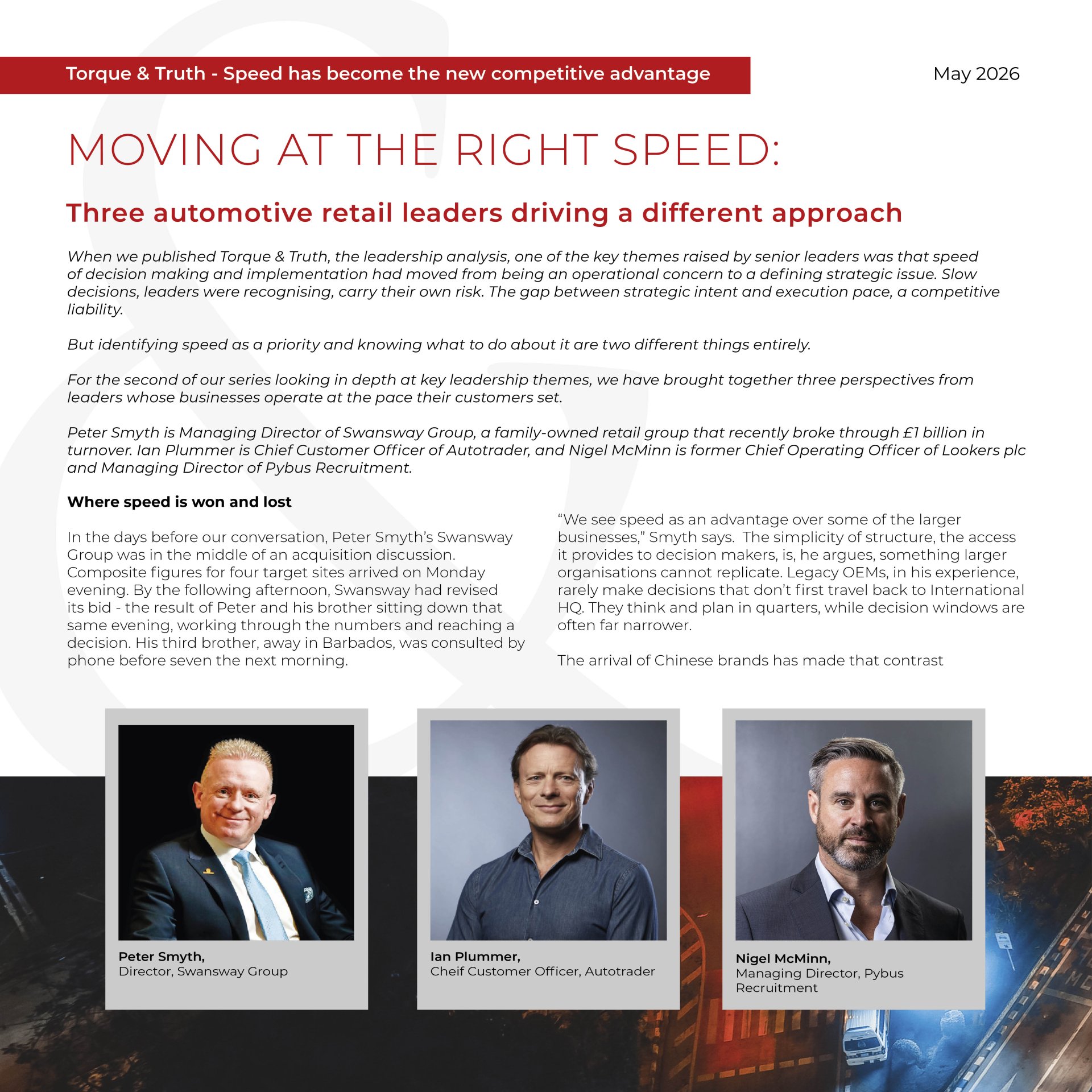
Peter Smyth is Managing Director of Swansway Group, a family-owned retail group that recently broke through £1 billion in turnover. Ian Plummer is Chief Customer Officer of Autotrader, and Nigel McMinn is former Chief Operating Officer of Lookers plc and Managing Director of Pybus Recruitment.
Where speed is won and lost
In the days before our conversation, Peter Smyth’s Swansway Group was in the middle of an acquisition discussion. Composite figures for four target sites arrived on Monday evening. By the following afternoon, Swansway had revised its bid – the result of Peter and his brother sitting down that same evening, working through the numbers and reaching a decision. His third brother, away in Barbados, was consulted by phone before seven the next morning.
“We see speed as an advantage over some of the larger businesses,” Smyth says. The simplicity of structure, the access it provides to decision makers, is, he argues, something larger organisations cannot replicate. Legacy OEMs, in his experience, rarely make decisions that don’t first travel back to International HQ. They think and plan in quarters, while decision windows are often far narrower.
The arrival of Chinese brands has made that contrast sharper. Smyth recalls a BYD representative visiting a Swansway site before a dealer agreement had even been signed, touring the building and handing over an order form before the meeting ended. “That would never happen with more traditional brands”.
McMinn, is clear about the reason that larger organisations tend to lose pace — decisions travel too far from the people best placed to make them. “Having people write papers that would be submitted to their director, who would submit it to head office, is a nonsense in any organisation,” McMinn says. “The decision is then made just on bits of paper and data. The person who should be closest to making the decision is the one buying the stock”.
Ian Plummer reframes the topic of speed through the eyes of Autotrader, where speed is not a goal in itself, instead there is a mindset focused on planning to reduce friction at every point. What the business pursues is the quality of its foundations (the technology, the culture, the decision-making structures) on the basis that operational speed follows naturally. “If you build things on an incredibly strong and scalable foundation,” he says, “then operational speed naturally follows from that.”
Smyth’s speed is instinctive, built into the ownership structure and the culture that flows from it. Plummer’s is architectural, the result of deliberate investment in the conditions that make fast, good decisions possible. McMinn’s is experiential — the calibrated judgement of someone who understands which friction to remove and which to leave alone.
“If you build things on an incredibly strong and scalable foundation then operational speed naturally follows from that”
The discipline of greasy speed
On the wall of every manager’s office across Swansway Group hangs the same image. The scene, taken from Rocky II, depicts Rocky’s trainer telling his fighter that talent alone is not enough. What he needs, the trainer spells out, is “greasy speed”.
Swansway operates on what Smyth describes as the easyJet model – lower margins, faster stock turn, let the volume do the work. More transactions mean more service plan opportunities, finance opportunities and customer relationships. The margin per unit matters less than the rhythm of the business.
That rhythm is managed with obsessive precision. Every car has a clock running against it from the moment it arrives. At sixty days it is on a list. At ninety days it is on a different list… and the conversation that follows at that point is not a comfortable one. Every Friday morning at half past ten, a Teams call goes out to every head of business and sales manager across the group. The agenda is always the same: which cars are over sixty days, where they are, and what is happening to move them. “We’re on it, to the point of obsession,” Smyth says.
The mantra underneath all of it is simple: never a bad car, only a bad price. In a digital marketplace there is always a price at which a vehicle will sell. Sometimes you have to hold your nose and take the loss. The first loss, as the adage goes, is the best loss.
What makes the Swansway approach distinctive, McMinn argues, is not the principle but the rigour. “If you’re going to sell a hundred a month, you can only have a hundred cars in stock” — and that hundred includes cars awaiting preparation, sold but undelivered stock, and trade cars waiting for auction. Nothing is invisible. Swansway carries no cars on its website listed as awaiting preparation. If it is not ready to sell, it is not online.
“It’s not particularly scientific,” Smyth says. “It’s a boring process.” Which, perhaps, is precisely the point. The competitive advantage does not come from doing something clever. It comes from doing something straightforward every single day, without exception.
Strategic decision making: knowing when to move and when not to move
For Ian Plummer, speed is not a target but a byproduct of how Autotrader operates. Software updates are deployed roughly every seven minutes, while 40,000 consumer interactions per minute continuously refine the platform and inform retail and brand partners. At that scale, pace becomes embedded rather than consciously pursued, “It’s a natural way of working,” Plummer says, “rather than something we have to consciously pursue”.
The challenge, Plummer argues, is ensuring sufficent thoughtfulness combined with pace. As a FTSE 100 market leader with 14,000 retail partners and nearly 50 years of history, Autotrader must ensure that their solutions are properly scaleable and can be intregated both within Autotrader, but also crucially, within partner systems and processes too. “The biggest risk for us isn’t moving too slowly,” he says. “It’s over-correcting when the market shifts.”
The rollout of Autotrader’s Deal Builder product generated significant pushback from retail partners who felt the business had moved without adequate explanation of what it was trying to achieve. Plummer is open: “We arguably moved too fast for some of our customers. We gave the wrong impression about what we were aiming to do.” The response was to pause, listen and course correct which is easier said than done.
Plummer’s message here, is that moving faster than your ecosystem can absorb doesn’t create competitive advantage. It creates remediation work, and remediation is significantly more expensive in time, resource and relationship capital than the original decision would have been.
At the same time, he is clear about moving forwards when needed. When internal debate does not resolve into consensus, Autotrader operates on a principle it calls disagree and commit. Every perspective is heard, a decision is made and then the organisation gets behind it. “You shouldn’t regret not reaching consensus,” Plummer says.
“But you do need, once you’ve made a decision, to get on with it.”
The pace of talent acquisition
There is one area where speed as a competitive advantage shows up in a way the industry rarely discusses – and it has nothing to do with stock turn or decision rights. The race for talent.
Nigel McMinn has watched this play out repeatedly from his position placing senior leaders across the sector. When a strong candidate is quietly in the market (often reluctantly, after years in the same role) the organisation that moves first and moves personally tends to win. The one that takes two weeks to respond, four to six weeks to organise an interview, and runs a formatted process loses. Not ocassionally. Consistently. Speed here is not just efficiency. It is also a signal, telling a candidate something about what working for that organisation will actually feel like before the conversation about culture has even started.
“Moving at pace, seeing candidates quickly and flexibly, can be the difference between making that person jump out of what they’ve done for ten or twenty years,” McMinn says- and with a nod to Peter Smyth, adds that a leader who clears a Saturday morning to meet someone, who rings rather than emails, who gives a clear answer quickly, is demonstrating the culture before the conversation about it has even started.
Swansway’s pace, though, doesn’t suit everyone. Swansway has had mixed results with senior hires from corporate environments – people who find the pace disorienting, who expect a paper, a process, a committee. His brother David’s instruction to anyone new captures the philosophy: a ‘no’ is better than a ‘maybe’. Clarity at speed is itself a form of respect.
Ian Plummer sees strong cultural alignment as essential to moving both quickly and effectively. Autotrader’s attrition rate sits in the low-to-mid single digits, against fifteen to thirty percent common across retail automotive. Plummer argues that having such low attrition rates is particularly helpful when building a team that genuinely understands and engages with the company’s culture and operating model.
Ownership, he argues, comes from something deeper than financial incentives. A decade ago, Autotrader removed bonuses and commissions entirely – a deliberate move away from short-term targets. An approach that is captured in the company’s mission: ‘Drive Change Together. Responsibly’. “That long-term focus on customer value,” Plummer says, “is what delivers sustainable growth for us both.” The result? When people understand why they are doing what they are doing, the organisation moves more smoothly – and more quickly.
What does this all actually mean?
The Torque and Truth research Ennis & Co completed earlier this year, identified speed as a defining strategic issue for the automotive industry. What these conversations suggest is that the reality is more nuanced (and more interesting) than that finding alone implies.
Speed is not a single dynamic. At Swansway it is instinctive – built into the ownership structure and felt in every stock list and hiring decision. At Autotrader it is architectural – the product of deliberate investment in foundations and culture that makes fast, considered action possible without sacrificing ecosystem trust. In the hands of an experienced operator like Nigel McMinn, it is something else again: a judgement call, shaped by context, that the best leaders learn to calibrate rather than simply maximise.
In all three cases what drives it is the same: a ruthless honesty about which processes serve the business and which merely slow it down.
In an industry where strategic intent is converging (where most leaders agree on where the market is heading) the question of who gets there first is no longer abstract. The window for advantage is narrowing. Organisations that remove internal friction, clarify decision rights and build cultures where pace feels natural will gain a head start slower competitors will struggle to close.
Speed is not the goal. It is the result. The goal is building the kind of organisation in which moving quickly is simply what good leadership looks like – every day, at every level, in every decision.
The automotive leaders who have understood that are not waiting for the right moment to act. They already have.
Taking your foot off the brake (key behaviours)
Make speed a signal: How quickly you respond to a candidate, a customer or a partner tells them something about your organisation before a word has been spoken about it.
Simplify decision structures: Remove the layers between a decision and the person best placed to make it. The closer authority sits to the coalface, the faster and better the decision.
Set the clock running: Establish clear, non-negotiable timelines for every operational process (stock, hiring, responses) and manage to them daily, not quarterly.
Build foundations before chasing pace: Invest in the technology, culture and governance structures that make fast, considered action possible. Speed that outpaces your foundations creates remediation, not advantage.
Know your ecosystem’s pace: Moving faster than your partners, customers or colleagues can absorb is not speed,
it is disruption of the wrong kind. Calibrate accordingly.Disagree and commit: Encourage genuine debate, but once a decision is made, get behind it. Unresolved internal friction is one of the most consistent brakes on organisational pace.
Hire and retain for culture: Recruit people whose instincts match the pace of the business. High attrition forces constant explanation of who you are and how you work – and that, more than anything, slows an organisation down.
This article is the second in a series of deeper dives into the themes that emerged from Ennis & Co.’s Torque and Truth research, conducted by interviewing fifty senior automotive leaders earlier this year.
This series of conversations developed from a research partnership between Ennis & Co and Pybus Recruitment and delivers a unique platform of insight from leaders speaking candidly about success in their organisations.