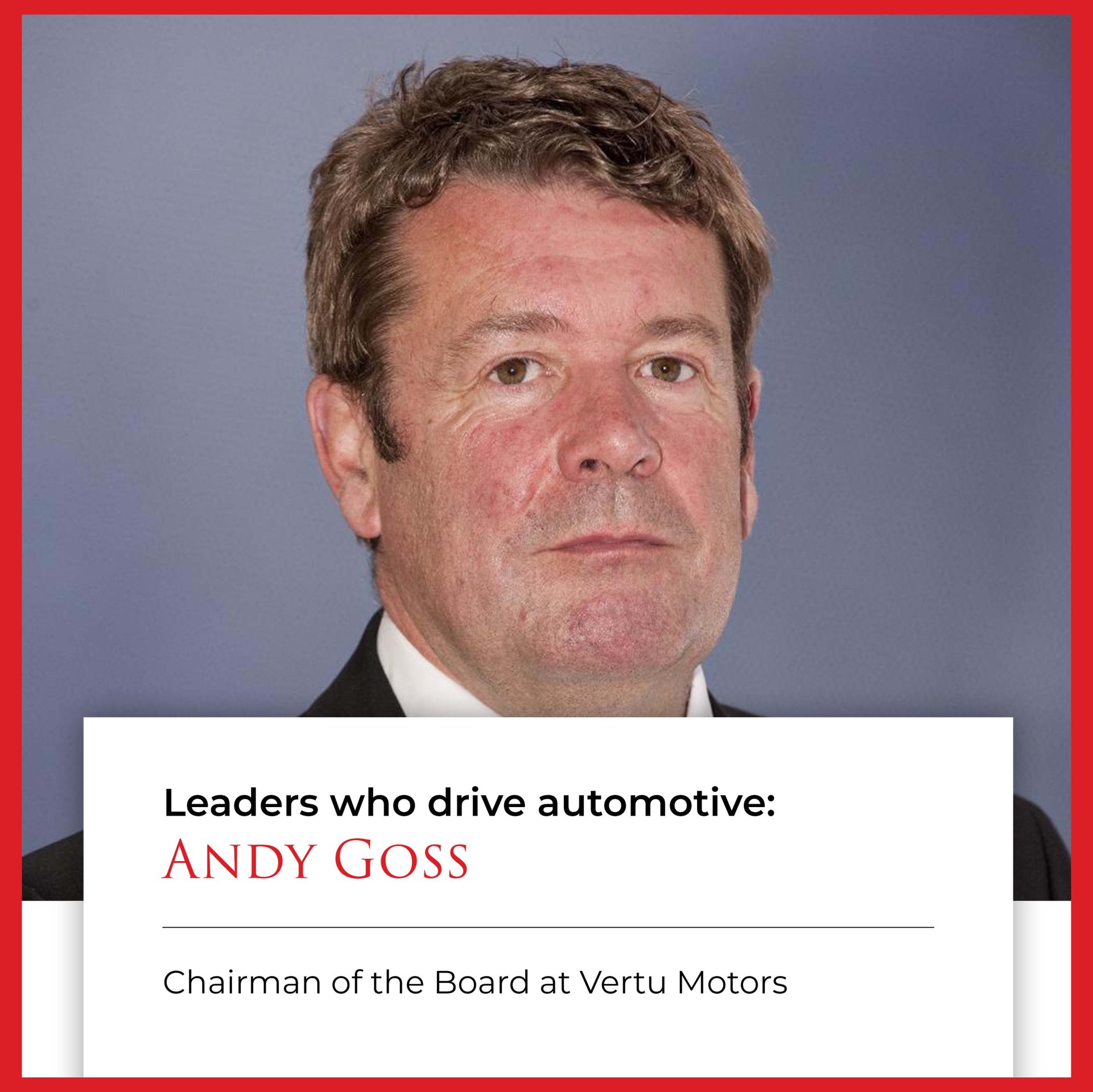
After a long and successful leadership career on the brand side at Toyota, Porsche and JLR and the retail side at Vertu Motors, Andy Goss tells Al Clarke, Chairman of the Ennis & Co Advisory Group, that experiencing life on both sides of the fence brings huge added value to aspiring automotive leaders.
AL CLARKE: You’ve had an amazing 40-year career in the automotive industry, holding senior leadership positions with iconic brands before crossing to the retail side. Going back to the start of your journey, did you set out with a grand plan about how your career would unfold?
ANDY GOSS: No, I didn’t. I never had any career advice growing up, and it was only when I went to university to study economics that I got an inkling of what I wanted to do. I remember doing the careers ‘milk round’ and being attracted to British Leyland, not because I liked cars in particular but because they had a very charismatic South African CEO, Michael Edwardes, who had effectively saved the company.
After graduating from The University of Manchester, I moved straight to Birmingham to begin my career at BL’s Longbridge factory as a graduate trainee. Not long after, my father died, and, as a rather immature 21-year-old, I suddenly had to grow up very fast. The following year I moved to London, but at that stage in my life there was still no grand plan. Things seemed to happen to me by default more than by design.
AC: You’ve had many roles in your career, but what were the ones that stand out for you, and what was the thinking behind the career decisions that you took?
AG: I suppose I would have to start with my landing my first C-suite role 33 years ago, which was really a launchpad for my career. I had just started working for Nissan in Amsterdam on a project that I very quickly realised was ill-conceived, and so I decided to write to the Managing Director of Toyota (GB), Trevor Taylor, who I remembered from his time in charge of Austin Rover commercial operations. I didn’t know him that well because I had been very junior when our paths crossed, but he made a big impression on me as an influential leader, and I saw him as a bit of a god. Amazingly, he remembered me, and days later I was sitting in front of him for a job interview. Twelve months after that, I got a massive uplift when I was promoted to Sales Director of Toyota (GB), which was – and still is – a phenomenal organisation. A lot of that was down to Trevor, who has played a huge part in my career.
AC: What were the main things that you learnt in that first C-suite role?
AG: Well, there were some obvious hygiene factors. I’ve always been extremely results-driven, so getting the job of Sales Director at the age of 32 and with such a fantastic brand was an incredible opportunity for me. I was a square peg in a square hole. Those were the days of Supra, Celica, Land Cruiser, MR2, and RAV4, so the product range was unbelievable.
The biggest thing I learnt from Trevor was the importance of network relations. Trevor was a master at building great relationships with the dealer partners because he listened. Of all the things I’ve done in my career, dealing with the retailers has always been the most enjoyable because they are absolute professionals at what they do. In fact, they have become more professional over the years, to the extent that they are more at the cutting edge than the national sales companies. Building relationships with the dealers is about listening to people, applying the learnings from that to your policies and processes and working with them to get the right solution to the marketplace. That, for me, was the biggest learning I took from my period as Sales Director, and it has always stayed with me.
AC: You worked on the brand side before crossing over to the retail side when you joined Vertu in 2018. How important do you think it is for commercial leaders to experience both sides of the fence?
AG: I think it’s absolutely essential. I waited until the latter part of my career to move to retail, but I think I’ve learnt as much in the last seven years with Vertu as I did in the previous 20. Retail is incredibly complex and full-on. We operate in a world where the margins are so wafer-thin that you have to be really diligent on every issue, and that’s not easy. To a large degree, you’re on the receiving end of policies from the government and the manufacturers, so you’re not always in complete control of your destiny. If I’d known 25 years ago what I now know working in retail, then I would definitely have done some things differently.
I believe strongly that if there was a way of creating a process of cross-fertilisation, with manufacturing people moving to retail and vice versa, then both parties would be substantially better off. You really do learn a lot from experiencing the other side, and people with a retail background who have then gone to the manufacturer side bring a lot of added value. But, thereafter, you’ve got to keep in touch with the retail side. You’ve got to go out and listen to people to avoid many of the errors, wastage and over-complexity that have been created over the years. Go out there and really listen and take it in. Don’t just tick the box.
AC: If you were advising your younger self, how would you go about getting that experience of the manufacturer side and the retail side? Would you do a kind of tour of both at the start of your career, or is it better to get a reasonable amount of experience in one before switching codes?
AG: Ideally, I think you need to get to a certain level on either side and be sufficiently credible so that when you make the move, you’ll be in a position where you are involved in key decision-making and are able to take a proper look at things. I don’t think it matters which way you do it – retail side first or manufacturing side first – and you can, of course, move from one to the other more than once. But the important thing is to do it. It brings huge value to you as an individual, and it also helps the partnership between manufacturer and retailer.
AC: You’ve had a lot of cross-cultural experience in your career. You’ve worked with Japan, China and Germany, and you’ve lived in the United States and Europe. Given the dominance that China is now exerting in the industry, would you advise aspiring leaders to go and spend some time in China?
AG: I certainly would. I first visited the country when I was at Porsche, and I went to China more than 30 times when I was with JLR. I was one of the three JLR directors in the joint venture with Chery, and, from a commercial perspective, I was out there for a full week every month. You learn a lot by going out there because it is very, very different. The culture is different, the decision-making is different, and interpretations about whether or not you have an agreement are different as well.
In the world in which we as an industry are moving towards, living and working outside in the UK has become increasingly critical because of the amount you learn. I was fortunate to spend three years in the US, which I absolutely loved, and before that I lived in the Netherlands. I also feel as if I’ve lived in China because of the amount of time I’ve spent there. Because of the growing influence of China, I would say it’s a very good idea to go there if you want to build your career. It’s not for the faint-hearted, not least because of the language differences and the near impossibility for Europeans to learn Mandarin, but you will learn a lot, and the experience will be invaluable.
AC: Looking back to when you were in your 30s, you had landed your first C-suite role as Sales Director of Toyota (GB), and then you had the opportunity to lead a business as CEO of Porsche Cars GB. What made you decide to take the leap into the No. 1 role, and what were the key differences compared to your Sales Director experience?
AG: I was head-hunted to go to Porsche, and I learnt more there than at any other point in my career. People might assume that going to Porsche would be straightforward because the brand is so great, but, believe me, it’s tough. Yes, it’s a fantastic and hugely enjoyable place to work, but it’s tough because Porsche is all about lean, and you don’t find lots of layers of management. On our UK board we had global big-hitters like Dr Wolfgang Porsche, Dr Hans-Michel Piech, Wendelin Wiedeking and Hans Riedel. Hans was the Global Sales and Marketing Director, and he became one of the biggest influences on my career.
What you learnt at Porsche was the business case and how to fight for a decision. You went into a meeting with your biggest sword, and you fought to the death until a decision was made. Every decision that was taken was made on a business case, and so you really need to know your stuff. What is the situation? What’s the assessment? What’s your request for decision? What’s the budget? What’s the timing? You went into the meeting, you were grilled about everything, and you either won or lost. But once the decision was made, there was no going back. The culture was tough, and the meetings could be very bloody, but once they were over, there was great camaraderie. You’ve felt you were standing shoulder to shoulder with this amazing, talented global team.
AC: How different was the Japanese culture at Toyota from the culture you’ve described at Porsche?
AG: First of all, Porsche and Toyota are the best brands I’ve ever worked for – by a million miles. Like Porsche, Toyota is a fantastic, world-class organisation, and they really do mean it when they say they want to look after the customers and the network. They don’t put themselves first at all, and, to my mind, they deliver the best A-to-B motoring in the world to this day.
The decision-making at Toyota is different from Porsche, though. In the Japanese culture, you often find yourself in situations where you’re unable to get a decision. Sometimes the need for a decision at all is questioned, and so the issue rolls on unresolved. In the German culture, a decision is taken on the day, and you go in and fight for it.
AC: After more than 11 years at Porsche, you decided to go to the United States as President of Jaguar Land Rover North America. You had a lot of leadership experience by then, but you still had a lot on your shoulders as a Brit being parachuted into a different culture and taking on JLR’s biggest market. What did you have to do to adjust to your new role?
AG: I had many advantages moving out there because clearly there is a common language, the Americans have a great work ethic, and they were looking for leadership. What I was doing essentially was making sure the voice of the markets in the US and Canada went back to manufacturing headquarters. Relaying the voice of the market to HQ remains a critical leadership skill today, and I sometimes get the feeling that it’s an art that has been lost to a certain extent because it entails managing upwards much of the time.
There’s a way of thinking that the Brits are exporting Britishness or the Germans are exporting Germanness, but you need to understand what’s needed in the market as well. A classic example is that Jaguar had no four-wheel drive products in the US when I went there, so you’re already restricting yourself in the snow states. With the help of the Tata guys, we were able to get Jaguar more into four-wheel drive because they began to understand the voice of the market.
AC: Then along came China because, although you returned to JLR HQ as Global Sales Operations Director, you were spending a lot of time in China as a non-executive director of the joint venture with Chery. What were your learnings from working in that very different culture?
AG: Presence was very important. I had to put any personal responsibilities to one side and be in China for one week a month, plus all the travelling time. That’s just the way it was. There was really no alternative but to be there in person and put in the hard yards to keep the Chinese partner happy and ensure the joint venture stayed on track.
As in the US, understanding the voice of the market was one of the big issues we faced. For example, Chinese customers hate the smell of a car interior, whereas we love it – particularly that old leather smell that you don’t get so much these days. Another example is the Chinese preference for sedans with a long wheelbase because they like to have lots of legroom in the back. That’s not the case in other markets. It just shows how much you need to understand the market to do business in China – what the consumer wants and how they want to consume it.
It’s also a different decision-making culture there. Unless things are stamped, you don’t have an agreement with anybody, even though you think you may have. And you’ve got to work really, really hard and put in the legwork to build relationships with people, because that’s how you do business in China.
AC: Do you think it’s still possible to follow the career path that you had, or has the industry changed so much that it’s difficult to progress to the top in the way you did?
AG: I don’t really know the answer to that, though the way people buy cars now is not so different in reality. At the end of the day, you need a passion for the business, you need to be self-confident and driven, you’ve got to be a fantastic team member, and you’ve got to be true to your brand.
I think people who aspire to be senior leaders need to do some of the things I’ve done. For example, you need to go abroad for a period of time to work in the industry. You also need to learn when to move on because it’s easy to stay too long in one position. I was at Porsche for nearly 12 years, but were it not for the economic crash in 2008, it would have been better to leave the organisation three years earlier. The business was so well run by then that it could have run itself. Although we’re now in a world of electric cars, the principle remains the same that you need to know when to go. I think after seven or eight years, it’s probably a good time to move on again.
By the end of my time at Porsche, I really felt I needed a fresh challenge. I was head-hunted for the JLR role in North America, which fulfilled my wish to do something very different, and then when I returned, I got on the main board in the UK. Leaving Toyota for Porsche was probably a tougher decision because my wife also worked for Toyota, but, at the end of the day, who would turn down Porsche?
For me, the biggest career change was moving from my executive role at JLR to portfolio work, but you have to face the fact that your energy levels are not what they once were when you reach 60, and my appetite for long office hours and constant travel had declined. There were also other aspects of corporate life that I was no longer enjoying. I was very fortunate, though, to have the chance to move to Vertu as Chairman while being free to do other things as well, and I have to say I’ve absolutely loved my time there and learnt so much. It’s been a privilege to work with the CEO, Robert Forrester, who is an unbelievable leader with a huge passion for the business.
AC: Now that you have a board chairman’s perspective, what are the skills that you are looking for in the leaders who report to you in the boardroom?
AG: Number one for me is always trust and transparency. Obviously, performance is critical as well, but the values and culture of the business are fundamental. It’s not about putting a set of values on the wall just to tick a box. They have to be embedded in the way the business is run. They were evident, for example, in the way Vertu communicated with colleagues during the Covid period and the way in which the board operates with total transparency on every issue. The culture of trust and openness runs deeply through the Vertu business, and, as leader, Robert lives those values.
AC: Going back to the very start of your career with the world in front of you, would you do the same thing again? Would you spend your whole life in automotive?
AG: I wouldn’t change anything. You cannot help but feel emotional about the brands and products; I don’t think I’ll ever get that out of my blood. It’s true to say the industry could be a lot better, because it’s an extremely tight-margin sector, particularly in the UK. I’ve also been disappointed at the ineffectiveness of some of the industry bodies in standing up for the industry, which has led to a series of ill-conceived government policies from the ZEV Mandate through to the latest EV incentives. The industry is great, and it could do better, but my goodness, how fascinating it is to be part of the biggest transformation to have taken place over the last 100 years.
AC: You mention standing up for the industry. You took a very public stand yourself against the proposed congestion charge in London during your time at Porsche. How difficult is it these days for a leader to take a stand like that? Presumably, you need the support of the board?
AG: As I mentioned before, one of the arts I think has disappeared is the ability to manage upwards. I don’t want to overgeneralise and tar everyone with the same brush, but there seems to be more of a command-and-control attitude among OEMs and NSCs nowadays, with notable exceptions such as Toyota and Kia. In certain areas, I think people haven’t fought hard enough for the market and for what’s right, which is why agency reared its head for a while and is now thankfully almost dead.
If you want to be a leader, you have to stand on some principles, and you’ve got to be prepared to fight for what’s right – not for the sake of a fight but to educate people and point out the consequences.