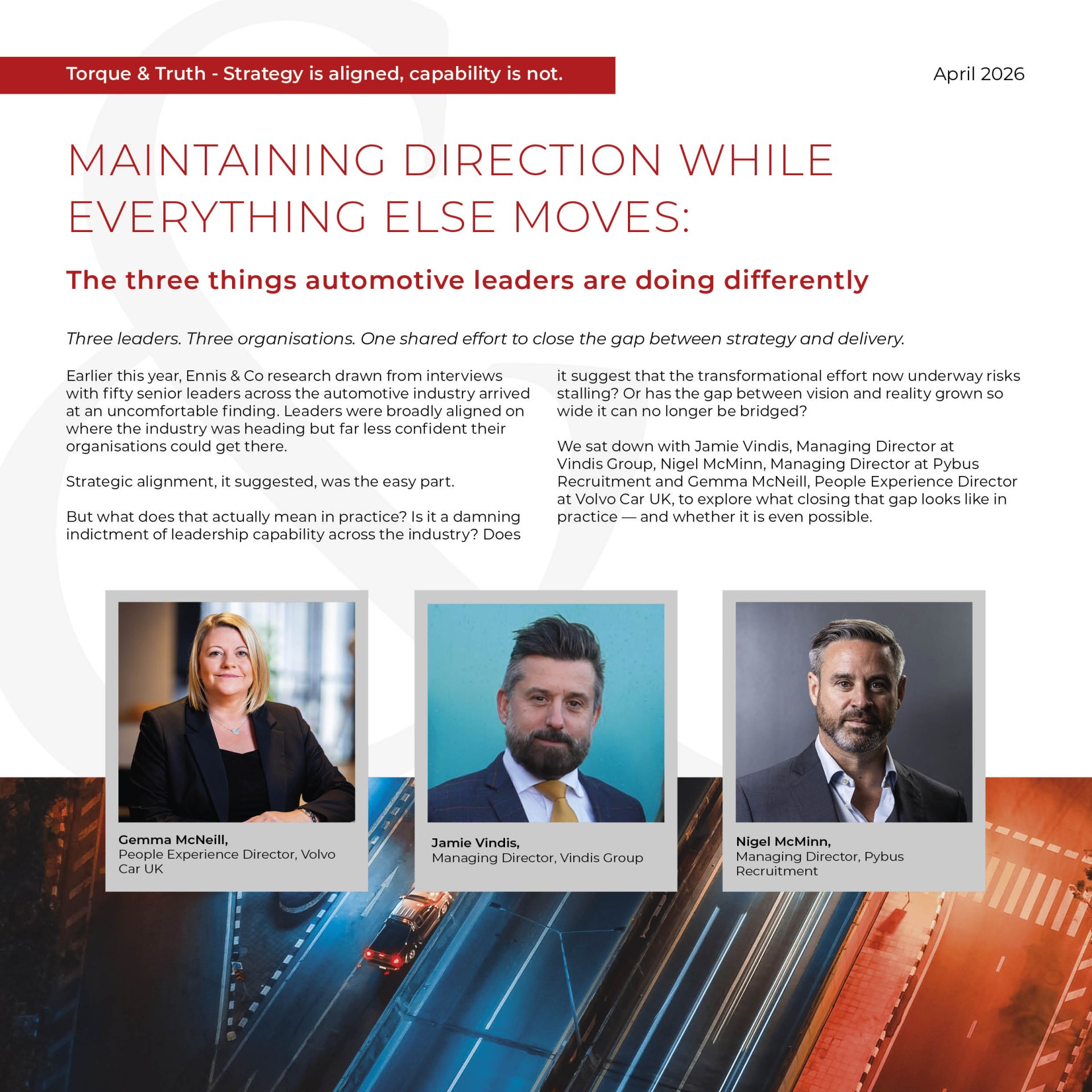

Following Lithia & Driveway’s acquisitions in the UK, Katie Macaddino, LAD’s VP for People & Culture, talks to Lynda Ennis, Co-founder and CEO of Ennis & Co Group, about different leadership styles across the retail group and the essential ingredients to be a successful leader.
You’ve maintained steady progression throughout your career. Tell me about your career journey and how your interest in HR was sparked.
Since I can remember, I have found ways to work and make money. Whether working at my parent’s school during the summer, at our family friends’ farm, or as a ‘petroleum transfer technician’ – pumping gas, I have always had a drive to work. While in college, a friend from Portland reached out and asked if I wanted to take an internship for an administrative assistant at Intel. It wasn’t the most glamourous role, but it was a way to get my foot in the door at a large, respected company.
I got hired into a permanent position quickly and, before I knew it, I had my own interns. Early on, a theme of my career emerged: I always made sure I worked for someone I respected, and that the respect was mutual. That trust and guidance from mentors was vital to my growth because you don’t always see what’s best for you from the inside.
I then moved from my admin position into the Software Group’s Operations team, so I was handling events, budgets, and metrics. That’s where I really started to thrive. I loved projects and getting things done. I also began working on HR-adjacent projects, which is where my passion grew. One standout opportunity was building a ‘women in leadership’ program for the software group, which was an area that had a lot of room for growth. The program’s goal was to increase visibility and exposure for women, build confidence, and create connections. It didn’t feel like work one bit, and I was excited every day. There was no blueprint. We knew the results we wanted and we created the pathway. I loved the creativity. I often say HR is like being a scientist: we create a hypothesis for a people or performance outcome, test it, see the results, tweak, and try again.
Later, I followed a mentor, Jason Trujillo, into the HR organisation. He believed I would be great in the role, and I trusted him completely. I moved into executive talent management, covering the top 500-600 leaders – VPs, fellows, executives, and the CEO – in the 110,000-person company. I gained experience in onboarding, high-touch development, events, promotion processes, employee relations, development, compensation, and offboarding executives. It gave me full exposure to all parts of HR, which was an incredible foundation.
It was never in my plan to do HR for life; I sort of fell into it. But I loved the work and saw the business value behind it all. The most successful HR professionals, in my eyes, are those who connect their work back to business outcomes, embracing both creativity and a scientific approach.
So, how did you get to Lithia?
I worked remotely at Intel for 15 months during Covid. The company was hiring its fourth CEO in my 15 years at the company, which usually meant a change in HR leadership as well. I got a call from Jason Bennett, an executive recruiter at Lithia & Driveway (LAD), about a role. At first, I said, ‘The car dealership?’ because I had no idea about the company’s scale, size or impact within the automotive retail industry. Jason shared the company’s ambitious growth strategy, customer-centric vision, and business successes, and I was amazed that, growing up in Oregon, I hadn’t known about Lithia’s achievements.
Lithia hires senior leaders carefully, rarely bringing in director-level roles externally. I wasn’t running from anything at the time, so I went through multiple conversations – around 11 interviews in total – to really get to know the people and company. I met the incoming head of HR, Gary Glandon, and we immediately connected. He had a similar corporate background but a ‘roll-up-your-sleeves’ mentality. That connection – as well as the various conversations with other LAD leaders Chris Holzshu, David Stork, Tina Miller, Danny Negra and members of the HR team – sealed it for me. I would have accepted the position even if it had been the role of a janitor. I remember the quote, “If you’re offered a seat on a rocket ship, don’t ask what seat. Just get on” from Sheryl Sandberg and that is exactly what I did, and I haven’t looked back since.
It appears your earlier career really shaped your approach to commercial HR in terms of understanding how the business operates and aligning people strategies with that. When you moved from tech into automotive, did you notice any differences in leadership style or how those strategies played out?
Yes, I definitely noticed some differences in leadership style and how things play out day to day.
In tech, especially at Intel, there was a real emphasis on deep technical expertise and advanced education – credibility often came from your knowledge base and analytical depth.
In automotive, leadership feels a bit different. What stands out to me is the grit and hands-on approach. Many leaders have grown up in the business – they’ve turned wrenches, run stores, and built their credibility through real-world experience. There’s a roll-up-your-sleeves mindset that I find really inspiring. It’s less about titles or degrees and more about results, teamwork, and doing what it takes to move the business forward.
How do you approach bringing different cultures and teams together during an acquisition?
It really comes down to mindset. We acquire new stores because they have something special, such as high-quality teams, goodwill within the communities, or the potential to strengthen LAD’s footprint in a particular market or region. We want them to align with our values, of course, but they don’t have to become a carbon copy of us.
The goal of LAD’s business model is to have entrepreneurial, experienced leaders at the stores so they can make the best decisions for their local teams, markets, and customers. These leaders can make nimble, quick decisions without waiting for a top-down approval. We look for high-performing leaders who can merge cultures, identify who’s going to get on the bus, and make the hard decisions to reposition or replace where needed.
At the end of the day, people are people and managers are managers. If you can get the right people on board, trust them and let them do the work, it comes full circle. For example, Sian Hall, our People & Culture Director in the UK, knows what’s best for the business and the culture there.
It’s about trusting those local leaders to do what’s right without forcing them to become chameleons. Things may look a little different here and there, but the key objective is to ensure we all support our mission of Growth Powered by People.
Lithia & Driveway are one of the largest automotive retailers in the US and have also started to grow across the UK with the acquisition of Pendragon. Do you see any differences between the style of leadership in the US versus the style of leadership in the UK?
We have so many different styles of leaders across our vast network. Our Canadian leaders are very different from those in the US Southeast, who in turn, are very different from the US Northeast. As a company, we truly thrive on those differences. Neil Williamson, Regional President leads in a way that fits what’s needed for the UK – and his leaders do the same. The fundamentals don’t change though: it’s all about doing what’s right for our business and our team members.
That said, the UK faces a lot of headwinds due to the geopolitical climate. Leaders must be ready to respond swiftly to major developments that can impact costs, operations, or workforce planning, so agility is essential.
Given the pace of change in the industry – electrification, tariffs, rising costs and so on – do you think leadership itself needs to evolve to keep up?
Absolutely. Leaders need to evolve constantly. If you’re not growing, improving, and developing yourself, the world will change without you. You must be proactive, agile and ready to shift quickly; otherwise, you won’t last long in leadership in any industry.
Automotive, though, moves incredibly fast. When I joined Lithia & Driveway, I was asked, ‘We move very fast here. Can you handle that?’ I came from tech and figured it would be the same fast speed, but I was caught by surprise at how fast it really moves. Tech tends to operate on quarterly cycles, sometimes three to five years, to see results, but in automotive, situations can change overnight. As a result, automotive works on a monthly rhythm, and margins are so tight that the smallest shift can turn profit into loss.
How do you approach developing future leaders within Lithia? And how does that compare with your perspective on leadership more broadly?
When I think about developing people, I’m a big believer in what I call the three E’s: Education, Experience and Exposure.
Education can take so many forms – whether it’s reading, listening to podcasts, taking courses, or just staying curious and learning from others. Growth doesn’t have to come from a classroom; it’s about constantly expanding how you think.
Then there’s experience – getting as many meaningful experiences under your belt as possible. That’s often where the real learning happens. We want people to keep improving constantly – one of Lithia & Driveway’s core values – by stepping into new challenges, learning from different industries, and seeing how others approach the work. Automotive is evolving into a more data-driven business, so helping people build those analytical and consumer insight skills is becoming increasingly important.
The third piece, and maybe the most powerful, is exposure. Giving leaders access to broader conversations – being in the room where strategy is discussed, hearing different perspectives, and sharing ideas – that’s where you see growth accelerate. When you put smart, motivated people together, one plus one really can equal three.
I’m also a big advocate for strength-based leadership – helping people lean into what they naturally do best. For areas that don’t play to someone’s strengths, let’s pair them with others who thrive there. Leadership isn’t about being great at everything; it’s about building teams where everyone’s strengths complement each other and move the business forward.
LE: Why do you think we rarely see CPOs become CEOs, even though their role is so fundamental to a company’s success?
That’s such an interesting question. In my view, it often comes down to the dynamics of trust. The relationship between a CEO and a CPO is built on complete transparency – the CEO needs a confidant, someone they can be fully open with about people, strategy, and even their own challenges.
If the CPO’s next ambition is the CEO seat, that can unintentionally shift the relationship. It’s not that CPOs can’t become CEOs – many absolutely have the capability – but the aspiration itself can change the dynamic.
For me personally, I’ve never seen my career path that way. The CPO role is about being the CEOs trusted adviser and partner, helping them lead through people. You lose a bit of that unique position if you’re the one sitting in the top seat yourself.
I see similar situations sometimes when placing HR Business Partners. If their next move is effectively to take over from the leader they’re supporting, it naturally creates tension. It’s hard for a leader to be truly vulnerable and open with someone who ultimately wants their job.
Will you be encouraging more cross-cultural movement and development as the business grows?
Absolutely. I think a global mindset is incredibly important. It’s one of the main ways I grew and learned during my time at Intel. Working with people from all over the world really opens your eyes to new perspectives and processes. It’s not about our way versus their way; rather, it’s about bringing them together. That’s where one plus one equals three.
We regularly have calibration and succession planning conversations with senior leaders. We talk about who might be willing to relocate to the US for a period, and likewise, which of our US and North American leaders would consider spending time in the UK. Those exchanges are invaluable. The bigger your experience and knowledge pool, the greater the insights. We already run leadership events where Neil Williamson and his UK team come to the US for strategy sessions, and our US and North American leaders visit the UK too.
Of course, there are two key questions when it comes to international moves. First, do they have the aptitude to make it valuable, and is it worth the investment? Second, do they have the willingness to do it? In my experience, the number one reason expat assignments don’t work is because of spouse or family integration. We often see people raise their hands for opportunities, but once they’ve talked to their families and understood what’s really involved, far fewer are truly willing to make that move – even within the US, let alone internationally.
As the world changes and we face more global challenges, what do you see as the essential ingredients for a good leader going forward? We’ve touched on a few already but, if you had to sum it up, what qualities do you think leaders absolutely need to succeed?
I think there are several things that make a great leader. First, humility – that sense of humble confidence. It’s such an important quality in leaders. As dollars grow, sometimes egos do too, so keeping a level head is vital.
Then, I would say it’s about relationship building. There’s no better way to learn, influence, and connect than by working with other people. If you can’t develop relationships, you’re not going to get far. You may be able to move faster on your own, but sometimes you need to slow down to bring everyone else along. I’ve seen leaders come in and forget about their peers. Ultimately, they don’t go far.
A mindset of continuous improvement and growth is also essential. Taking classes, listening to podcasts – the world, technology, and business change so fast, you need to stay proactive and keep learning. The ability to see around corners and anticipate what’s coming next is key. Agility matters too – being able to say, “What got me here won’t get me there.’ The mindset of ‘we’ve always done it this way’ is a recipe for disaster. A growth mindset will take leaders a long way.
LE: Who have been your most significant mentors or inspirations, and what was it about them which made them memorable? What lessons have they imparted that you carry with you today?
Gary Glandon has been a huge inspiration. He set up, in my view, one of the most seamless HR succession plans at Lithia & Driving, and there was no disruption at all when I took over the team. I’m inspired by his wisdom and humility. He genuinely wants his people to be better than him, and he never shuts down bigger ideas. I always felt he had my best interests at heart.
Jason Trujillo at Intel was similar. He came from an engineering background and had a very different perspective than me, but I learned so much from his business lens. I trusted him completely. He always had my back and guided me wisely, while allowing me space to grow.
Beyond that, my parents have been hugely influential. Both were teachers – my dad in special education and my mom in elementary education – and neither had an easy job. They worked incredibly hard, often sacrificing personal opportunities, to provide a foundation for me. My dad used to say, ‘Don’t ever let school get in the way of your education,’ which has stayed with me. Their dedication taught me the value of grit, sacrifice, and a work ethic.
I also think about the balance between work and family. There’s often guilt around missing your kids’ games or events, but my parents couldn’t be present at everything either. They worked hard to provide and to do well in their jobs. I remind myself of that fact with my own kids. Seeing me passionate and committed about what I am doing is just as important, if not more important, than being at every single event.