
- The hidden realities threatening transformation across the automotive sector
- The behavioural patterns holding organisations back when they must accelerate
- The practical leadership changes organisations can make to deliver their ambitions
Stockbridge 19 March: Ennis & Co has released a major new leadership report, Torque & Truth, capturing a rare, unfiltered view of how senior leaders across the automotive sector are managing the pressure of transformation.
The findings reveal a sector that understands exactly where it is heading but is struggling with the practical realities of delivery. The implication is clear: without strengthening leadership capability and organisational readiness, transformation will stall.
Drawing on in‑depth conversations with 52 senior leaders, the report exposes a consistent pattern: the sector is aligned on where it is heading, but the experience of leading is far more complex, constrained and demanding than perception might suggest.
Leaders describe a landscape defined by shifting expectations, sustained pressure, and the constant tension between ambition and organisational reality. Their reflections reveal the practical challenges shaping leadership capability today and the widening gap between strategic intent and the ability to deliver at pace.
Lynda Ennis, Founder & CEO of Ennis & Co Group, said: ‘Torque & Truth is the start of a conversation about the reality of leading automotive organisations through evolution at unprecedented speed. From R&D through the supply chain, manufacturing, distribution, retail and fleet the pressures on today’s leaders are consistent in both theme and impact.
‘This report brings together the day-to-day experience of leaders navigating extraordinary complexity. It highlights where the industry is going and what it takes to lead by exploring six key topics raised by leaders and how they are tackling them.
‘The data and insight within Torque & Truth provide a starting point for automotive industry leaders across the sector to identify how their organisations must evolve to deliver on their ambitions.’
The Torque & Truth report assesses where the 52 leaders had commonality of issues: shared tensions around uncertainty and collective energy for topics of strong conviction.
The six themes are:
- Strategy is aligned. Capability is not.
While 98% of leaders are clear on strategic direction, confidence drops sharply when the focus turns to delivery. Leaders point to friction caused by governance, talent depth, decision‑making speed and organisational structure as the real barriers to progress.
- Speed has become the new competitive advantage
The report highlights a decisive shift where speed, not strategy, is emerging as the defining differentiator. Leaders warn that slow decisions now carry strategic risk, eroding momentum and weakening competitive position in an environment where timelines are compressed, and expectations reset by new entrants.
- Cost pressure is reshaping leadership behaviour
Cost is no longer a cyclical challenge but a structural condition shaping how leaders prioritise, sequence and resource change. The report shows a clear behavioural shift toward disciplined focus, sharper trade‑offs and doing fewer things better.
- AI is everyone’s priority but no one’s strength
Despite broad agreement on the importance of digital capability, confidence in execution remains mixed. Legacy systems, competing priorities and a leadership skills gap mean AI is often supported in principle but not yet integrated into everyday decision‑making.
- The leadership pipeline is not ready for what’s next
The report reveals low confidence in near‑term succession, with many leaders noting that traditional career paths have not prepared future leaders for the complexity and pace now defining senior roles.
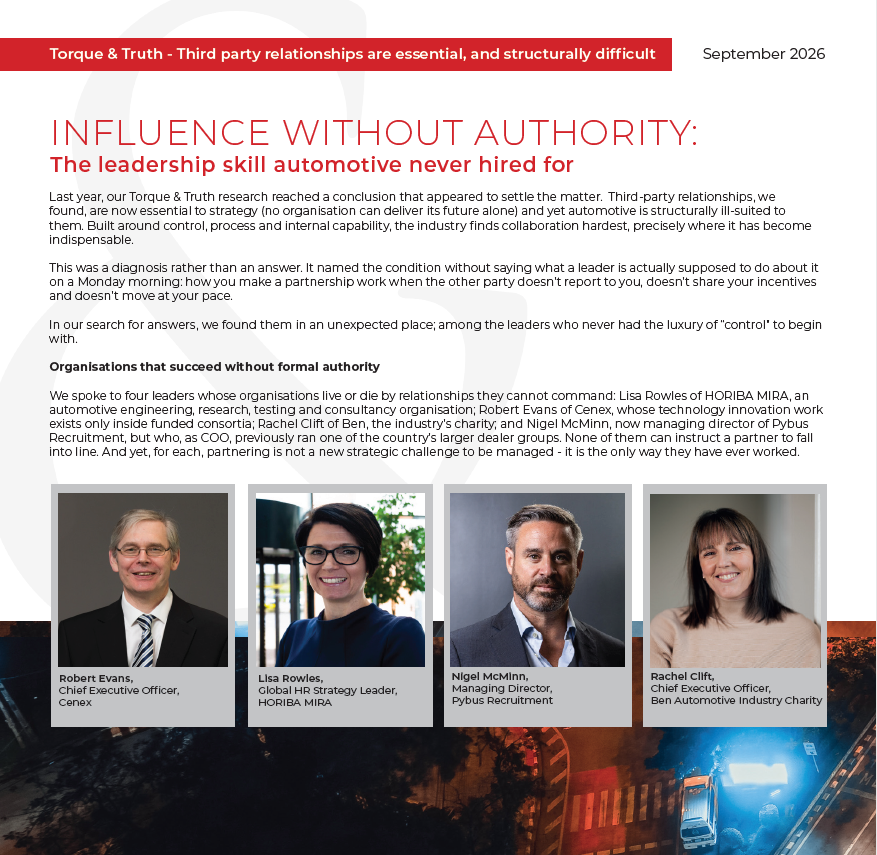
- Third party relationships are essential and structurally difficult
Leaders rely on external partners for critical capability, yet describe partnerships slowed by misaligned priorities, governance friction and incompatible ways of working. Collaboration is now vital, but structurally hard to execute at pace.
Behavioural science adds a deeper layer of insight
Ennis & Co partnered with Lumina Learning, whose behavioural data provides a sector‑wide benchmark for how automotive leaders prefer to think, decide and lead.
The data reveals a leadership population strong on clarity, control and structured decision‑making, but less naturally inclined toward adaptability, experimentation and rapid iteration. These behavioural patterns help explain why organisations aligned on strategy still struggle with pace, digital adoption and execution.
Stevie Fine, Lumina Learning Partner & Managing Director, Inspire, who assessed the Lumina data said:
‘The patterns we see are behavioural as much as operational. Leaders have real strengths in rigour and purposeful decision‑making, but those same strengths can limit adaptability when speed and experimentation are required.
‘Leaders need to leverage every advantage including psychological insight to create rapid shifts in how individuals and teams create new mindsets that deliver increased impact and improved performance.’
Ennis & Co, together with Stevie Fine and the team at Inspire, provide leadership advisory services that help organisations interpret these findings, build capability and develop leaders equipped for the realities of today’s environment. Through practical frameworks, behavioural insight and tailored support, both organisations help leadership teams turn reflection into action.