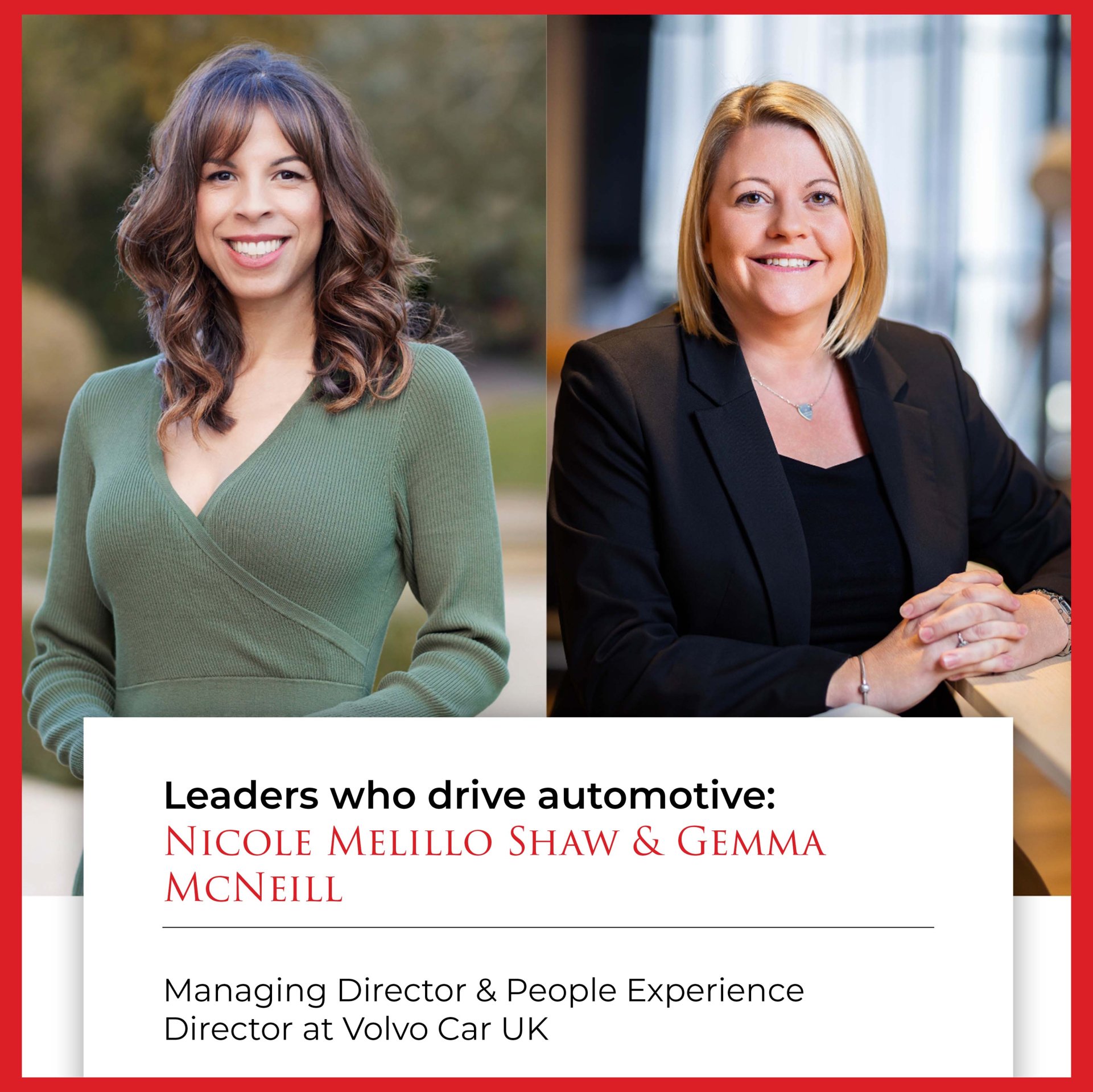
Nicole Melillo Shaw, Managing Director, and Gemma McNeill, People Experience Director, have worked closely together at Volvo Car UK for more than five years. They talk to Lynda Ennis, Co-founder and CEO of Ennis & Co Group, about Volvo’s famously people-first culture and the importance of leading with honesty and authenticity.
You’ve both taken unconventional routes into automotive, bringing together experience from sectors including telecommunications, pharmaceuticals, manufacturing, gaming, FMCG and retail. What were the key decision points that brought you to your current roles?
Nicole Melillo Shaw: For me, it started with embracing the opportunity to do something different. My background is in healthcare and FMCG, but when my role moved overseas, I paused to ask myself, ‘Do I want to stay on the same path or evolve in a new direction?’
Looking back, my most successful moves have always involved a value exchange – learning something new while bringing something unique. At E45, for example, they wanted healthcare experience, which I had, but the role also allowed me to learn about media, TV and working with major retail buyers, which was a great mix of contributing and developing. When I first moved into automotive, I noticed the consumer wasn’t always the main focus as many people within the industry hadn’t actually bought a car for years. By asking questions and putting myself in the customer’s shoes, I could bring valuable insights – for instance, understanding the anxieties people feel when buying or driving a new car.
The transformation to a direct-to-consumer model was already planned at Volvo Car UK when I joined, and there was a recognition that it was pivotal to get closer to consumers. My input brought a fresh perspective. I’ve always been passionate about heritage brands and making them relevant to new audiences. Just as I helped move E45 into mainstream skincare, we’re now championing our legacy in automotive, while embracing electrification. That parallel made this role especially exciting.
Gemma McNeill: For me, the attraction of Volvo was very much about the company’s culture and values: personal, sustainable and safe. From an HR perspective, I wanted to work for a business that truly values people – Volvo is a human-centric business and recognises that people make the difference.
Exploring the company and understanding its culture was very attractive. We were entering a business gearing up for change, and people were a huge part of that transformation. HR has always been my career, and I’ve worked across different industries. Automotive was interesting because it was new and different for me. I liked cars, but that wasn’t the main factor. For me, it was about the company’s values and the opportunity to lead an area the company fully believes in and supports. Being part of a business where your contribution directly shapes culture and people strategy was the key draw for me.
You both have a really unique and interesting dynamic in how you work together. Looking ahead, how do you see your roles evolving as leaders to maintain that balance between delivering strong commercial results and ensuring you have the right people and leadership in place to achieve them?
NMS: I often talk about making sure you see people at their best. You can’t develop anyone without understanding what they stand for and what they bring. In this industry, we can sometimes be guilty of a hierarchical setup where only senior voices are heard. Broadening that conversation helps us understand people’s perspectives and creates more opportunity for the future.
As the industry evolves, especially under the direct model, we’re bringing in a different profile of employee, which means adapting how we make people feel valued. From a leadership standpoint, it’s about finding that balance and magic combination between experience and fresh thinking.
Competition is more fierce than ever – with new entrants, greater diversity and more demanding consumers – all against a backdrop of shifting government direction, it’s critical that we represent the growing consumer base we are trying to attract and retain. At Volvo, for example, we’ve embraced lifestyle representation. Many women want to see female leaders who are also mothers. It’s about connecting through lifestyle and lived experience, not just product performance. To be truly consumer-first, we must be representative, understanding different groups and experiences. Operationally, taking orders and carrying out deliveries are hygiene factors, but how we do it ultimately defines quality and retention.
GM: Adding to that, how we operate really reflects our people-first approach and the culture we’ve built at Volvo. The way relationships evolve is critical. Everyone needs to be considered from a broad perspective, and that’s what helps us stand out in such a competitive market. At the same time, business-as-usual must run smoothly for both consumers and employees. It’s about having the right people, in the right roles at the right time. Ultimately, evolving successfully comes down to two things: keeping people high on the agenda and retaining talent. The companies that do this well are always the most successful.
If you were advising future leaders who aspire to build a corporate career, what should they be thinking about now to prepare and equip themselves for the future? Is it possible for leaders to ‘have it all’ in terms of their professional and personal lives, or is that a myth?
NMS: I think two of the most important qualities are vulnerability and humility. You need everyone leaning in to build momentum in such a challenging world, and that won’t happen if people think you’ve got everything perfectly together. I’ll often ask questions even if I’m 80% sure of the answer because it shows I’m willing to ask something basic, and that gives others permission to do the same.
The phrase ‘having it all’ is so pressurised. It makes people feel they must prove they can do everything, but nobody can. It’s really about timing and knowing what needs to flex at any given moment. Right now, work is positive. September was great and the UK is on the global agenda. But I haven’t seen my daughters much this week, so I’m not winning at home. It’s rare to have your best month at work and at home at the same time, and that’s okay. Sometimes you just need to accept a tough period and ride it out.
I’m also honest about perception. People will sometimes say ‘she’s so organised’ when talking about me, but I explain why. It’s because my husband and I meticulously plan to make it work. It might look easy, but it isn’t. It’s not easy for anyone.
GM: The powerful thing about that is recognising that sometimes you can handle the job, but life outside work can be challenging, like the school run with a 10-year-old, at times, that can be harder than a challenging situation at work. What’s so valuable is the honesty and vulnerability we bring. As Nicole says, we don’t pretend everything is fine if it’s not. Creating that kind of environment is vital because it shows people that nobody is perfect and everyone can struggle at times, that’s OK – showing vulnerability is a strength.
For our employees, that authenticity means they’re not afraid to be human. When people feel safe to be themselves, they’re more creative, willing to ask questions, unafraid to make mistakes and confident they’ll be supported. It’s a simple but powerful principle: honesty and vulnerability aren’t weaknesses. They’re what enable people to give their best, push boundaries and truly innovate.
Your culture emphasises inclusivity and humanity, but leadership also requires resilience to handle criticism and high-pressure decisions. How do you prepare future leaders for the realities of the business while maintaining that human, inclusive approach?
GM: It’s interesting you mention resilience, because in our leadership development programme at Volvo Car UK, one of the modules is dedicated entirely to it. We focus on understanding and building resilience because it’s essential for leaders to navigate today’s complex and challenging environment.
Other modules focus on leading with data and combining experience with insight to make well-rounded decisions. Another key area for us is feedback – both giving and receiving it. We coach and train our leaders extensively on how to provide constructive feedback that lands respectfully, and how to take feedback on board and respond effectively. Resilience, combined with these skills, is a core part of preparing our leaders for the landscape ahead.
NMS: I would add that launching the direct-to-consumer model with the world watching required an immense amount of resilience. We were navigating something unprecedented, often without clear answers, while still delivering results and managing day-to-day operations. It created a lot of closeness within the team. We were vulnerable, but that vulnerability helped us come out stronger. Throughout the process, some of the softer leadership skills naturally emerged.
How do you identify potential future leaders within Volvo?
GM: That’s an interesting question. We have a strong set of competencies we look for from a Volvo perspective. The company really values people who are human-centric and people-first. It’s about authentic leadership – building trust and creating a culture where people feel safe to speak out.
To achieve that, our leaders need to be highly self-aware and able to adapt their style to meet the changing and diverse needs of their teams. That ability to flex is so important. It requires emotional intelligence and a genuine understanding of what drives and motivates people. Everyone is different, and we all have different ways of working, learning styles and traits. Great leadership is about recognising, valuing and adapting to those differences.
NMS: I totally agree. For us, it really comes back to that human-centric style of leadership – valuing differences and creating an environment where people feel motivated and engaged. The people focus within Volvo feels like it’s just getting stronger and stronger. It’s no longer acceptable to focus only on what we do and not how we do it. The behavioural conversation is a very live one. As leaders, we’re responsible for so many people’s wellbeing at work – how they feel, how they grow and how they’re treated.
Our job is ultimately to enhance people. That doesn’t mean it has to be hearts and flowers every day, but it does mean nurturing them and creating an environment where they develop. Even if someone is only with us for a short time, they should still leave feeling they’ve learned something and were respected. Like any relationship, if it comes to an end, you shouldn’t feel worse leaving than when you arrived. That’s such an important part of our culture and our brand.
From your experience in other sectors, are there lessons or approaches to leadership that the automotive or mobility industry could learn from?
NMS: I’ve experienced very different cultures across sectors – from rigid, hierarchical and controlled environments to process-heavy setups and everything in between. Both extremes have lessons to offer. In the more structured environments, decision-making was robust. For example, every Monday, people were exposed to the leadership team through project updates and clear decision-making processes. Everyone knew where leadership stood and how to access them, which prevented missed opportunities and encouraged people to speak up.
Here at Volvo, we have the people skills and culture, but there’s an opportunity to introduce more structured frameworks. Since joining, the UK organisation has doubled in size, so it’s critical that everyone understands what we’re doing and feels connected. Creating more structure and increasing visibility and access to the management team helps people engage, present their ideas and feel part of the bigger picture.
GM: I’ve worked across five different industries and while pace, size, and context might differ, some foundations remain the same: purpose, direction, clarity and ensuring everyone understands how they contribute. Communication underpins all of that. It’s about sharing information in a way that people understand, learn from and can act on, while also encouraging them to challenge thinking and offer new perspectives.
NMS: Where leaders often go wrong is assuming they have to know everything. If you think you must know all the answers, you’ll only stay in your lane, because it feels unsafe to be vulnerable. That often leads to small incremental changes rather than real innovation. People simply replicate what they already know.
The beauty of leadership is understanding it’s broader than that. If you can accept not having all the answers, you can be vulnerable and ask questions openly. When I joined, I didn’t fully understand PCH or PCP*, despite having bought so many cars. I admitted that and asked how to make it simpler, so people felt secure. That vulnerability enabled the business to move forward. For me, skills matter more than knowledge. Knowledge can be learned but the ability to adapt, ask questions and navigate uncertainty is what truly drives leadership impact.
When starting out in your careers, did you both know you wanted to become a Managing Director or a People Director, or did your ambitions develop over time?
GM: I think I knew from an early stage. I have always been interested in people and behaviours. Curious about what motivates and drives people, how people contribute to business success and improve consumer experience. Here at Volvo Car UK my role combines the employee experience with consumer experience, this combination is really exciting.
NMS: I wasn’t necessarily aiming for the title, but definitely the leadership level and the ability to make an impact. I reflect on this a lot. I used to watch films like Baby Boom or courtroom dramas where there was always a woman who was overlooked or under-estimated. I loved seeing her power and presence, and it really inspired me. I wanted that kind of influence – the ability to lead, make decisions, and create impact. So yes, I’ve always had that vision.
What advice would you give to aspiring leaders of the future?
GM: I would always say: be patient. We learn new things every day, we have new experiences every day, this all contributes to how effective we are as leaders. I see people who want to climb the ladder maybe too quickly, and sometimes they aren’t fully ready. Drive and ambition are important, but timing matters. Things tend to work out best when you’re truly prepared. For me, the last six years have been incredible in terms of growth, developing into the kind of leader I’ve always wanted to be. If you’d asked me 10 years ago, I wouldn’t have recognised that, I thought I was totally ready. And I hope to be an even better leader 10 years from now.
My advice is to enjoy it in the moment, keep learning, stay curious, keep progressing and be authentic. Don’t try to be what you think others want you to be. Be yourself, embrace growth and learn from every experience.
NMS: Two things come to mind. First, don’t get obsessed with titles. You’re better off focusing on work you’re passionate about and doing it well. Good leaders spot people who are skilled and passionate, and they want to keep them in the company. It’s not about the job title but about doing work you enjoy. Too often, people get stuck in roles they dislike because of salary or status, but that doesn’t lead to growth or fulfilment.
Second, while I’m competitive, I’m not outwardly so. It’s important to have a bit of that drive, without focusing on what others are doing. Everyone has different agendas, many of which you don’t know. Ultimately, focus on what drives you, what you’re good at and what you’re passionate about. Don’t get distracted by things that don’t help you grow.
In an industry full of strong and successful leaders, who has inspired you both the most?
GM: Nicole and I have worked together for five and a half years now. I was always inspired by bold and successful women in films when I was younger, but working with Nicole has cemented my view of what leadership should be. Having a voice, sharing your view, keeping people high on the agenda and ensuring people are valued – that’s huge. In HR, if people aren’t high on the agenda, it’s hard to feel you’re making a difference. It takes a leader who shows you the power of having a voice and the confidence to use it, to realise the importance of authenticity, confidence and self-belief. Nicole has opened my eyes and I have developed my approach as a result.
NMS: That is such a hard question because there isn’t one person. There have been inflection points along the way in my career, often examples of ‘in spite of’ certain people rather than ‘because of them’. The people who made me feel written off have been just as important in shaping me as those who have inspired me. One person who stands out as an inspiration is the former CEO of GSK. She had four children, led a global company and was a real force to be reckoned with, without being on any kind of mission to prove herself. From a different angle, my husband’s unwavering support has been equally inspiring. It’s not always the person in the spotlight who influences you. Sometimes it’s those in the background who make the biggest difference.