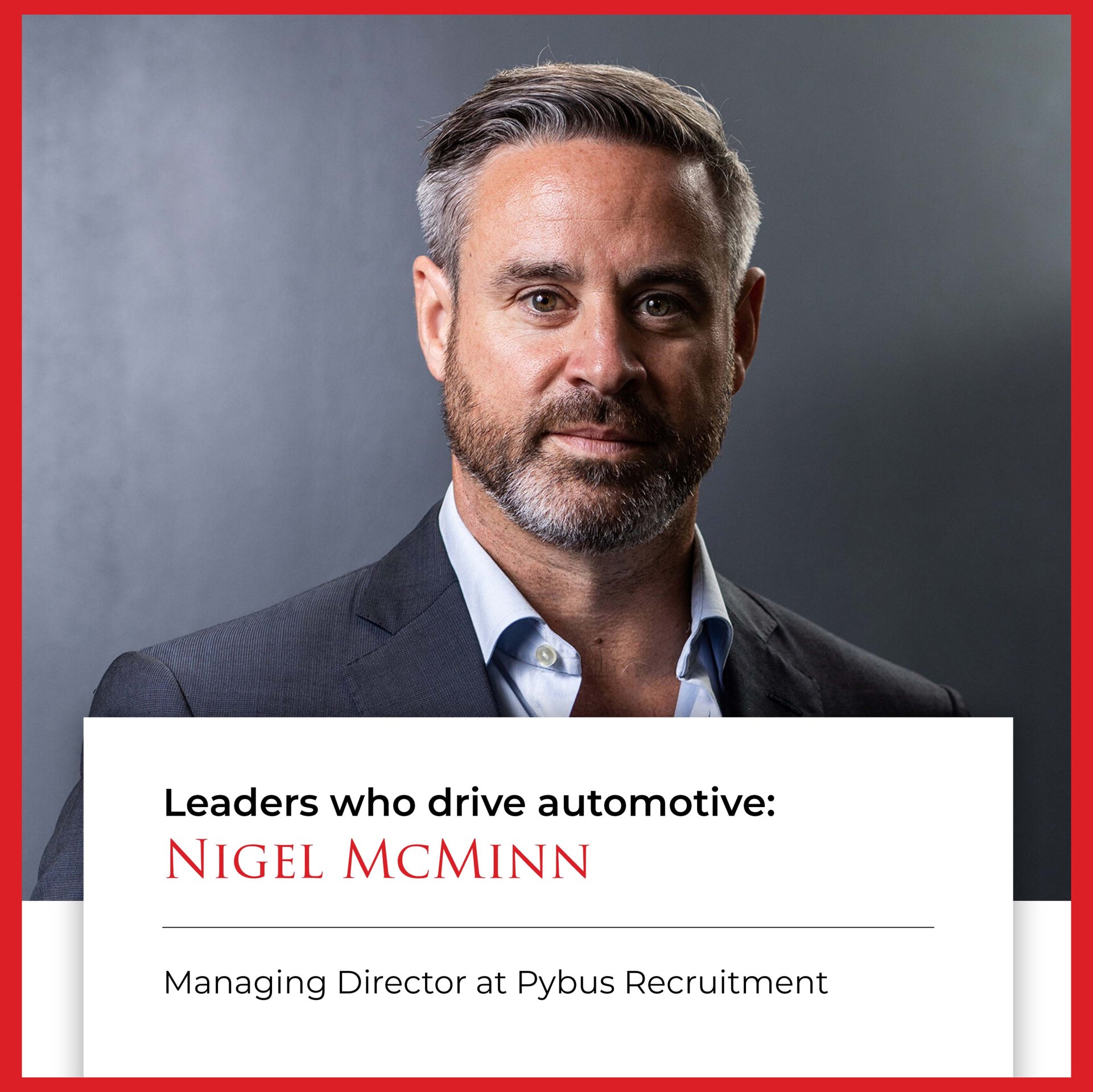
Inspired by his father, Nigel McGinn learned the importance of hard work, integrity and treating people with humanity and respect. He tells Al Clarke about the values he has carried with him throughout his successful leadership career in automotive retail.
You’ve worked for some big players in automotive retail, including Reg Vardy until the buyout, and Lookers more recently. Talk me through your career journey and some of the experiences that have shaped your leadership style. What were some of the pivotal points in your career?
On reflection, I was influenced by my dad. He had worked incredibly hard for a lot of reasons, but primarily because he’d been brought up by a single parent. He left school at 15 with no qualifications and went into the bank – Martin’s Bank, which later became Barclays. He started work before even taking any school exams and worked his way up through sheer determination, hard work and personality. He stayed with Barclays all his life and ended up as a very senior manager, ultimately running the Durham branch, which is how our family ended up in the North East. He managed a network of five branches and around 200 staff.
I saw that and thought, ‘Wow, that looks great – to be running a business with so many people.’ I suppose I grew up seeing my dad as a respected leader – a commercial boss. I didn’t really understand the nuances of banking but I admired the leadership side of it. I think that is probably why I always wanted to run a business. That was really what was in my head in those early days. I didn’t have a clue how I’d get there, but I knew that’s what I wanted to do.
I found myself at school actively wanting to do a degree and then to go into accountancy because I saw it as a further qualification and a route into business. I pretty much knew I didn’t want to be an accountant; I just wanted the broader business qualification.
You studied economics and then joined PwC. It sounds like you wanted to be a leader and were learning the foundations. How did you make that decision to go into PwC?
I did a four-year degree in Edinburgh, and, at the end of my third year, I found out about Price Waterhouse’s STEP scheme – the Student Training and Experience Programme, which ran for eight weeks in the summer. I applied and somehow got in as the Newcastle office representative.
Initially, I thought it would look good for the ‘milk round’, but they were actually assessing us throughout. Most participants, including me, were offered training contracts at the end of the summer, so I went into my final university year already having a job.
PwC were ahead of their time. Their summer training courses filmed and analysed our behaviour, teaching presentation skills and group dynamics. One memorable exercise tested memory and networking under pressure. We had 20 minutes to get round a room of 50 people and remember as many people as possible by name and some details about them. It was brilliant training and made my decision to join them an easy one.
Your next move – to Reg Vardy – took you into automotive. Did you have a yearning to work in the car industry, or did that just happen?
No, like so many things that have happened in my career, it was really just right place, right time. I’d always had an interest in cars because my dad had Autocar or Auto Express by his bedside, and when he’d finished with them, I’d read them.
For a bank manager, he had some fairly racy company cars – a red Alfa Romeo GTV, for instance, and before that an Opel Rekord. He loved his cars, and I think that must have bled into me a bit.
We used to go up to the Reg Vardy specialist dealership between Durham and Sunderland at a place called Houghton-le-Spring. They had Rolls-Royce, Bentley, Ferrari, Maserati, Aston Martin and Jaguar – all in the same showroom. It was a fantastic toy shop. We’d sometimes go there on Christmas Day, just to look through the windows at all the exotic cars. So, there was always something deep inside me that liked the product. I’ve always believed that if you work with something you genuinely like, it doesn’t feel like hard work. So, when a job came up at Reg Vardy, after I qualified with PW, I thought, ‘Why not?’
Was it a strategic decision? Did you think, ‘I’ll join this organisation and work my way up?’ Or did you just go with the flow?
No, I definitely went with the flow. I had this sort of naive objective in my head back then that if I could earn £30,000 by the time I was 30, I’d be doing really well. So ‘30 by 30’ was my short-term objective.
When I joined Reg Vardy, I was on around £23,500, having qualified as an accountant on slightly less. I had absolutely no idea where it would take me, and I certainly had no intention at that stage of jumping the fence into operations.
I joined Vardy as a financial analyst at their head office, working for a great guy called Ged Murray, who’s still a friend today. Ged was, I think, the youngest PLC finance director in the country at the time. He was super bright, engaging and inspiring – a very hands-on CFO. And of course, there was Sir Peter and Graeme Potts. Between the three of them, it was an incredible leadership team. I didn’t know where my career was heading; I just knew I was in a great environment and learning a lot.
What opportunities came from that? Because it’s not always natural to move from finance into the front line of the business.
No, absolutely, it’s not. But because I was on the analysis side of accounts rather than the preparation side, the output of my work was craved by Sir Peter and Graeme Potts. Ged’s team was creating the numbers; I was analysing them and feeding them to the operational leaders.
At that time, there was no divisional structure, with around 30 dealerships all reporting directly to head office. So, most of my interaction was with the operational team rather than finance. From that, I gained a much deeper understanding of what they were doing with the numbers and how they used analysis to make changes in the business.
My role naturally became more commercial. I started following them around, seeing what they did with the output of my analysis. Over time, that evolved into taking on negotiations with finance companies and warranty suppliers, doing investment appraisals for acquisitions and so on. It eventually morphed into what was formally called ‘commercial PA to the chief executive’. And at some point, they said to me, ‘Well, you clearly understand how a dealership works. Why don’t you go and run one?’
Why did you go and run a dealership? Coming from a professional finance background, how did that first operational role feel?
It was undoubtedly one of those scary, pivotal moments for me. Reading numbers and understanding them is one thing, but it’s another thing actually running a business and leading a team of people. It was Sunderland Nissan, which was the dealership next door to the head office of Reg Vardy. Being on the doorstep of the Nissan factory helped, but it was a very well-run dealership and highly profitable. I joined the dealership following an excellent GM, Brian Park, which was a double-edged sword, in a way, as it meant any mistake would be noticed.
Expenses were tight, pay rises long overdue and the building lacked investment. I knew the cost base would have to rise slightly. I remember within my first week, a great salesman, Bob Grazier, said he would leave if he couldn’t work shorter hours – a potential precedent. Panicking, I called my boss, Neil Dunkley, who told me to close my door, breathe deeply and trust the team to replace his numbers. I addressed the situation directly, called Bob’s bluff, and he stayed. What a lesson that was.
I had lots of difficult situations like that and leading a team was a steep learning curve. I made mistakes, but I never pretended to know it all. I asked my team and my boss for guidance, and that honesty proved invaluable in learning that leadership isn’t just about numbers – it’s about managing people to get results.
When you made the decision to take that job, knowing there would be pitfalls ahead, how much of it was your boss guiding you through it, and how much of it was your own desire to step up?
It was definitely both. Neil was incredibly supportive. Had I had a boss who didn’t want me around, an old-school motor trader who didn’t want this sprog of an accountant being given a chance, it would have been very difficult. The fact that Neil wanted me to succeed was a really big part of it.
But yes, there’s no doubt that I was prepared to get my sleeves rolled up. I was prepared to work Sundays as well as Saturdays. I was prepared to speak to customers, sell cars, close deals and finalise the figures. I put myself in all sorts of situations where I was completely out of my comfort zone.
Looking back, I suppose some of the very experienced GMs who had come up through that sales route probably didn’t do those things because they’d been there and done it. They didn’t need to prove anything. I was still learning, so part of it was about educating myself, part of it was about getting right in the thick of it to help the team, and part of it was proving to them that I wasn’t afraid to have a go.
I think, in my naivety and determination to learn and do a good job, I found myself as an integral member of the team – what you’d probably call ‘servant leadership’ today. I saw my role as supporting them to do their jobs. I treated them as the experts, because they were.
How did your leadership style evolve as you progressed from managing a single dealership to running regions and eventually becoming an MD or CEO?
Early on, there was some pressure from my peers at Reg Vardy to adopt a command-and-control style – telling people off, ‘banging the desk’ – because that was common 25 years ago. But my instinct was different. I believed it was more effective to address issues without stripping people of their dignity. You can hold people accountable without shouting, and I’ve always aimed to be myself while respecting the people I lead.
Anybody in a senior leadership position with a long career would be lying if they said it always went smoothly. It wasn’t all plain sailing for me in Scotland. There were a lot of acquisitions to integrate, and the Vardy name wasn’t well known up there. Arnold Clark was a dominant player, so there were lots of challenges along the way. But all of that makes you more experienced and hardens you up. For all the difficult moments, I genuinely enjoyed being in a leadership position.
How did you end up at Benfield as MD?
I met the Squires family a few times and, unbeknown to me, they’d probably been following my career at Reg Vardy. So, when they needed an MD, perhaps they thought I was a reasonable candidate.
The prompt to move came when Vardy was taken over by Pendragon. Initially, I saw some positives from a career perspective, but it became obvious that Pendragon was culturally very different from Vardy and I realised I’d be better off moving on. I left within six months. I couldn’t pretend that I liked it, as my people knew me too well. I always tell people that I joined Reg Vardy, but I never left them; I left Pendragon.
Benfield was one of several companies I was talking to at the time I decided to leave, but I felt that it was the best fit for me, especially considering my contacts with good Reg Vardy people in the North East, and my family being close by with our new baby boy.
What would say were some of the differences in terms of leadership as you moved from a regional director role into managing director?
It’s a leap that many seem to struggle with. As an industry I feel we don’t seem to be very good at taking people from that divisional, franchise director level up to the MD and CEO roles. Our industry seems to be following football management by simply recycling the same old names. I often wonder, ‘Where is the next crop of people doing what I did?’
In my experience,the essence of a group operations director, managing director or chief operating officer remains the same – managing people who run dealerships. The core of the managing director role was exactly what I was used to from my prior experience as a regional director at Vardy, in a decentralised culture, which prepared me to make decisions on stock, marketing and people.
My accounting background made corporate responsibilities – managing finance, banks and lawyers – less intimidating. The leap felt manageable because I was familiar with the fundamentals, but the scale and complexity required adaptability and confidence.
How has your career progression affected your personal life and work-life balance?
Looking back, I realise now how much I sacrificed – family, social life, even health. People around me got used to it; my wife and friends accepted that I was consumed by work. At the time, I didn’t consciously choose it. It just came with the territory. But it wasn’t healthy, and I only fully understood that after stepping back.
A turning point was my 50th birthday, when my best friend entered us both in a half Ironman. That forced me to prioritise health, scheduling gym sessions before meetings, and creating discipline in my day. It showed me that with careful planning, balance is possible, though it’s challenging at senior levels.
You mention on LinkedIn that ‘happy colleagues create loyal customers and shareholder value’. How do you translate that philosophy into how you lead teams and businesses?
I treat it a bit like being a parent. Leadership starts with your own behaviour – integrity, honesty, consistency, challenge and support. If the most senior people closest to you see that behaviour, they tend to emulate it, and it then cascades through the organisation.
I also believe in ‘diving to the bottom of the pool’ rather than just swimming across the surface – visiting dealerships, workshops, parts teams – to understand what’s really happening. It’s not just about formal reviews with management; it’s about talking to people and unearthing issues, understanding the customer and colleague experience and addressing problems as they become clear. That accessibility and involvement on the front line helped embed good culture and values throughout the organisation.
You’ve worked with many different leaders. What, from your experience, makes a good leader?
For me, it starts with the human touch. My dad taught me from a young age to look people in the eye, shake their hand and use their name. Remembering names and treating people as individuals is the core of an effective leadership style. I saw that with Sir Peter, Graeme Potts, John Squires and Andy Bruce.
Other aspects include having acute judgement and knowing when to push and when to slow down, when to listen to trusted voices and when to be brave enough to admit mistakes. Leadership, I think, is about balancing clear direction with responsiveness to feedback.
Do you think pathways to leadership have changed?
I think the pathways are still there. In automotive, you can come in at the ground floor in any role and progress to senior roles. I would say most franchise directors and chief executives in motor retail have risen from the floor up. Of course, it requires someone to take a chance on you, but with support and the right character traits, it’s entirely possible. Our industry is still brilliant for that.