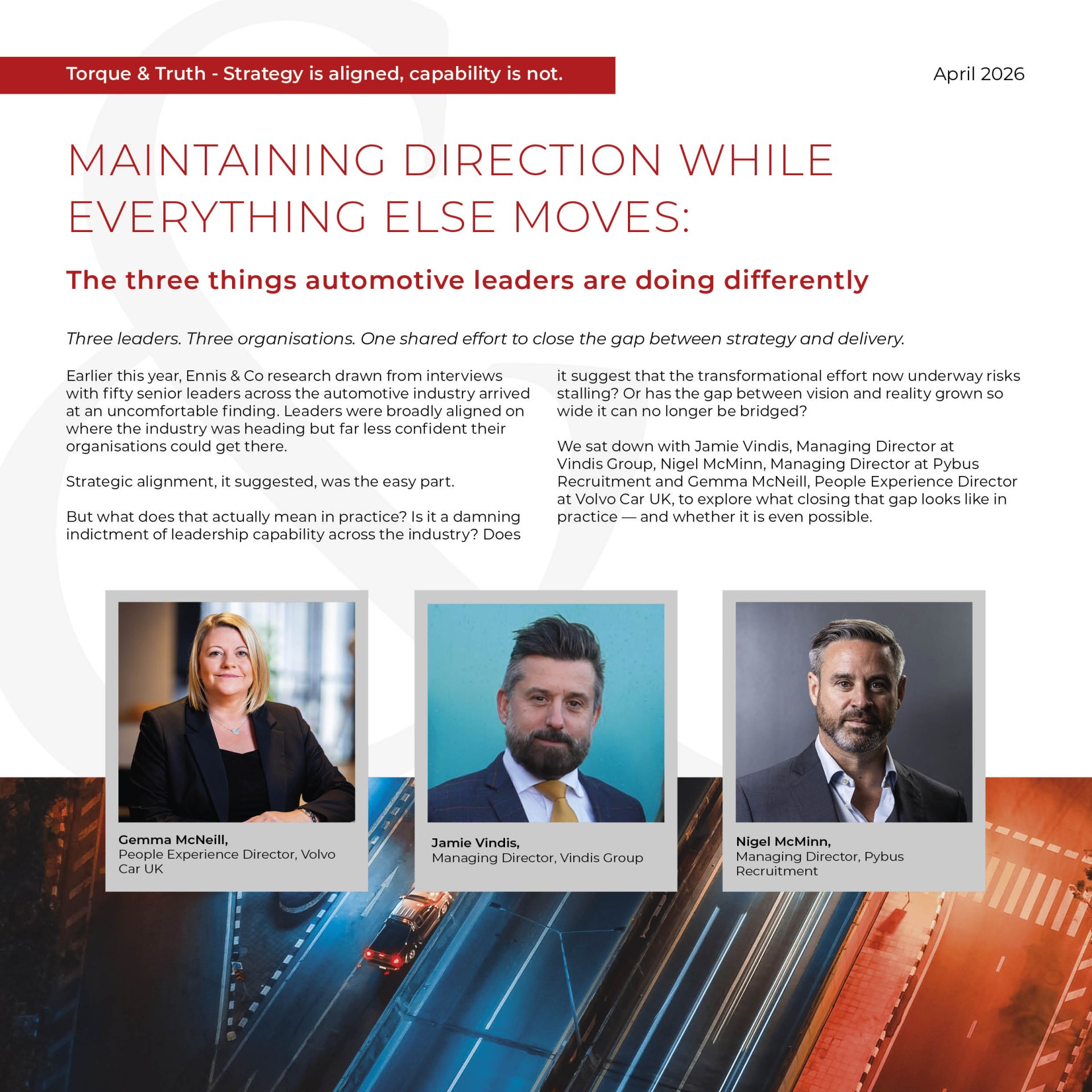
Three leaders. Three organisations. One shared effort to close the gap between strategy and delivery.
Earlier this year, Ennis & Co research drawn from interviews with fifty senior leaders across the automotive industry arrived at an uncomfortable finding. Leaders were broadly aligned on where the industry was heading but far less confident their organisations could get there.
Strategic alignment, it suggested, was the easy part.
But what does that actually mean in practice? Is it a damning indictment of leadership capability across the industry? Does it suggest that the transformational effort now underway risks stalling? Or has the gap between vision and reality grown so wide it can no longer be bridged?
We sat down with Jamie Vindis, Managing Director at Vindis Group, Nigel McMinn, Managing Director at Pybus Recruitment and Gemma McNeill, People Director at Volvo Car UK, to explore what closing that gap looks like in practice — and whether it is even possible.
Keeping teams anchored around a clear direction
Ask Jamie Vindis how his organisation approaches strategy and he’ll push back (gently, but deliberately) on the word itself.
“Strategy used to be a fixed, determined thing,” he says. “I think today it [business strategy] needs to be an element of the overall vision. It’s no longer about the action plan. It’s all about direction.”
In an industry where conditions shift faster than any plan can anticipate (new competitors, margin pressure, regulatory change) Vindis’s view is that organisations which anchor themselves too rigidly to a strategy document are setting themselves up for a fall. What they need instead is something more durable: a clear vision that doesn’t need rewriting every time the market moves.
For Vindis Group, that means separating the long-term direction (defined as being genuinely stable, revisited perhaps every five years) from the shorter-term operational decisions that inevitably flex in response to circumstance. The vision becomes, in his words, “the anchor point. The tethering point for everything else to flow from.”
Gemma McNeill describes a similar approach at Volvo Car UK, (though the architecture is necessarily more complex). As a National Sales Company sitting within a global organisation, the strategic challenge isn’t just about communicating direction internally – it’s about translating a global agenda into something locally meaningful without losing coherence in either direction.
At Volvo Car UK the answer is a two-lens framework: perform and transform. Perform covers operational delivery – the targets, volumes and consumer experience metrics that constitute day-to-day business. Transform addresses the shift underway across the business and wider industry: what automotive retail looks like in five years, how the direct-to-consumer model evolves, and what a genuinely premium consumer experience requires of the people and processes behind it. The clarity of that distinction, McNeill explains, is what makes strategic communication possible.
“Clarity is the key piece,” she says. “It needs to be easy to understand and well understood.”
The harder challenge, as Nigel McMinn observes from his work across the talent industry, is that clarity at the top frequently fails to survive contact with the middle of an organisation. “It takes time to slow down and consider all this stuff,” he says, “rather than just keep doing the same thing and largely getting the same outcome.”
Vindis is clear-eyed about this too. A communicated vision that lives only in emails and presentations is, he argues, worse than useless – people spot the gap between rhetoric and reality quickly, and cynicism follows.
“It has to become part of your language,” he says. “Part of your thinking. Part of your process. And then, at the end, part of your communications as well.”
What that looks like in practice is less about formal cascade and more about relentless, consistent behaviour from leadership. The vision must show up in how decisions get made, how performance is discussed, how people are developed – not as a programme, but as a habit. Knowledge and insight can feel like progress without actually being progress. It is only the disciplined, ongoing repetition of aligned behaviour that makes a direction genuinely cultural.
Simplifying execution: less activity, more focus
If the first challenge is keeping teams anchored around a clear direction, the second is resisting the instinct that kicks in when things get difficult – the urge to do (and control) more.
Vindis is direct about this. In his experience, the default response to pressure in automotive is to reach for additional activity: more KPIs, more reporting, more oversight. The logic is understandable. When results disappoint, it feels like control. In practice, he argues, it achieves the opposite.
“When there are so many KPIs, they can’t be KPIs anymore,” he says. “They’re just PIs.”
An organisation drowning in performance indicators isn’t managing performance – it’s generating noise. And noise, particularly when it lands on already-stretched front-line teams, doesn’t drive improvement. It drives exhaustion.
Nigel McMinn puts it plainly. “The management teams at the front line can be overwhelmed by measurements,” he says, describing a pattern he has seen repeatedly. Brand partners impose output metrics, group functions add their own layer, and the people closest to the customer end up buried. “There’s a risk that people are set up to fail. It’s not that we’re not communicating or not working.”
The response at Vindis Group has been deliberately counter-intuitive. Rather than managing outputs more intensively, the focus has shifted to the quality of inputs – specifically, the rigour and clarity of the plan agreed before execution begins. If the plan is right, the conversation that follows becomes simpler. Either it was implemented and delivered (in which case you build on it) or it was implemented but didn’t deliver, which means the plan needs revisiting… or it wasn’t implemented at all, which is a different conversation entirely. In each case, accountability is clear and the diagnosis is honest.
“Why don’t we just spend longer on getting the plan better at the beginning?” Vindis says. “Because then the conversation becomes really straightforward as it progresses.”
His view of what central functions are for is worth pausing on: not to generate reporting or cascade strategy downward, but to absorb external pressure, distil it into something usable, and protect the front line from noise that doesn’t help them serve customers.
“We need to strip away wasted energy, wasted time, wasted effort, wasted communications,” he says. “We’ve got to make the lives of the team on the ground simple.”
The goal, in four words, that Vindis returns to more than once, is simply this: do less – just better.
Building capability through behaviour
Strategy can be clarified in a boardroom. Execution can be simplified by stripping back what isn’t working. But capability (the kind that actually changes how an organisation performs) is harder to install and easier to underestimate.
It is also, Jamie Vindis argues, widely misunderstood. In his view, the industry tends to treat capability as a single thing when it is actually three distinct things that require three distinct responses. There is capability (the potential to perform). There is competency (the proven history of having performed). And there is capacity (the bandwidth to perform right now). Confuse them, he says, and your interventions will consistently miss theirtarget. Developing someone’s skills when the real problem is that they are overloaded, or restructuring a team when the real problem is a gap in confidence, is effort spent in the wrong place.
Nigel McMinn frames the same risk from a hiring and leadership perspective. Organisations, he observes, can be too quick to label underperformance. “We can say they’re not trying hard enough, they’ve got their eye off the ball,” he says, “when in fact it might be that we’ve loaded the diary very ineffectively, or we’re bringing far too much work in and making it impossible.”
Vindis tackles this head on. Earlier this year, Vindis Group brought its heads of business together for a quarterly planning session and spent the first three hours not on numbers, but on human psychology and behaviour. The group explored how thinking shapes feeling, and how feeling drives action. They examined operant conditioning. They challenged the assumptions they routinely make about their teams and their businesses.
“As the saying goes, sometimes the problem isn’t the problem,” Vindis says. “Sometimes the problem is the attitude about the problem.”
One exercise in that session stands out. Each head of business was asked to write down what they believed to be universally true about their employees – the shared frustrations, the accepted wisdoms, the things everyone just knows. They then scored each belief on a scale of one to ten for relevance. The result was striking: every single belief scored somewhere between three and eight, with different leaders scoring the same statement at opposite ends of the scale.
The conclusion Vindis drew was pointed. “What we know to be true is not really true. We’ve got to challenge what we perceive as the truth.”
If the session was designed to shift thinking, the habits Vindis encourages are designed to sustain it. One of the most telling is what he calls the forty-five minute rule. When a leader visits a site, they should budget forty-five minutes to get from the car park to the meeting room – walking through the workshop, stopping in the showroom, talking to people, understanding what is actually happening on the ground. And another forty-five minutes to leave. The meeting itself sits in the middle.
It sounds simple. In practice it runs against the grain of how most senior leaders operate – the tendency to arrive, conduct the formal business and depart, treating the visit as a transaction rather than an opportunity. But Vindis is clear about what it builds over time: visibility, trust and a culture in which feedback flows upward as readily as direction flows down.
“Feedback is a gift,” he says. “Sometimes an incredibly painful gift. But those are the best ones.”
Going a level below: the foundation beneath the framework
The three practices described above (anchoring direction, simplifying execution, building capability through behaviour) represent genuine progress. McNeill’s experience throughout her career to date points to something fundamental that sits beneath all of them. A layer that can be missed if not embedded in the culture of the company and considered as a significant driver of performance, the employee experience.
For years, OEMs have responded to capability gaps in the retail network with training. Identify a need. Design a programme. Deliver it. Measure completion. Move on. The logic is tidy, and the intent is genuine. What it can miss, McNeill explains, is the foundation on which all that effort rests.
“We can have the best training in the market that’s great and essential,” she says. “But in addition our day-to-day employee experience needs to be aligned, by that I mean our employees are engaged, have a sense of purpose and feel they belong, that’s going to come out through their performance and the experience they deliver to our consumers, no matter how well we train them.”
Volvo Car UK extend their focus beyond the training provided to their retail partners, to how those retailer partners operate from a people, employment and engagement perspective. The consumer experience, McNeill explains, cannot be reliably engineered solely from the outside in – through training, product knowledge, process compliance and brand standards alone. It must also be built from the inside out, starting with whether the person delivering that experience is engaged and motivated; feels safe and valued.
“In order to get a consumer centric approach, we need a people centred approach internally as well,” she says. “That comes from having the right culture, where people are at the heart of the organisation”
This is not, she is clear, a soft HR debate. It is a strategic one. If the destination is a premium, omnichannel, consumer centric experience across a distributed retail network, then the quality of the working environment and approach to people within those businesses is not an HR matter to be handled elsewhere. It is a core performance driver, and it needs to be treated as such.
The same logic applies to how organisations navigate ambiguity – and ambiguity, McNeill notes, is no longer the exception. It is normal. “I couldn’t tell you a time, since I started out in my career, when I felt the external environment we operate in was stable and clear, without change or ambiguity,” she says. “That changing environment is the norm.”
Her response is not to try to create stability where it doesn’t exist, but to build organisational capability and resilience that allow people to function well without it. At Volvo Car UK, we have two competencies that explicitly focus on developing competence to support this: Managing Ambiguity and Situational Adaptability. Alongside them sits a principle the organisation calls ‘freedom in frameworks’; the idea that clear boundaries (a profitability target, a headcount number, a strategic priority) don’t restrict agility, they enable it. Within the framework, people have genuine freedom to flex, experiment and take accountability for outcomes.
“A level of autonomy brings with it a level of accountability,” McNeill says. “In my experience, if people feel safe and have autonomy, they are accountable. If they fear failure, blame and repercussions, they may be less likely to take true accountability and perform to their true potential.
The final piece of this foundation is one that organisations often treat as a process rather than a strategy: succession. McNeill is emphatic that it should be neither an afterthought nor an annual form-filling exercise, but a proactive, continuously managed commitment. Volvo Car UK runs regular people boards at which leaders review talent across the organisation – assessing potential, identifying risk, and making deliberate decisions about who is being developed for what. The goal is not just retention, but readiness.
“Leaving a business with no successor isn’t success,” she says. “It’s about developing and building talent so that we’ve always got strength internally and making sure that we take a balanced and blended approach to talent and succession, bringing in experience from outside of Volvo Car UK and the industry when appropriate, to keep us thinking differently.”
That blend (of internal development and deliberate external diversity) reflects a broader conviction McNeill holds about where competitive capability comes from. Volvo Car UK has consciously assembled a leadership team that draws on backgrounds in telecoms, pharmaceuticals, gaming and FMCG. Each brings a different lens on how consumers think, how organisations operate and change, and what good looks like. The automotive expertise is there. But it is no longer the only voice and experience in the room.
“You need a blend,” she says. “Everything’s about having the right balance of knowledge, experience, creativity and diversity — through the people and through their experiences.”
So, what does this all actually mean?
One of the central findings of the Ennis & Co earlier research was that leaders across the automotive industry were broadly aligned on strategy but far less confident in their organisation’s ability to execute. The concern at executive level was less about direction and more about delivery.
What the conversations in this article suggest is that the gap is real, but it is also avoidable. It suggests that organisations that are closing the gap are doing at least four things.
- They are protecting their direction from short-term noise while staying flexible in how they deliver it.
- They are simplifying relentlessly, stripping back the complexity that accumulates around execution until the work that matters becomes visible again.
- They are treating capability not as something that can be trained in or restructured into existence, but as something that must be modelled, reinforced and practised daily by leaders at every level.
- And they are doing something the industry has been slower to confront: they are going a level below the frameworks, the training programmes and the brand standards, to ask whether the human foundations are in place.
That last shift is perhaps the most consequential. The assumption that employee experience is someone else’s problem (the retailer’s, the HR function’s, the individual manager’s) is precisely the assumption that limits how far the other three practices can take you. Consumer experience does not begin at the showroom door. It begins with whether the person standing there feels engaged, safe, trusted, supported and clear about what they are trying to achieve.
The gap between vision and execution is not primarily a strategic failure. It is a human one. And human problems, unlike structural ones, respond to consistent, deliberate leadership behaviour over time.
That is, in essence, what Jamie Vindis, Nigel McMinn and Gemma McNeill are each describing – not a crisis, but a discipline. Not a broken industry, but one that is learning, sometimes slowly and sometimes painfully, that execution is a capability. One that must be built from the foundations up, protected from noise and practiced every day.
The question is not whether automotive can close the gap between strategy and delivery. It clearly can. The question is whether enough leaders are willing to challenge themselves, think differently and drive the change that closing it requires, and whether they are prepared to go deeper and look honestly at the next layer down.