
Last year, drawing on interviews with more than 50 automotive leaders, our Torque & Truth research found that the leadership pipeline is not ready for what comes next. The shortfall was not one of talent, because capable people exist in abundance. It was one of preparedness, caused by a mismatch between how leaders have historically been developed.
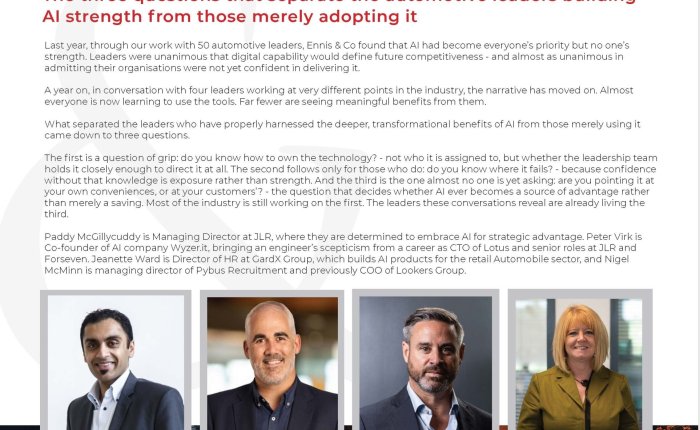
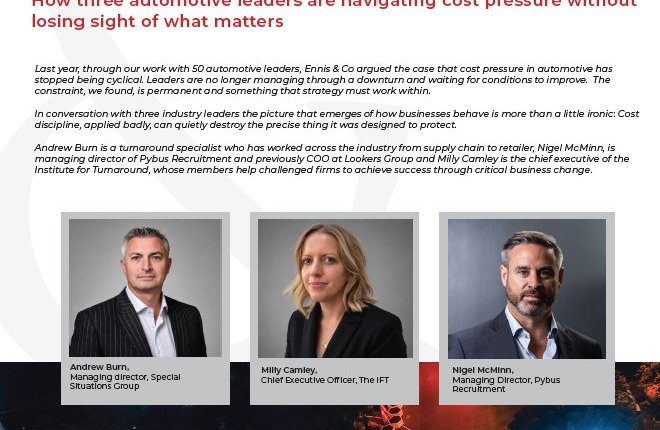
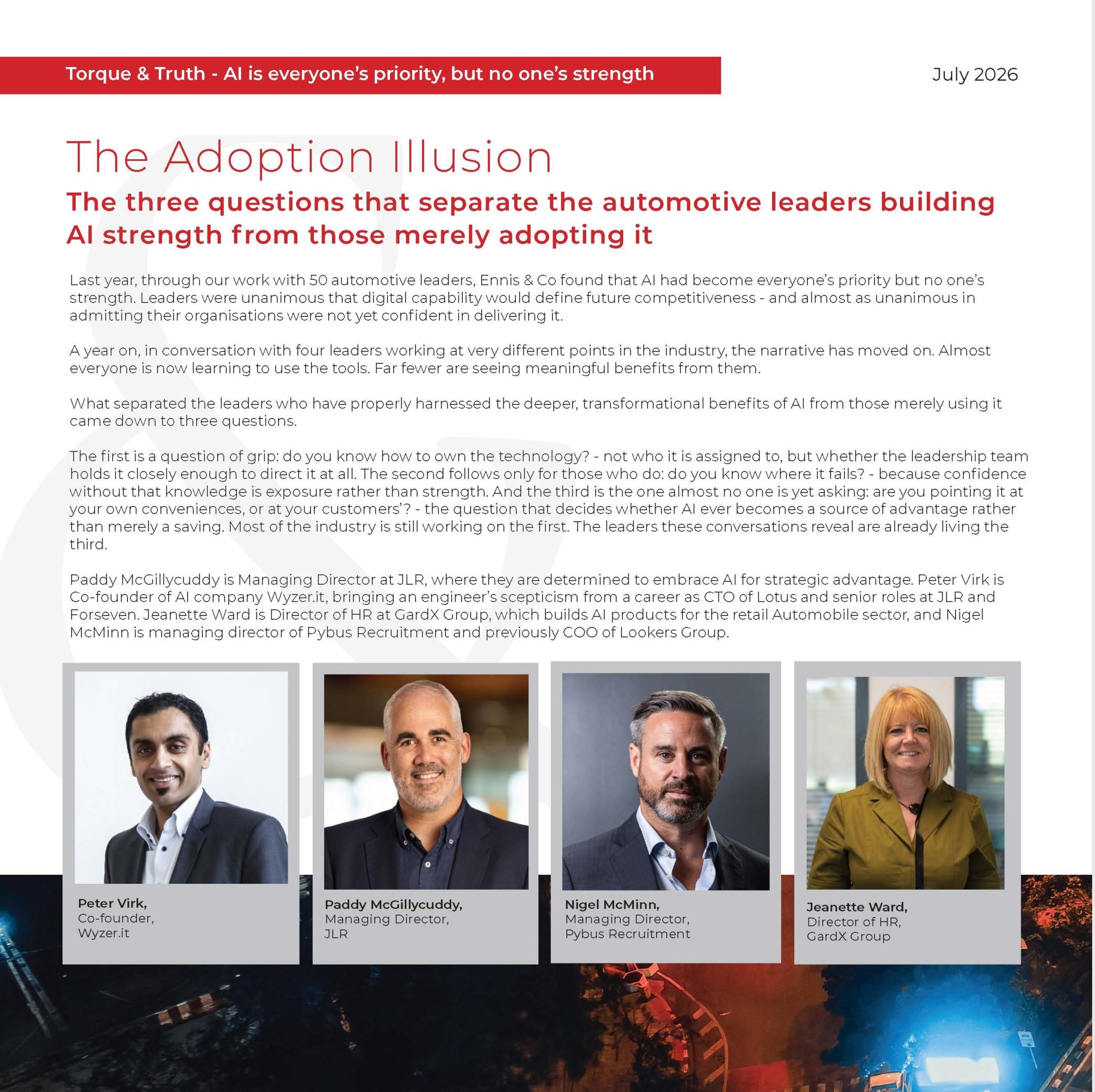
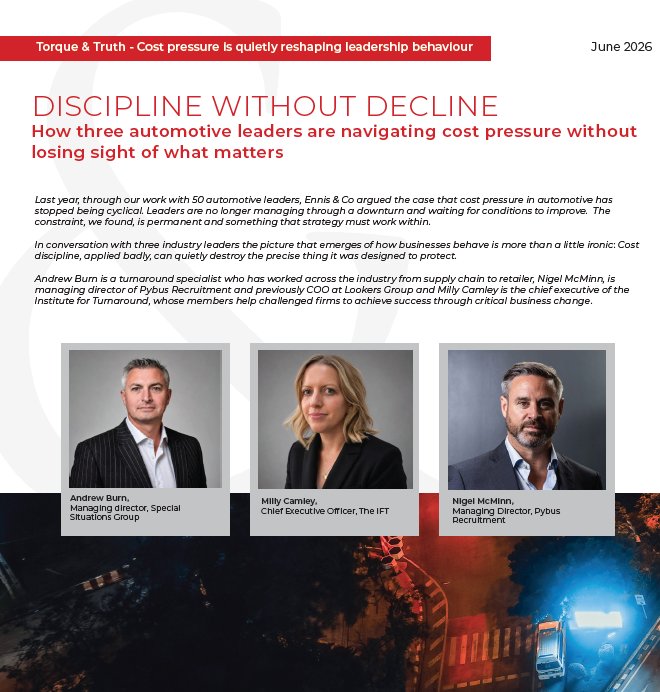
To test that finding, we went back to industry and spoke in depth with four senior leaders: Mandeep Dhatt, People Director at Hendy Group; Matt Galvin, Managing Director of Polestar UK; Laura Coase, CEO at the Automotive Leadership Network (ALN); and Nigel McMinn, MD at Pybus.
Between them they confirmed that talent and appetite are not the problem. It is the focus on talent preparation that is lacking.
But the conversations also identified something beyond the scope of the original research: a fix already working quietly in parts of the industry, and a harder truth about why it so rarely gets used.
The fix is exposure, not curriculum
When we asked these four leaders how you build the next generation, not one reached for a training programme. What they pointed to instead was deliberate, cross-boundary exposure (being put in the room and given real responsibility) paired with mentoring from people who have actually done the job.
Matt Galvin has built this into the rhythm of the business. Polestar runs a global CEO review meeting each quarter. In two hours, each market must account for every part of its performance. Rather than deliver it himself, Galvin brings people from across the organisation, including junior analysts, to present to the global CEO and two boards, and take the feedback. “That’s how I learned, frankly,” he says. “You put people in those situations, and they have to deal with it.” The point is not to test people to the point of discomfort (senior colleagues step in when needed) but that the experience is real, and can’t be replicated by describing it.
That instinct is being formalised elsewhere. Coase has watched a cohort move through a twelve-month future leaders programme built to give exactly this breadth (exposure to a large retailer’s central operations, to a national sales company, to technology providers and their AI plans) each nominee paired with a senior mentor from outside their own organisation. It was oversubscribed in its first full year. Part of what makes it work, she observes, is that it sits outside any single employer: the mentoring is candid because it is independent.
McMinn makes the same case from the balance sheet. Ask which retail groups have been most durably profitable, he says, and you keep landing on the ones that prepare their own successors deliberately, over years. Arnold Clark is his exhibit A: a business relentless about today’s numbers that has nonetheless produced one of the sector’s most stable leadership successions, insider to insider, across decades.
“The groups that develop leaders on purpose are not sacrificing performance. They are among the best performers precisely because of it”
Mandeep Dhatt has reached the same conclusion through reverse mentoring – placing a graduate at the leadership table to disrupt settled thinking. But she is blunt about how thin the market is for anything more structured: a programme built around the challenges leaders now face is, she says, not “a product that’s sold to us.” The formal offer stays traditional (managing self, others, the organisation) while the real need goes unmet.
Why it works: it beats the time problem
Our original research identified transformation fatigue as a major brake on developing future leaders: after years of constant transformation, coaching the next generation quietly loses out to delivering today. Every leader knows they should invest in successors; few feel they have the hours.
Two of our contributors dismantle that excuse. Galvin’s is the sharper cut: the value of the CEO review, he notes, is that nobody had to carve out time for it. “It was already in the diary.” No one had to create the time to coach those skills in the abstract because the development happened inside work that was going to take place anyway.
McMinn puts a number on it: developing a handful of genuine contenders for the top job requires only a couple of days a quarter over a year or two, provided real responsibility is deliberately channelled toward them – bringing them into an acquisition from the first conversation rather than handing them the file once it’s done.
So if it works, and it’s cheap, why is it rare? Here McMinn is unsparing: part of the answer is short-termism (how many leads this week, what’s service capacity on Saturday) but part is that too many chief executives aren’t strong enough to develop the people beneath them, and quietly prefer not to. In other sectors, retailers and banks, succession is discussed openly; in automotive it too often is not. Arnold Clark is the rebuttal to anyone who says focus on today and preparation for tomorrow can’t coexist.
The harder problem: not unready, but unmade
Beneath readiness sits a second question the original research did not fully surface: not only whether capable people are prepared for senior leadership, but whether the path to it still looks worth taking – and, if so, whether anyone is being prepared to walk it.
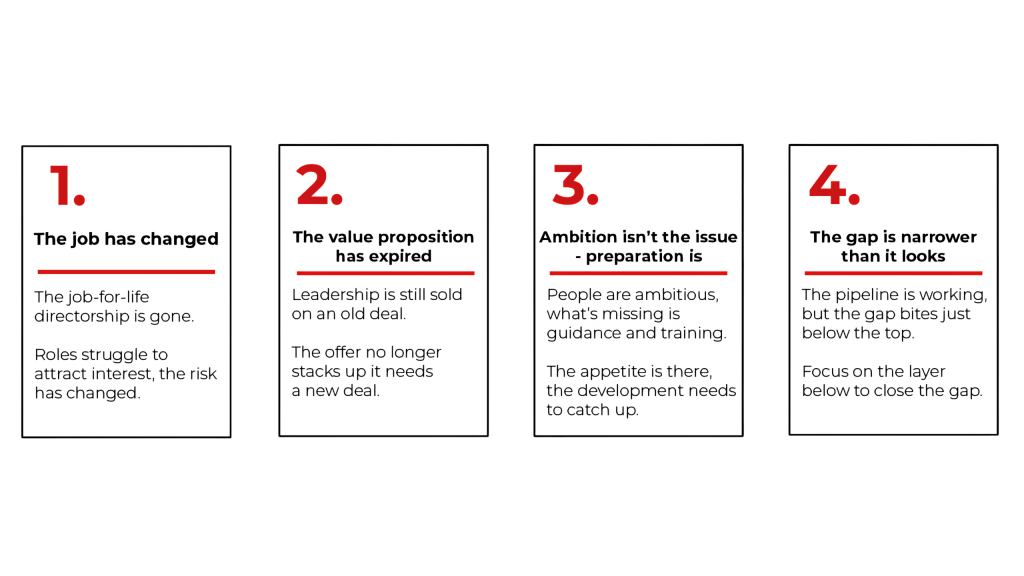
Galvin describes the first half starkly. The world of a job-for-life directorship, the nice pension, the settled tenure has gone. “You’re renting the space you’re sitting in,” he says, “and the rent is your performance.” What makes that precarious rather than merely demanding is that the performance you’re judged on isn’t wholly in your control: a market shift or a decision taken above you still lands on the person accountable. “It might not be your fault, but it’s your responsibility.” The effect shows in his own business – he recently opened an internal role he expected to be popular, and only two applicants put their hand up”
Dhatt diagnoses the same discomfort from the organisation’s side. Leadership is still sold on a proposition that has quietly expired. In simple terms, the long hours away from family, softened by a good salary, a company car and the golfing holiday is no longer attractive. For the generations now rising, that “does not fly”; the questions have changed to what the work returns to them and the community around them. The value proposition, she argues, needs rewriting from first principles.
And yet, the notion that no one wants these jobs any more is, from where McMinn sits, a myth. Speaking to candidates across the country, he sees no shortage of ambition: there have always been a few stars prepared to put the effort in, he says, and there still are. Don’t believe the story that nobody’s bothered. What those people lack is not desire but guidance, training and exposure – “and that’s not their fault.”
Coase narrows it further, and rescues the argument from over-reach. The gap is not everywhere. The OEMs and national sales companies run strong graduate programmes that give exactly the rounded, whole-company grounding this piece keeps praising; the technology providers, with livelier workplaces, attract high performers without much difficulty. Much of the pipeline is working. Where the gap genuinely bites is narrower: inside established businesses, at the tier just below the top, among leaders not yet seasoned by a full cycle of the industry.
Put them together and the problem sharpens into something more useful than “leadership has lost its shine.” The roles have become more exposed, and the industry does a poor job at selling them. But the binding constraint is not a shortage of willing, able people. It is that, in parts of the industry, those people are left to fall into the top jobs unprepared – if they make it at all. Last year’s report asked whether the industry could ready its leaders. The follow-up asks something more damning: whether it is even trying.
What this means for finding and growing leaders
If exposure is the mechanism and mis-preparation the constraint, three things follow for how the industry identifies and grows its leaders.
The first is to widen who gets seen. Galvin is emphatic that nepotism remains “absolutely rife” in automotive, and guards against it: the people in his high-visibility rooms volunteer rather than being hand-picked from the familiar, because it’s the unfamiliar profiles who otherwise never get a look in. Dhatt pushes the same door: the assumption that senior roles can’t flex (that part-time “doesn’t work in this industry”) is largely untested. “That amazing mother who just needs five years out,” she says, “is going to be your next CEO.” Both describe the same correction – opening the pipeline to people the traditional pathway would have filtered out.
And widening cannot begin only once people are inside the building. Coase points out that the pool the pipeline draws on is itself too narrow – and that the industry has largely done this to itself. From outside, automotive still reads as “oil and mechanics,” when the career she has had was one of variety, international travel and cultural breadth; that misperception deters the very people it should draw in. It saddens her that the sector isn’t aspirational for the high performers. The industry, in her view, simply undersells itself.
The second, is to be honest about what “ready” means – because our contributors disagree. Galvin argues readiness is a temperament, not a checklist: no one knows the vocational skills the future will need, there are no “gold and silver bullets” an education hands you in advance, so what he screens for is comfort with uncertainty “knowing what you don’t know.” McMinn says that that the basics of business are still essential for any leader. Too much of what the industry calls leadership training is “nebulous” (culture, communication, development) the kind of course people agree with and then change nothing after. Meanwhile the decisive skills go untaught: how a P&L, cash flow and balance sheet interact; what a covenant is and what happens the day you breach one; how an acquisition is run end to end; how to hold a room from a stage. These are not unknowable; they are teachable. The industry simply doesn’t teach them – which is why capable franchise directors stall short of the top job.
Galvin and McMinn are addressing the same axis – how much of readiness can be taught before the fact. Coase points to something neither is measuring: the tier just below the top has not been tested. They have not been through the financial crash, she notes, nor the full ups and downs of four decades in a cyclical industry; some have led only since COVID. What they lack is not aptitude but seasoning – the resilience that comes from navigating real adversity rather than reading about it. Tellingly, when the ALN asked its future leaders what they most wanted help with, the answer was, in addition to finance, navigating change.
None of the three is wrong; they describe different layers of the same thing – hard commercial fundamentals as the floor, temperament as the ceiling, and the resilience that only exposure and time supply running between. The reason “ready” so rarely gets built is that most development efforts reach for only one layer at a time.
For executive search, the direction of travel now runs two ways: away from matching candidates to role specifications built on linear experience, and towards assessing adaptability, learning agility and cross-domain capability — but also towards testing for the hard commercial fluency too many senior profiles are quietly missing. Increasingly, it means helping organisations rethink what they offer and how deliberately they develop, not only who they seek.
The reframed challenge
Last year we asked whether the automotive leadership pipeline was ready for what comes next. The honest answer was: not yet. The talent is missing, but only because it has not been developed for the world it will inherit.
These four conversations move the question somewhere more uncomfortable. The industry already has the mechanism it needs, it is cheap, and the best-run groups have proved for decades that it works. The willing, capable people are out there. What it has not reckoned with is that it neither prepares them properly nor develops them deliberately – and, where it does nothing, lets the top jobs look more punishing than they need to.
So the challenge is no longer readiness alone. It is to stop wasting the talent that already exists: to teach the fundamentals that can be taught, build the exposure that readies people, and make leadership in this industry a thing worth wanting. None of that is a mystery – the best groups already do it. The rest just need to stop believing the myth that the leaders aren’t out there, and start making them.
This article is the fifth in a series of deeper dives into the themes that emerged from Ennis & Co’s Torque and Truth research, conducted by interviewing fifty senior automotive leaders earlier this year.
This series of conversations developed from a research partnership between Ennis & Co and Pybus Recruitment and delivers a unique platform of insight from leaders speaking candidly about success in their organisations.