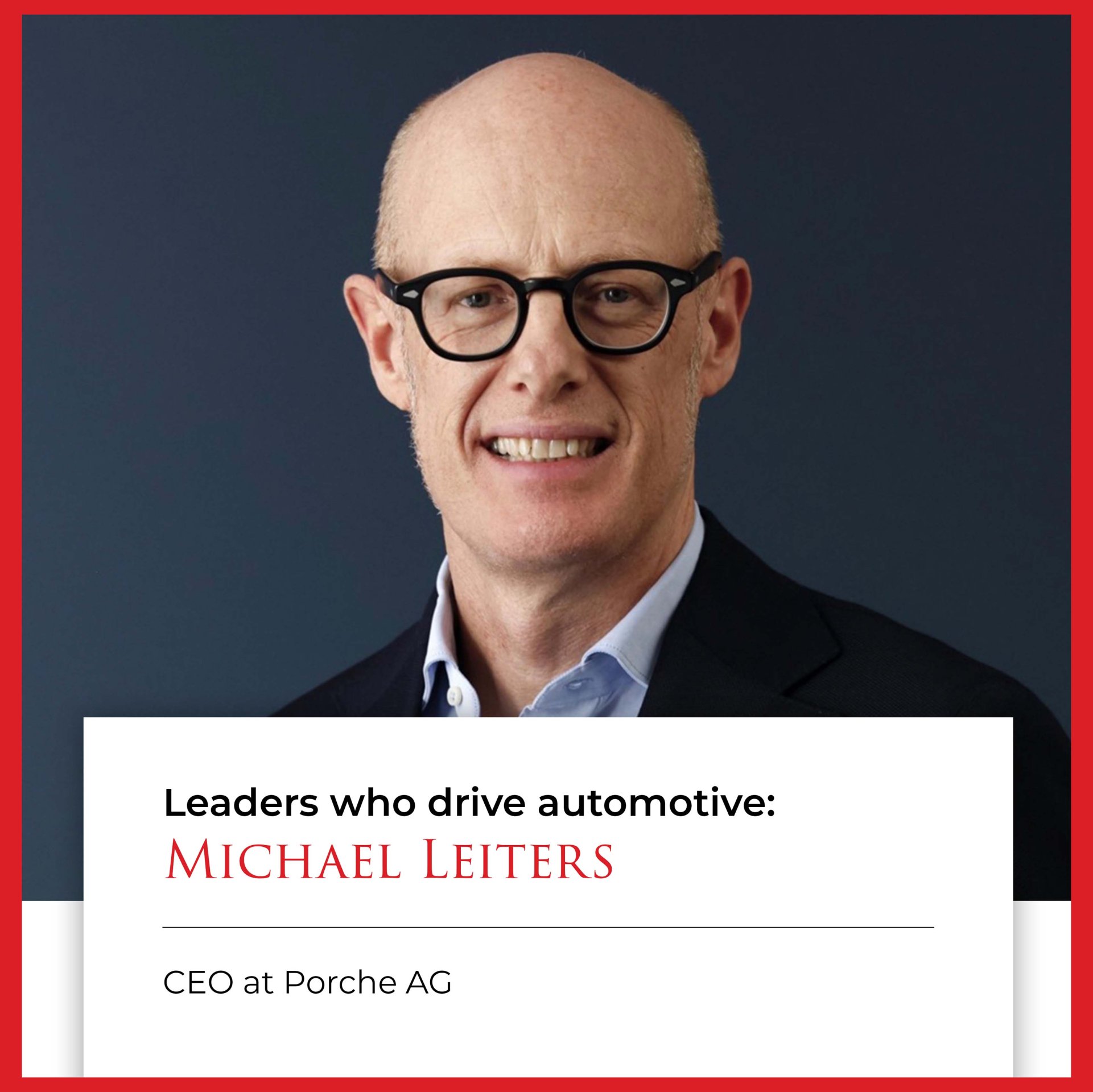
After leadership roles at Ferrari and McLaren Automotive, Michael Leiters has now returned “home” to Porsche AG, where he is now CEO. He tells Al Clarke that moving between cultures has been one of the important yet challenging experiences of his life.
Your career journey has taken you from engineering roles at Porsche, to the chief technology officer position at Ferrari, and more recently CEO at McLaren Automotive. If I may, let’s go back to the start. What were some of your early ambitions?
I studied in Aachen and did a degree in mechanical engineering. After that, I decided to do a doctorate – not because I had a clear vision of becoming a leader at that time, but because in those days, doing a doctorate was seen very positively in the industry.
In the 1980s and 1990s, it was considered a sign of ambition – something that showed a person’s drive to reach a higher level in their career. Of course, it depended a little on the industry. In Germany, for example, having a doctorate was very important in fields like chemical engineering, pharmaceuticals and the energy sector. In automotive, it was less essential but still seen as a good thing. I also wanted to gain experience – not just academic or scientific but practical industrial experience as well.
During my doctorate, I had a fantastic opportunity to work with the Fraunhofer Institute in Germany – a really great organisation that focuses on transferring innovation from universities into industry. Over my four years there, I worked with around 20 to 25 companies on both large and small programmes, doing technical projects and consultancy work.
One of these projects was my first contact with Porsche, where we worked on optimising the cost of the V8 engine for the new Cayenne. We approached it technologically, analysing and monitoring alternative production methods to reduce the manufacturing cost of the engine. That experience was very helpful for me. I never wanted to be a purely scientific or technical person; I was always interested in combining theory and practice, technology and business.
To be honest, at that stage, I didn’t know what it really meant to be a CEO or a member of a management board. I was simply a car enthusiast – I loved cars. So, when it came to deciding on my first job, I chose to go into the automotive industry, even though it was struggling in Germany at the time. It was a mature, demanding industry, and everyone knew it would take a lot of effort and hard work to build a career there.
That’s also why, during university, I focused on studying the fundamental principles of mechanical engineering rather than just automotive engineering. I wanted a broad foundation – something that could be applied anywhere, whether in automotive, energy or even the food industry. But I always knew I had the greatest affection for automotive, and that passion ultimately guided me.
You’ve led three of the world’s most beautiful brands, so there’s clearly a lot of passion there. But do you think you could lead in an organisation outside of automotive – say, in consumer goods or electronics? Or are you solely an automotive person?
Yes, I could. But for me, it’s important to have a certain connection to the product you’re selling to the customer. At the end of the day, a company has to be customer-oriented – that’s essential – but the product itself also has to be good. The real thing you have in your hands is the product you are offering to the customer, and you have to make sure the customer experience around that product is excellent. It’s not only about the product itself but everything that surrounds it, and that becomes especially important when we talk about luxury.
So, as long as it’s a technical or technological product, I think I could easily get emotional about it and really enjoy what I’m doing. There are so many fantastic products in the world beyond automotive, but again automotive is the one I love the most.
You spent much of your career in Germany before moving to the UK to lead McLaren. What differences have you observed in leadership styles and business culture across Europe? Would you say your international experience has been an advantage in your career?
I would say that moving between cultures has been one of the most important experiences of my life. You have to distinguish between the culture of a company and the culture of the country you are in. They are related, of course, but they can differ hugely, especially in international organisations. For me, understanding culture is absolutely crucial, and also one of the most challenging aspects of leadership.
You can’t imagine how big the differences are – sometimes just because there are the Alps between two nations, or The English Channel. The challenge is that you have to adapt. You can’t walk in and expect everyone else to adapt to you, because you will fail. You need to be humble, self-aware about your strengths and weaknesses and, above all, authentic. But at the same time, you must adapt to the way people behave, think and react, and take the time to really understand that.
As a German, I would say one of our strengths is our ability to separate the personal from the contents of a discussion. We can have very tough debates on a topic without touching the personal side. It’s rare to combine that. A decision against a proposal, for us, is not a decision against the person.
In Italy or the UK, the personal relationship to business plays a much bigger role. There is more personal pride involved in professional matters. Of course, Germans also have pride, but it’s a different kind. For me, that was surprising and challenging. I was used to being logical and analytical, deciding for or against something based purely on facts, but in other cultures, things are sometimes taken personally.
If you compare the UK to Italy, the differences are again very distinct. Italians are generally more extroverted; they express their emotions openly and show their involvement very directly. In contrast, British people tend to be more introverted. They may have the same reaction emotionally, but they don’t always show it outwardly. It’s more internal.
For me, learning to read and interpret these differences was a big challenge. In the UK, people are also very polite, which means feedback is often delivered less directly. I needed a lot of help from my team at times to interpret things correctly and to understand what was really meant. In Italy, on the other hand, you can be surprised by the intensity and openness of emotional reactions.
So, these cultural differences in the way people behave, communicate and show their commitment are huge. Managing across them has been one of the greatest learning experiences of my career.
Can you really prepare yourself for that kind of transition? It must have felt like jumping into a cold bath – moving from Germany, with your academic background and 13 years at Porsche, to suddenly arriving in Maranello. Beautiful weather, yes, but a completely different culture. How did you prepare for that change?
I must admit, I totally underestimated it. For me, language is the biggest thing. So much of a culture embedded in its language that you simply have to learn it. Without that, you will struggle. Learning the language is really the first step in understanding how people think, communicate and work.
It also helped a lot that I moved with my family. When your family is living there too, you start to learn the culture not just professionally but through normal, everyday life. That gives you a much deeper understanding of how people live and interact. Without that, I think it would be very difficult to truly integrate.
I would say, in general, I’m quite open-minded and genuinely interested in understanding why people behave in a certain way. That helps a lot. You also need people around you who you can trust – people who can help you interpret and explain aspects of the culture that you might not immediately see. Interestingly, not everyone fully understands the culture of their own country, so having someone who has a bit of distance or perspective on it is very valuable.
From a personal point of view, I would say the cultural piece is the most challenging one. I spent nine years in Italy, and it was a challenge until the end. Now, after three and a half years in the UK, I still have to work on it. But I see that as a positive thing, not as a struggle or a failure.
When you live and work in different countries, you learn a lot about your own culture, too. Sometimes you see things you thought were positive at home and realise they’re not necessarily so. At other times, you gain a new appreciation for aspects of your own culture that you used to criticise.
It’s a real enrichment to live in other countries, learn about new cultures and become part of another nation. With all the challenges that come with it, it’s still a wonderful experience and, over time, I’ve developed a real affection and connection for every country I’ve lived in.
How do you know when you’re ready for that next big role? It must be a mix of emotion as well as career timing?
It’s an important question – knowing whether you’re truly ready or not. And honestly, sometimes there’s also an element of luck. When I joined Ferrari, I had a lot of change all at once: a new company, a new segment, a new language and a new culture. Changing such major aspects of your life and work is risky, but I was fortunate. I had a very supportive CEO who protected and guided me through that transition.
That experience reinforced in me the realisation that chasing titles alone is dangerous. Early in my career I was very ambitious and eager to move up quickly. My most important mentor, the former CEO at Porsche, gave me great advice when I was his chief of staff. I would point to others who were further ahead and say, ‘Look, they’re already two steps above me.’ He told me, ‘Wait and see where you are in five or 10 years, and where they are.’ He was right. I’ve seen many people rise too quickly and not be ready.
So, I started thinking of my career like a puzzle. If my long-term goal was to become a CEO or a senior leader, I wanted to be prepared, not just hold the title. To be good in that kind of role, you need certain experiences. That’s why I left Porsche for Ferrari. I was very happy at Porsche but I’d reached a point where no-one could offer me a broad role like Ferrari. I wanted full accountability – the chance to deliver, to take risks and to make mistakes.
At Ferrari I joined the management board and became responsible not just for product lines and engineering, but also purchasing, quality, production planning and other areas. It was a huge scope, with a big budget, large teams and full responsibility. It ticked many boxes for me: international experience, strategic and operational accountability, resource management and leadership at scale.
So, by the time I joined McLaren as a CEO, operations weren’t a problem. I already had eight years of that experience. What I needed to learn was finance, shareholder relations and some commercial aspects, but otherwise I felt well prepared.
You’re set to join Porsche in January at what is, for many in the industry, a turbulent time. How do you approach navigating transition periods and implementing change? What do you see as the key skills for leading through change, and how do you prioritise where to focus first?
First of all, you have to understand the situation of the business you’re going into and do the groundwork. For me, it’s essential to always follow the first principles of business, as well as your own values. That sounds simple, but it’s actually very difficult, especially in times of crisis or conflict. Sticking to those principles is where your character and personality are really tested. But when you do that consistently, people start to believe in you, they get behind you and they follow you.
Then, of course, you look at the fundamentals: the customer, the product, financial targets, profitability, cash flow – all the obvious things that need attention. But one of the most important focuses for me is always people. With a strong team and a strong organisation, you can do almost anything. We’re in very volatile times, and who knows what tomorrow will bring, whether it’s new geopolitical challenges, another pandemic or something completely unexpected. What matters most is having what I call a future-proof team – a group of people capable of managing whatever challenges come next. If you have that, you can navigate through any turbulence.
Looking back on your career, what advice would you give to leaders stepping into senior roles today? What skills would you say are most important for leaders to possess?
One of the most important lessons I’ve learned is the value of decisiveness. Sometimes you inherit a strong team, and that’s fortunate. But whenever I delayed making a necessary change, it proved to be a mistake. Leaders must be willing to act. My method is consistent: give everyone a fair chance, take time to understand the context and then make a decision. You’ll encounter people who are already performing well, so those are straightforward calls. Others may show promise but need development, and that’s where investment pays off. Then there are individuals who aren’t suited to the role and are unlikely to grow into it. Those situations require tough but necessary decisions.
For senior leaders, especially CEOs, the ability to depend on your team is critical. Your people must embody your culture and values, and manage operations effectively so you can concentrate on strategic leadership. The CEO is positioned at the top of the organisational pyramid, but also at the centre of an inverted one, surrounded by shareholders, investors, the media and the public. Navigating both structures adds complexity. Without a trusted and capable team, you’ll be consumed by operational issues and unable to lead strategically.
When I speak to younger professionals, I always tell them: think about your career as a puzzle. Define your target role, identify which pieces you need to complete the picture and then build them one by one. Don’t just move upwards. Sometimes a sidestep helps you learn more and grow faster.
My first role at Porsche was technically a step down in hierarchy but it brought me close to the CEO and gave me a deep understanding of the business. And of course, like everyone, I’ve had failures. But I see them as opportunities. Every problem or challenge can teach you something that makes you stronger for the next role.